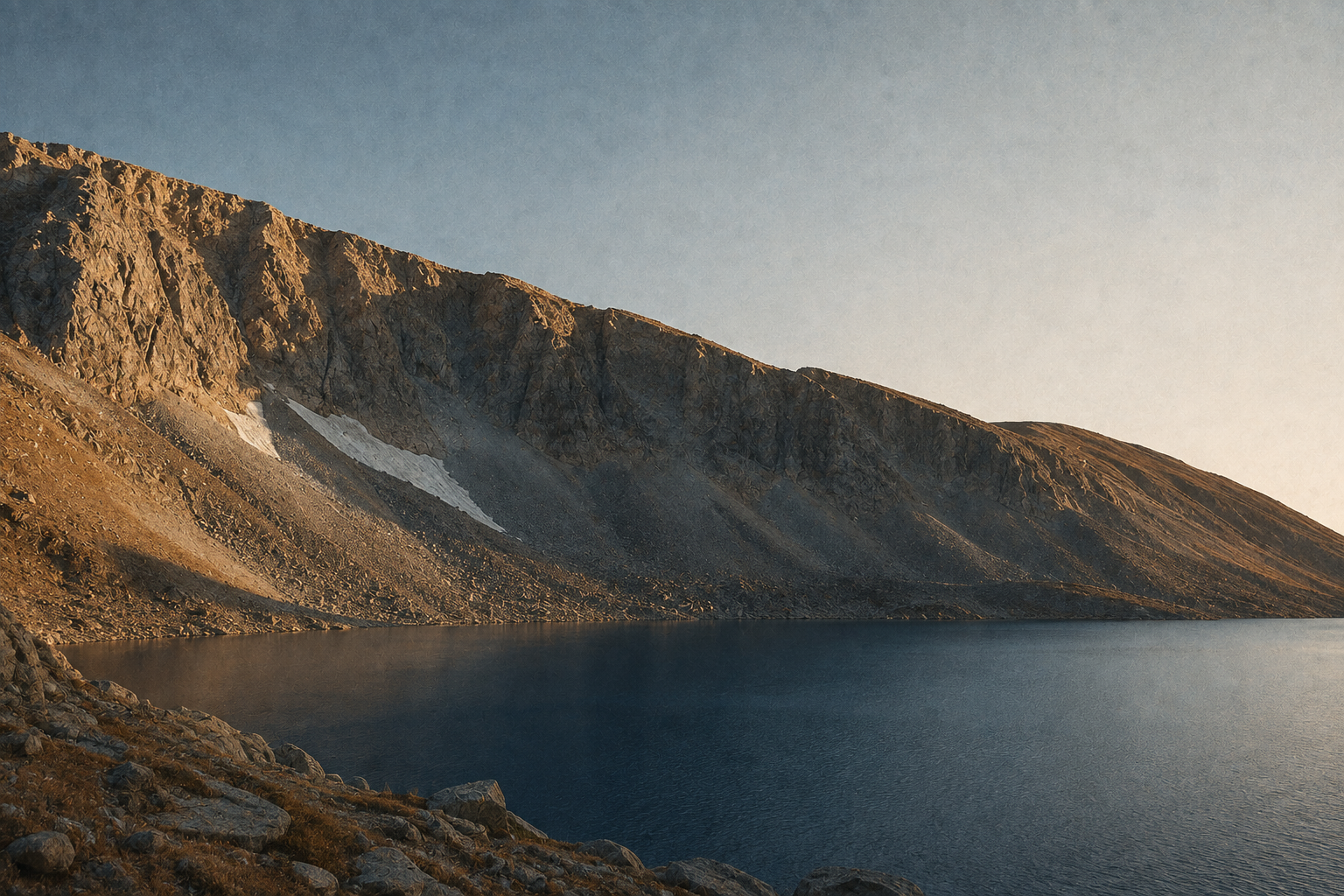
The service’s survey, built on Sentinel-2 imagery and the old glacier catalogues, counts 957 glaciers covering 560.8 square kilometres in the basin at the 2018 baseline. Against records 70 to 90 years old, the area is down 33.7%. Against the most recent 7 to 10 years alone, 23.1%. The second number is the finding, and the service draws the conclusion itself: the retreat has accelerated. Around 118 rivers and streams feed the lake, whose level fell 2.75 metres between 1927 and 2003.
Attribution came from the same agency in the same week. Bishkek hit 43.5 degrees on 19 July, the hottest July day since measurements began in 1936, with daily averages running about 10 degrees above the norm. Director Daurbek Sakeyev’s summary: springs arrive earlier, summers run hotter, winters bring less snow. Nationally the ice is down about 16% over 70 years; the Talas valley has lost 22%. The bill for this summer is already partly booked: record power demand brought supply restrictions in Bishkek and Chuy during the heat, and mudflow warnings ran across Kyrgyzstan and Uzbekistan in late July.
The finance layer exists, on paper. The Green Climate Fund approved $250 million last October for the ADB-led Glaciers to Farms programme across four basins including the Naryn; the cabinet adopted an Issyk-Kul development concept to 2030 in December; a national cryosphere monitoring system is listed as under development. For scale, Tajikistan’s entire annual land-reclamation budget is $48 million. The melt does not wait for disbursement schedules, and the acceleration number is precisely the kind that outruns programme design: money approved against the old loss curve is spent on a basin living on the new one.
Geography makes the setting exact. Six presidents signed their declaration on this shore on Friday; the EAEU’s prime ministers arrive Thursday; UNCCD COP17 opens in Ulaanbaatar on 17 August, 13 days out, with water and land degradation at the centre of the region’s brief. What would settle the trajectory is an annual published series from the cryosphere monitor the cabinet has promised. It does not exist yet; until it does, the summits on the shore will keep being better documented than the ice above them.