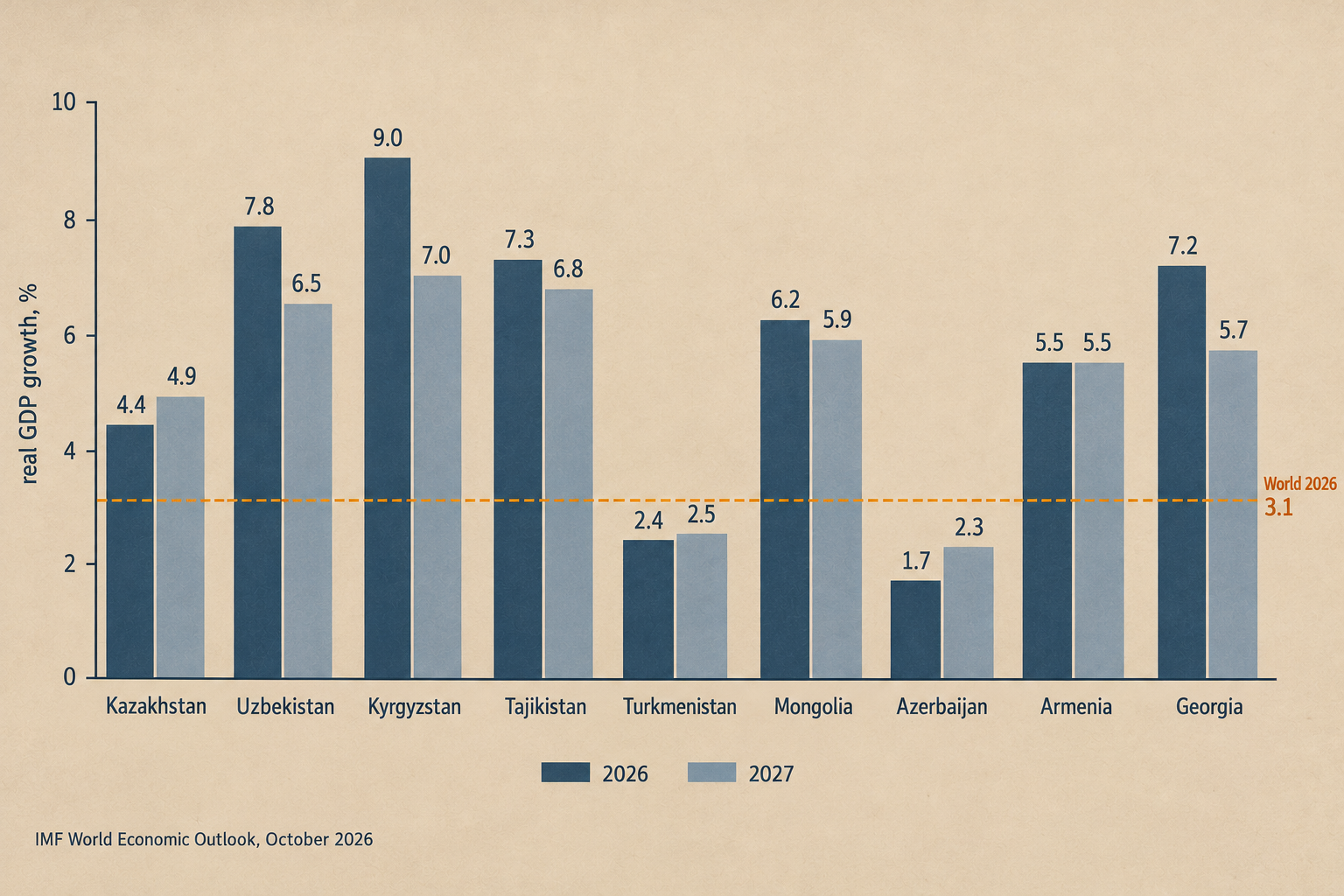
The country figures come from the Fund’s data mapper, which serves the October vintage from the day of publication: Kazakhstan 4.4% in 2026 and 4.9% in 2027 after 6.5% in 2025, Uzbekistan 7.8% and 6.5% after 7.7%, Kyrgyzstan 9% and 7% after 11.1%, Tajikistan 7.3% and 6.8% after 8.4%, Turkmenistan 2.4% and 2.5% after 3.6%, Mongolia 6.2% and 5.9% after 6.8%, Azerbaijan 1.7% and 2.3% after 1.4%, Armenia 5.5% in both years after 7.1%, Georgia 7.2% and 5.7% after 7.5%. Russia stays at 0.9% in both years and China slows from 4.5% to 4%.
Inflation is the second table. The Fund has Kazakhstan’s consumer prices rising 10.3% this year and 8.2% next, Uzbekistan’s 6.9% and 5.7%, Kyrgyzstan’s 12.7% and 14.3%, Tajikistan’s 4.1% and 4.8%, Turkmenistan’s 5.6% and 4.3%, Mongolia’s 11% and 10.7%, Azerbaijan’s 5.8% and 5.6%, Armenia’s 4.6% and 3.6% and Georgia’s 5.4% and 3.6%. Kyrgyzstan is the one economy where the Fund sees prices accelerating into 2027.
Russia stays at 0.9% in both years and China slows from 4.5% to 4%.
On the external side the Fund puts Azerbaijan’s current-account surplus at 11.3% of GDP in 2026 and 9.8% in 2027, Tajikistan’s at 8.2% and 3.5% and Turkmenistan’s at 1.4% and 1.8%. Kazakhstan sits near balance at 0.5% and then a 0.7% deficit, and the deficits run at 9% and 8.7% for Kyrgyzstan after 24.9% in 2025, 8.2% and 7.7% for Armenia, 5.1% and 4.6% for Uzbekistan, 3.5% and 3.7% for Georgia and 2.2% and 2.4% for Mongolia.
The other houses printed their numbers earlier. The World Bank’s Europe and Central Asia update of 6 October had Central Asia at 5.8% this year with Kyrgyzstan at 9.6%, Uzbekistan at 7.9% and Georgia at 7%, and UNCTAD’s trade and development report of 9 October had Kyrgyzstan at 8.8%, Uzbekistan at 7.9% and Tajikistan at 6.6% against Dushanbe’s own 8.5%, Asia-Plus reported on Monday.
Under the title Resilience Under Strain, Urgent Choices, the report’s own global line runs: growth slows to 3.1% in 2026 and rebounds to 3.4% in 2027, headline inflation rises to 4.7% this year before easing to 4.1%, and energy importers outside the technology value chain face the most difficult outlook, the summary says.