British horticulture now runs on Central Asian hands. Of the 41,766 Seasonal Worker visas granted in the year to June 2026, 10% more than the year before, Central Asian nationals together held nearly four fifths, 79%, the Home Office says in its immigration statistics of 27 August, naming Kyrgyzstan, Tajikistan, Uzbekistan and Kazakhstan. Ukrainians, who held 19,894 of the visas in 2021, received 429 in the year to June 2026.
The route began in 2019 with a cap of 2,500 visas. The quota rose to 47,000 for 2024 and 45,000 for 2025, the same release says. Poultry workers come under a separate window each year, from 2 October to 31 December, with applications closing on 15 November, by the government’s guidance page.
Of the 41,766 Seasonal Worker visas granted in the year to June 2026, 10% more than the year before, Central Asian nationals together held nearly four fifths, 79%, the Home Office says in its immigration statistics of 27 August, naming Kyrgyzstan, Tajikistan, Uzbekistan and Kazakhstan.
Who pays for the road to a Kent orchard is the question the survey answers. Defra and the Home Office asked workers on the route between 19 December 2025 and 16 February 2026, received 17,796 responses, a 43.3% response rate, and kept 16,787 eligible ones in the results published on 3 September and updated on 17 September. Central Asians made up 87.6% of respondents and Kyrgyz nationals alone 33.4%, the largest single nationality.
Nearly all respondents paid their own way in. 90.1% stated they paid for the visa themselves and 54.3% paid their own travel to Britain, the executive summary says. Most, 87.6%, paid under £1,000 before arrival, but the share spending £500 to £999 rose from 38.9% in the 2024 survey to 63.0% in 2025.
The money came from savings for 61.7% and from loans by family and friends for 27.5%, and 7.3% took a formal loan, from a bank for example, according to Table 8. A seasonal worker who borrows from relatives in Osh or Namangan to reach a farm in Lincolnshire carries the debt home if the season is short.
One cost separates Uzbeks from everyone else. 26.8% of Uzbek respondents reported paying “labour/migration ministry fees” against 2.0% of respondents from countries outside the four, the survey’s ‘other’ group, section 4.1.1 reports. Across all respondents the fee was reported by 5.9%, down from 13.3% in 2024.
The survey does not say what the fee is or who collects it. Uzbekistan runs its overseas labour through a state agency for external labour migration, and the questionnaire’s wording ties the payment to a ministry, so the fee sits somewhere between a state service charge and an intermediary’s cut. By CAW’s reading, it is the one cost in the survey’s list that points to a Central Asian state body, and not to a British farm or a recruiter, as a recipient of the worker’s money.
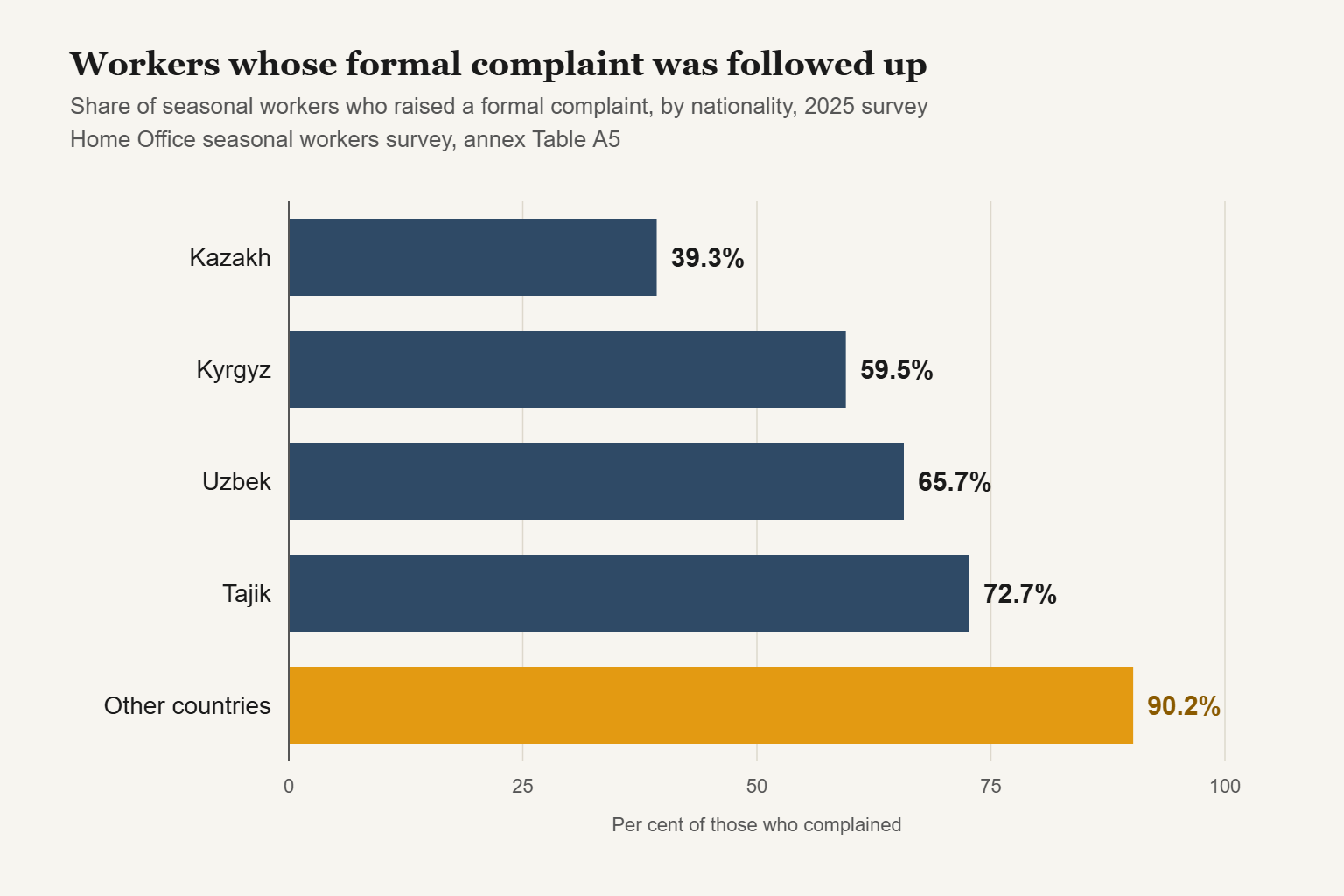
Complaints are the other place where the nationalities part. Of workers who raised a formal complaint, 70.4% said it was followed up, in the answers to question 27d.
By nationality the figures run 39.3% for Kazakh respondents, 59.5% for Kyrgyz, 65.7% for Uzbek, 72.7% for Tajik and 90.2% for respondents from other countries, Table A5 of the annex gives. The Kazakh figure stands on 11 answers out of about 28 and the Kyrgyz on 47 out of about 79, by CAW’s arithmetic on the counts the report prints beside the percentages.
The survey records attitudes as well as money: 94.1% of respondents rated their experience positively and 98% said they would like to return, the executive summary says. A worker who paid his own visa and borrowed for the ticket has reasons of his own to rate the season well and to come back for a second one.
Transfers between farms are the route’s safety valve. 15.9% of respondents said they asked to move to another farm, and of those 61.4% were transferred, 33.6% were refused and 5.0% were approved but could not move, section 7.2 says. Of the refusals, 45.2% were told no job was available and 17.6% received no answer, Table 20 records.
Every figure here is in two documents on gov.uk, and the Home Office publishes the route’s nationality table with each quarterly release. What the two documents do not do is speak to each other: the statistics count the visas, the survey counts the costs, and neither asks what share of a Kyrgyz worker’s season goes on repaying the £500 to £999 that got him there.
The next count comes on 26 November at 09:30 London time, when the Home Office publishes the year to September 2026. The poultry window runs to 31 December with applications closed from 15 November, so the winter workforce will be on the farms before the next count is out.