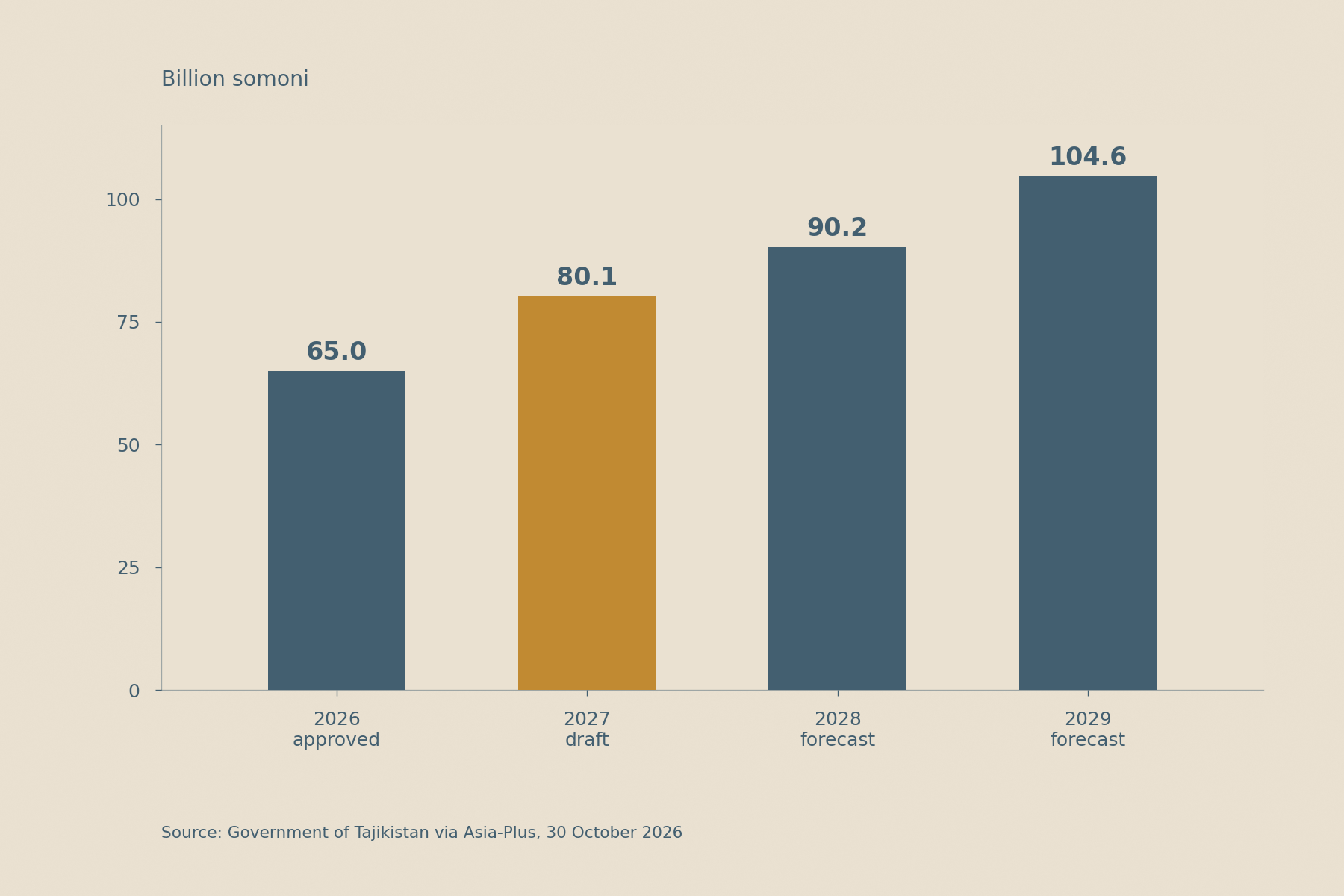
The forecasts attached to the draft put revenue at 90.2 billion somoni in 2028 and 104.6 billion in 2029, Asia-Plus reported on 30 October. At 44.8% of spending, the social figure implies total expenditure of about 81.9 billion somoni and a gap of about 1.8 billion, by CAW’s arithmetic, close to the 1.95 billion, or 1% of GDP, that the 2026 budget set as its deficit ceiling with revenue of 65 billion and spending of 67 billion. The press-service account prints no deficit for 2027.
Revenue in January to August reached 50.9 billion somoni, 36.6% more than a year earlier, against spending of 42.3 billion, by the finance ministry’s figures CAW reported on 27 October. Nine-month revenue exceeded 57.1 billion, 14.9% above the nine-month plan, so the 23.2% rise is measured against a 2026 plan the year is already beating.
Rahmon told the session to broaden the tax base, cut tax arrears, develop domestic production and reduce dependence on imports, and to press on with digitalisation, Asia-Plus reported. The meeting also considered the external borrowing programme for 2027 with forecasts for 2028 and 2029, without a printed sum, a police reform programme for 2026 to 2030, a programme on the cryosphere and glaciers for the same years and an irrigated-land reclamation plan for 2027 and 2028.
Energy took 26.4% of spending in January to August 2026 against 20% in the same months of 2025, with the Rogun hydropower plant the main item, and the draft’s energy line was not printed. On 27 October the EBRD’s vice-president Matteo Patrone told Asia-Plus the bank had not decided whether to finance Rogun’s next stage.