Rogun’s procedures put 20,563 people on the project in August 2026, against 14,877 at the end of 2023, a rise of about 38% by Asia-Plus’s arithmetic. The document, as the Dushanbe outlet read it, is written to the World Bank’s labour standard ESS2 and to Tajik law, and it replaces the edition of February 2024.
The two figures that carry the headline appear in the project description at the document’s end. Completion, given as about 2029 in the 2024 edition, is now 2032, and the estimated cost of completion moves from $4.9 billion to $6.6 billion. Asia-Plus cautions that the line is a project characteristic and does not mean that exactly that sum remains to be spent.
Rogun’s procedures put 20,563 people on the project in August 2026, against 14,877 at the end of 2023, a rise of about 38% by Asia-Plus’s arithmetic.
The 2032 is the dam’s date. The dam’s completion and the completion of the whole hydropower complex are separate stages, Asia-Plus writes, and the reservoir reaches its design level only around 2036.
S&P Global Ratings, in the outlet’s earlier report, put the remaining need at about $5.8 billion and the end of the works at 2035: a remaining sum and a later date, measured differently from the document’s line, and Asia-Plus prints no explanation for the move from 2029 to 2032.
Most of the document is about the people on the site. The 2024 edition had recorded what an inspection of March 2023 found: contracts without full terms on pay and hours, delayed payments, workers on 12-hour shifts put on overtime, and shortfalls in protective equipment, lighting and equipment safety.
The new edition does not say whether those faults have been cured.
It records that cases of incompletely drawn contracts, excessive overtime and delayed wages occurred in the course of the project, and it gives neither a count of recent violations nor the names of the contractors responsible.
Shifts stay at 12 hours for a large part of the workforce, day and night in rotation, on a 15-day tour. The text sets the Labour Code’s 40-hour week, 35 on hazardous work, as the yardstick, mentions shorter daily shifts as under consideration and records no final decision on schedules.
The housing norms are at least 4 to 5.5 square metres of sleeping space a person, ceilings of 2.1 metres or more, and a ban on the day shift and the night shift using the same bed.
Contractors whose dormitories fell short were still upgrading them in mid-2026, and older blocks are being replaced as the reservoir rises.
Grievances now have a single mechanism and a digital platform, eFeedback, where the 2024 edition had said no single mechanism existed, and complaints that came through informal channels were not always registered, the document says. Contractors answer first, with the project management and Bureau Veritas above them.
Bureau Veritas took over the supervision of contractors’ labour protection, safety and environmental compliance on 1 July 2026. Who engaged the firm, the article does not say.
The compensation lines restate the Labour Code: a one-off payment of at least 12 average monthly earnings for disability and at least 60 for a death, paid to the dependants. Transport is the gap the document names itself. There is no centralised transport on the site, workers walk or hitch rides on roads that carry more than 2,000 vehicles and machines a day, and transport home after a 15-day tour is not always provided.
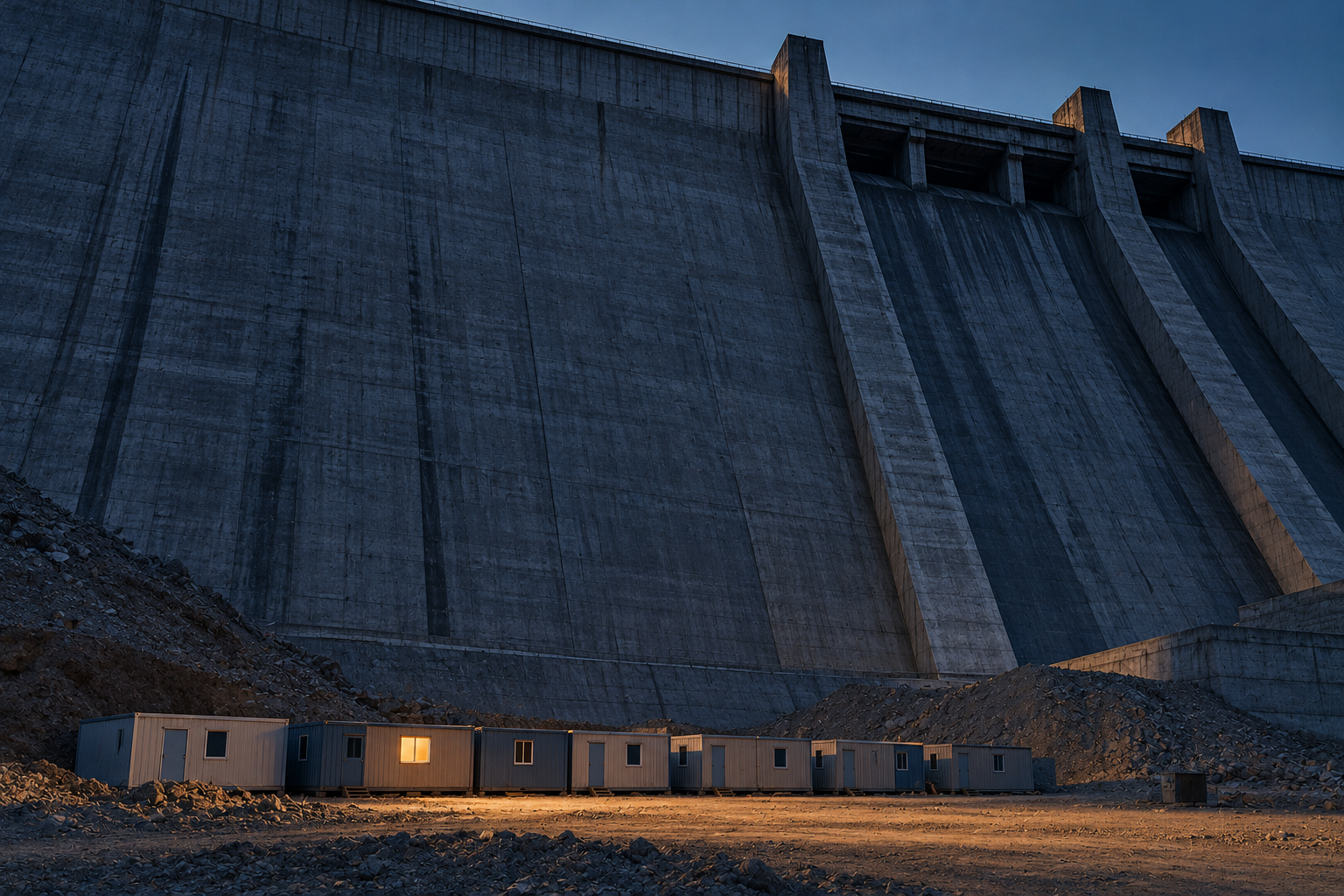
The plant is designed for 3,780 MW in six units of 630 MW and about 14.4 billion kWh a year. Two units have run at reduced output since 2018 and 2019. The dam stands at 190 metres of a 335-metre design with the fill past 61%, and 60.3 billion somoni have gone into the project since 2008, a cumulative sum Asia-Plus prints in somoni.
On shifts the document names the 40-hour week as the measure and sets no date for reaching it.