The paper, by Xinlei Guo, Xu Wang and nine co-authors from Inner Mongolia University and other Chinese institutions, appeared in Communications Earth & Environment, a Nature Portfolio journal, on 5 October as an article in press, shared ahead of final editing.
The authors surveyed herbaceous communities along a rainfall gradient of 152 to 411 millimetres a year. They measured two families of leaf traits: hydraulic efficiency, how readily a plant moves water, and hydraulic safety, how well it keeps that flow from failing when water is short.
The drier the site, the paper finds, the more the communities lean towards safety. Hydraulic efficiency goes with more aboveground biomass but lower water-use efficiency, the carbon a plant gains per unit of water, and less steady greenness. Safety goes with the reverse.
The authors’ trait-based model explains 43% of the variation in biomass across the sites, 40% in water-use efficiency and 60% in stability, and they propose it as a framework for “resilience-focused ecosystem management”. In practice, they write, the findings “inform dryland restoration and resilience-based management, particularly for steppe grasslands”.
Most of the sites are in China: 286 in Inner Mongolia and 20 in Mongolia, strung across some 1,200 kilometres from meadow steppe in the east to desert steppe in the west. The study measures stability by how little each site’s peak yearly greenness in Landsat satellite images varied from 2000 to 2020, and the paper’s analysis pools all 306 sites without testing the Mongolian ones on their own. Grazing, afforestation and tree planting do not come up.
The result describes a gradient across space, from wetter sites to drier ones, and the authors call the links in their model “associations, not causal pathways, with water as the main driver and traits as modulators”. At the dry end, the cover that stays steadiest through the years is the cover that grows least.
For herders that is a trade with a price. Aboveground biomass on the steppe is mostly grass and herbage, the forage their animals eat, and Mongolia carried 58.1 million head of livestock at the end of 2025, according to the National Statistics Office, as reported by Xinhua.
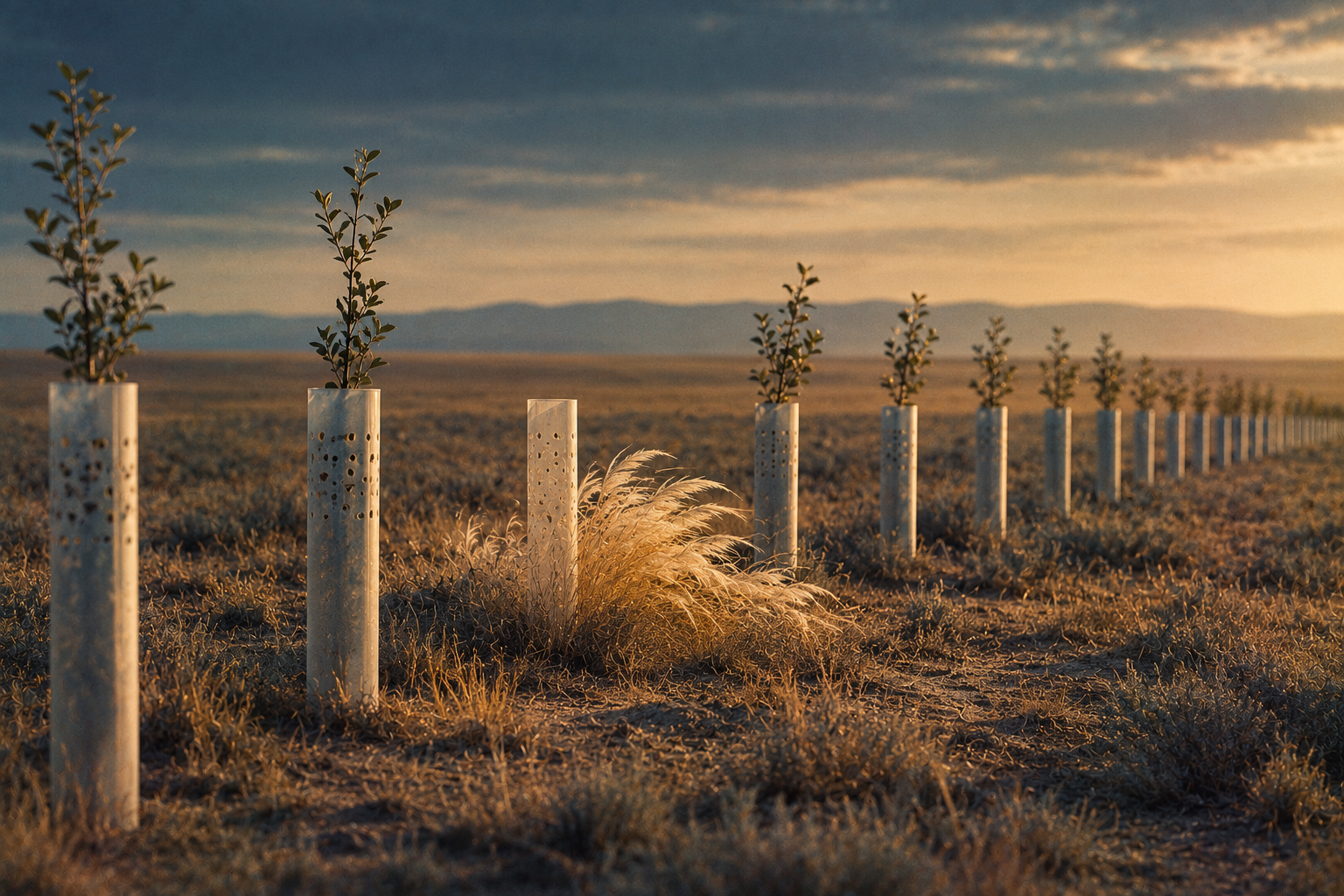
Mongolia’s flagship programme against land degradation counts trees. The Billion Trees national campaign, launched in 2021 with a target of one billion trees by 2030, has planted 140 million, the Ulaanbaatar news site Go Go Mongolia reported on 5 September, as a public tracking system built on Forest Agency data opened with figures on where trees were planted and how well they survive.
At the dry end, the cover that stays steadiest through the years is the cover that grows least.
In August 2024 Batkhuu Nyam-Osor, the president’s adviser on environmental and green development policy, put the count at 41 million, with survival over 90%, Montsame reported. If the two counts measure the same thing, the campaign has added about 50 million trees a year since then. Reaching the target now takes about 200 million a year, four times that pace, by CAW’s arithmetic.
Nearly 77% of Mongolia’s land is already degraded, the UN Convention to Combat Desertification says on its page for the COP17 conference Ulaanbaatar hosted from 17 to 28 August in the International Year of Rangelands and Pastoralists.
The FAO’s office in Mongolia, writing on 16 August, the day before the conference opened, put trees and pasture in one frame: “For Mongolia, strengthening drought resilience requires an integrated approach that recognizes forests, trees, rangelands, water, livestock and rural livelihoods as interconnected parts of the same landscape.”
The study gives that frame a yardstick Mongolia can apply to its own land. A tree count shows effort, and the steadiness of greenness over two decades of satellite images shows whether dry pasture is holding, a record that covers Mongolia’s steppe as fully as Inner Mongolia’s.