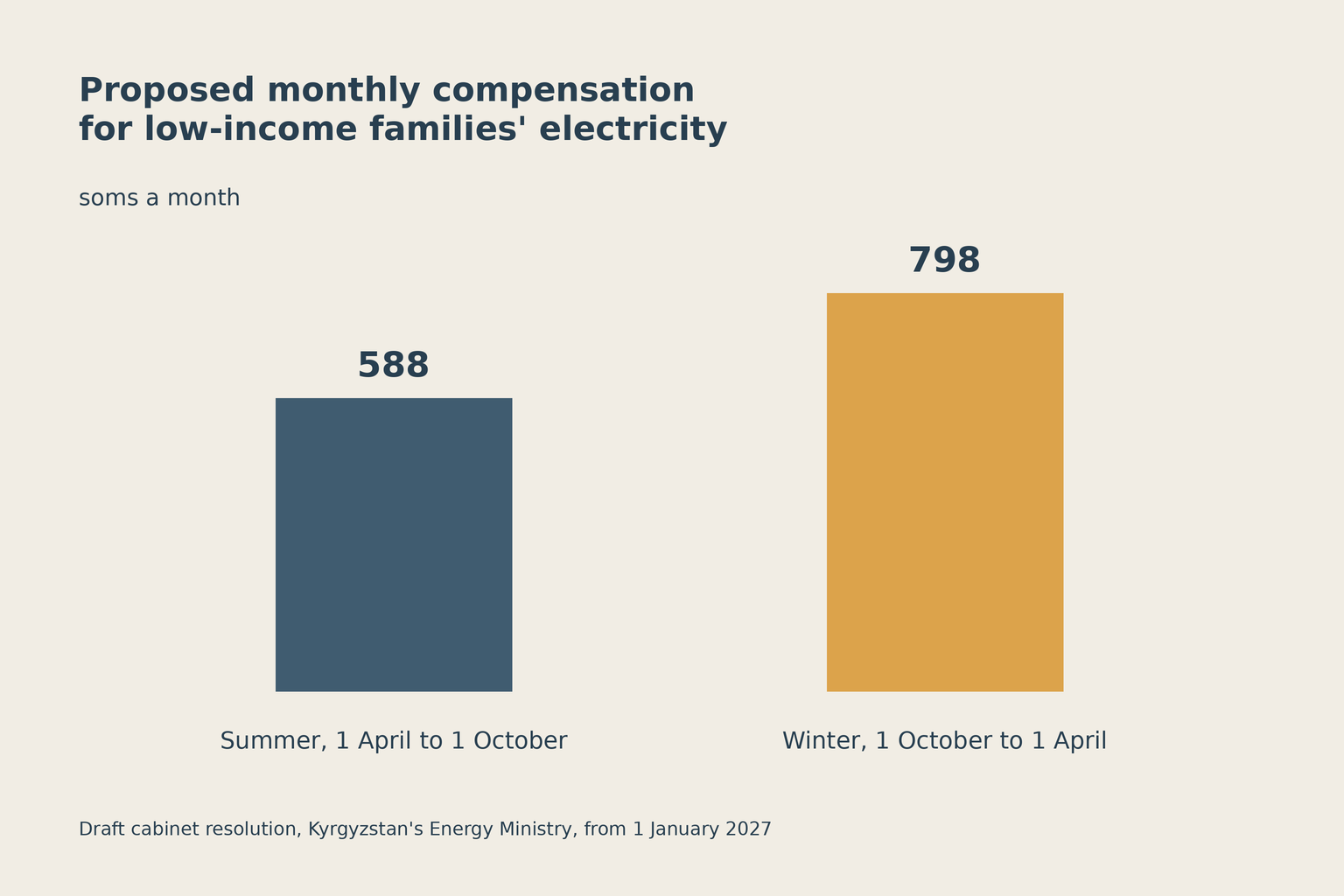
The tariff, half a som per kilowatt-hour for up to 700 kWh a month, goes to families with children under 16 who receive Ui-bulogo komok, the state benefit for low-income families, and 41,695 families use it, according to the ministry.
Summer payments of 588 soms, about $6.70 at the official rate of 87.45 soms to the dollar, cover each month from April to September against a norm of 400 kWh. In winter, from October to March, the payment is 798 soms, about $9.10, against a norm of 700 kWh.
By CAW’s arithmetic each sum is the gap between the 50-tyiyn tariff and the standard household tariff over the full norm. Winter is reckoned at 1.64 soms a kilowatt-hour, the rate in force since 1 May 2026, and summer at 1.97 soms, the rate the cabinet’s tariff schedule sets from 1 May 2027.
The ministry puts the cost at 381.2 million soms in 2027, about $4.4 million. On the same arithmetic the 41,695 families now on the tariff would draw about 347 million soms a year.
The ministry says the tariff misses families who rent or share a home, because the electricity account is in the owner’s name.
The same draft sets a tariff of 5.99 soms per kilowatt-hour that applies only to commercial charging stations for electric vehicles.
A second draft, from the Economy and Commerce Ministry, would extend the state subsidy on AI-92 petrol, diesel and automotive gas from 31 December 2026 to 31 March 2027, 24.kg reported on 25 November. It caps the subsidy at 20% of the fixed price, and most of its changes would apply from 1 December 2026.