
NORC at the University of Chicago wrote the review under a USAID contract. It is one of 248 files in a release the agency posted under the name USAID Files, as CAW reported on 26 November.
The review covers 23 activities. Seven got a case study each: Ukraine, Georgia, Serbia, Indonesia, Nicaragua, Libya and Tanzania.
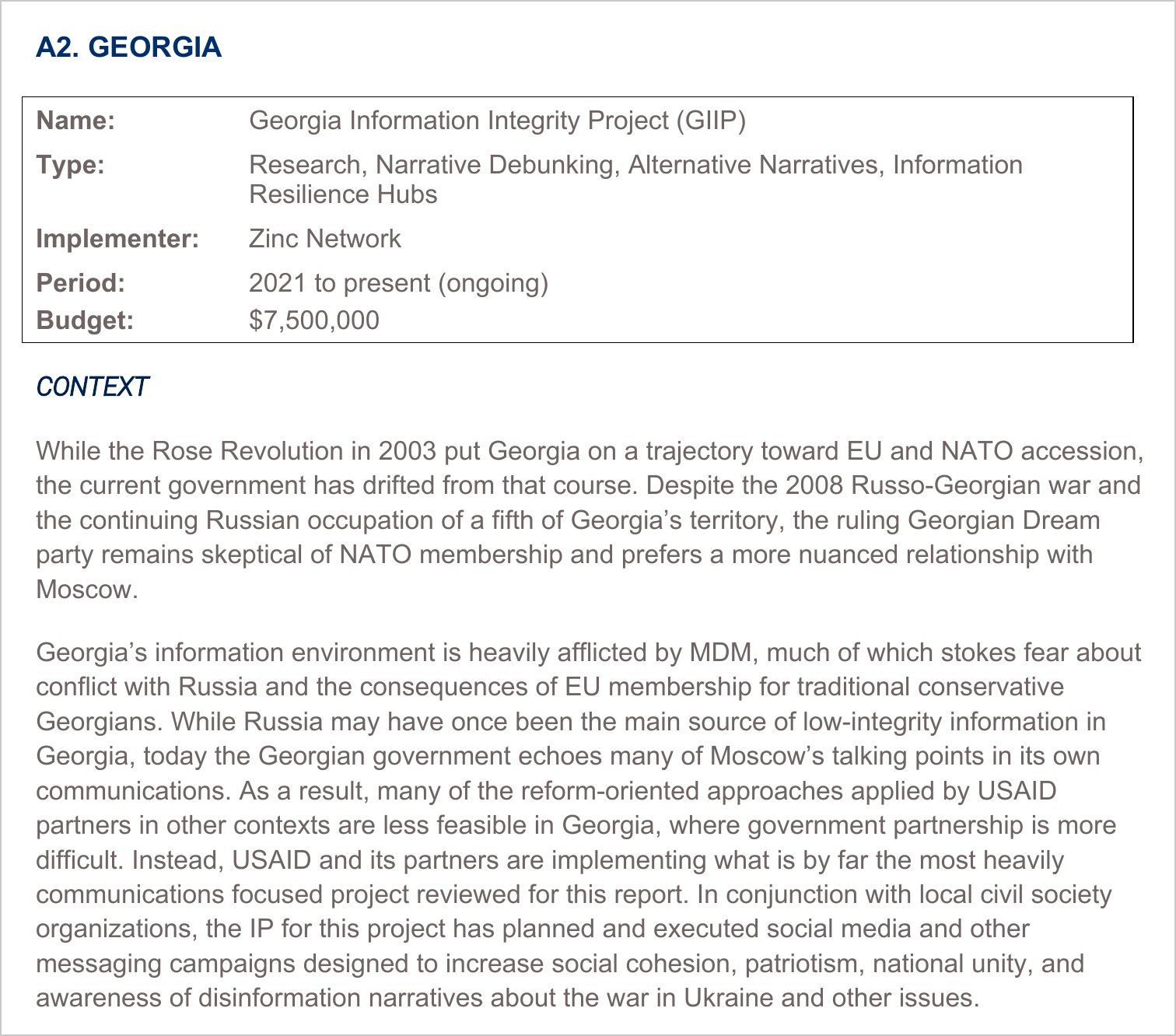
Its Georgia annex gives the project a budget of $7.5 million and a start in 2021. A USAID activity sheet in the same release dates it from September 2020 to September 2025 and names the implementer as Zinc Network Limited.
No partner in government
The annex opens on politics. The ruling Georgian Dream party, it says, is sceptical of NATO membership and prefers a more finely balanced relationship with Moscow, and it describes the government as now echoing many of Moscow’s talking points in its own communications.
That, in the review’s account, made the reform work USAID partners did with governments elsewhere hard to repeat in Georgia. In its place came “by far the most heavily communications focused project reviewed for this report”: social media and messaging campaigns for social cohesion, patriotism and national unity, run with local civil society groups.
From the Georgian project the review draws a general lesson: in many places government is a main source of the problem, perhaps the main one, and in such contexts alternative narratives may be among the most effective tools available.
The campaigns
The project served as a hub. Its staff produced monitoring reports on disinformation every two weeks, built a map of actors and channels with the Digital Forensic Research Lab in Washington, and ran an Information Integrity Coalition that grew from 8 member organisations to 13.
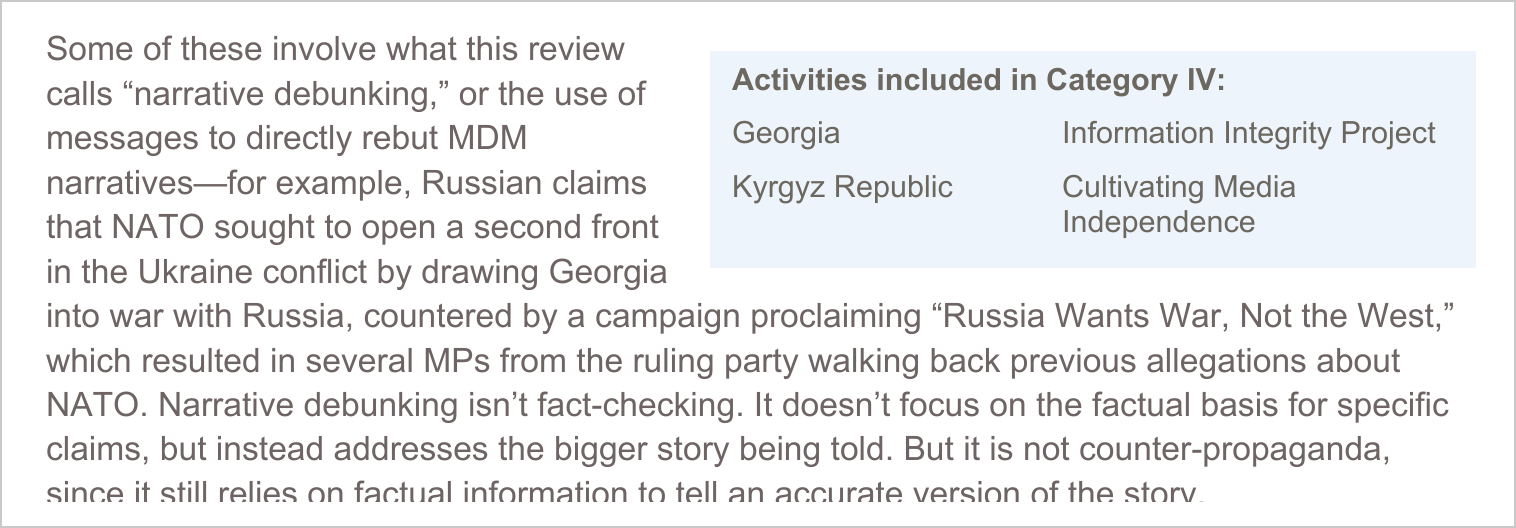
After Russia’s full-scale invasion of Ukraine the coalition ran “Russia wants War, not the West”. It answered claims from Moscow and from Georgian politicians that NATO wanted Georgia as a second front, and the review says the campaign resulted in several ruling-party MPs walking back earlier allegations about NATO.
Other campaigns asked Tbilisi shoppers to buy produce from farmers near the occupied territories (“Fruits of Heroism”), appealed to patriotism to discourage the sharing of unreliable content (“Disinformation Dishonors our Heroes”) and tried to give Gori, Stalin’s birthplace, other sources of civic pride. A project graphic in the review says about 80% of the project’s work was aimed at four vulnerabilities it lists, the last of them political and economic capture.
The project also supported three investigations: into Russian capital in Georgian businesses, into the finances of far-right groups and into the offline influence of pro-Kremlin actors. Among its tools was what the review calls the first software that recognises the Georgian alphabet in PDF files.
The review found that most of the project’s indicators measured the capacity of partner groups and the reach of campaigns, with the effect on audiences tracked through focus groups and social media sentiment. Some USAID staff, it records, doubted that strategic communications fit the mandate of a development agency.
The people around it
An email of 20 September 2022 in the release is signed by Mikheil Benidze as chief of party of the “USAID Information Integrity Program”, the name in his signature, with a Zinc Network address. Benidze led the International Society for Fair Elections and Democracy (ISFED) as executive director from 2016 to 2020.
ISFED later acknowledged inaccuracies in its parallel vote tabulation of the 2020 parliamentary election. Georgian Dream has cited that error, and Speaker Shalva Papuashvili has called for an inquiry into the role of USAID’s Georgia office in it.
The release is mostly about USAID’s contacts with the platforms, and in Georgia the project set up a meeting itself. In the email Benidze set up a meeting in Tbilisi between Meta’s regional public policy manager, Kateryna Kruk, and staff of the US embassy and USAID, describing her portfolio as electoral integrity, disinformation and hybrid threats.
The project was one of two USAID media programmes in Georgia in the release. A separate activity, Strengthening Media and Information Actors in Georgia, run by IREX at $10 million for 2022 to 2027, aimed at press freedom, self-regulation and independent sources of information.
Tbilisi’s version
The documents describe a programme that set out to shift Georgian attitudes through campaigns, in a country whose government, by the review’s account, echoed Moscow.
Papuashvili answered the release on 26 November. In a post on social media reported by Interpressnews, he called Zinc Network one of the organisers of a foreign information influence network in Georgia, named the Information Integrity Coalition as its formal face and said Georgia had been the target of a hybrid attack during the 2024 parliamentary election.
In October 2023 the State Security Service and leaders of Georgian Dream accused USAID of training groups that planned riots, and in February 2025 Papuashvili said USAID had spent $41.7 million on Georgia’s elections through what he called political NGOs.
A USAID briefing note of November 2024, in the same release, calls the 2023 accusation false. It says Russian state media carried the story, and that the law on foreign influence Parliament passed in May 2024 made it harder for USAID to work in the country.
A Zinc Network letter of 25 February 2025, sent from its London office and published by the Tbilisi group GRASS, ended a USAID-funded grant to GRASS under what the letter calls the CUBE Project. Citing the US stop-work order on foreign aid, Zinc closed the grant at 77,219.74 lari, against an original 116,840.