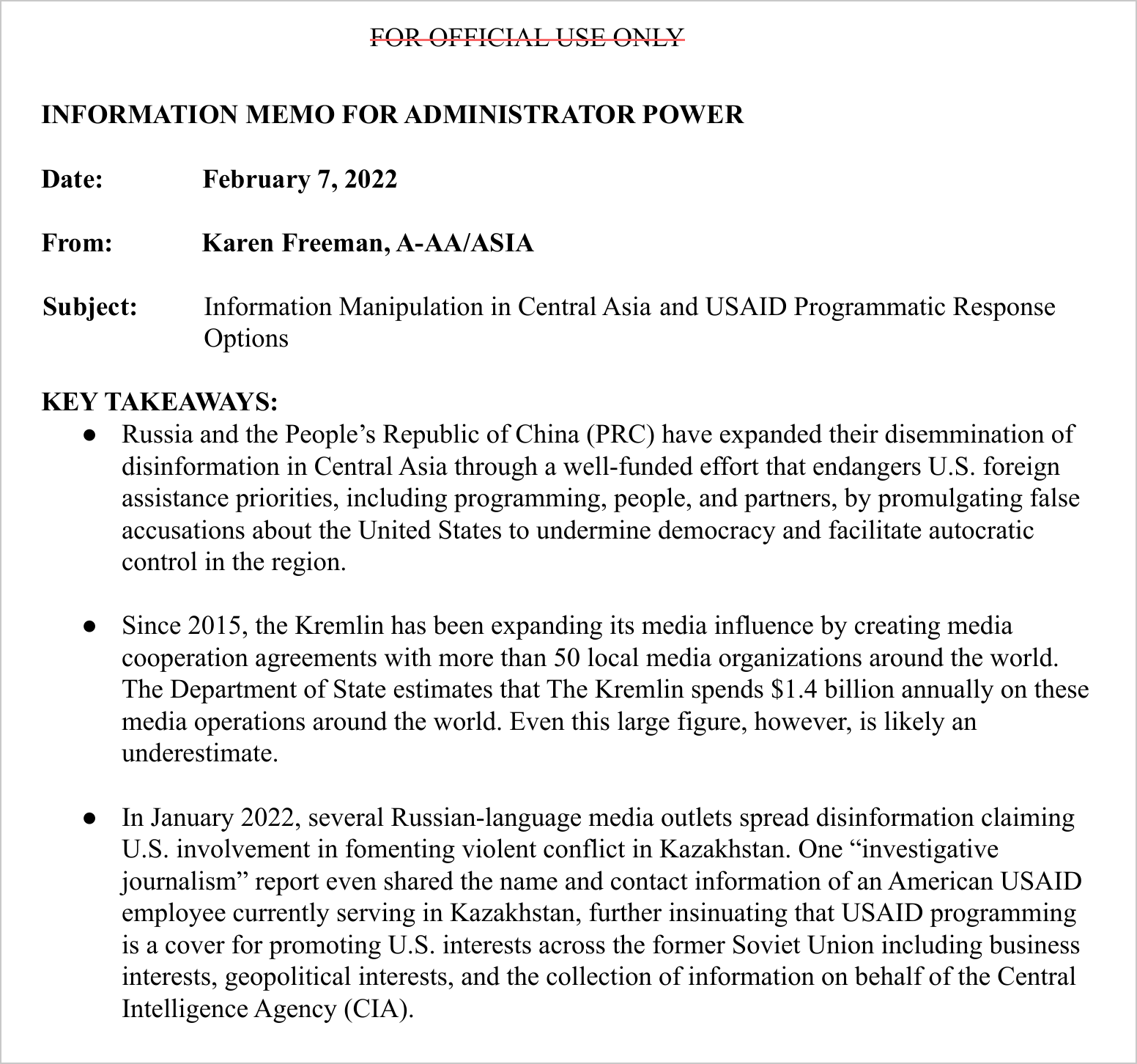
The memo went from Karen Freeman, then acting assistant administrator for Asia, to Samantha Power under the subject line “Information Manipulation in Central Asia and USAID Programmatic Response Options”. Power had asked how far disinformation reached in the places where USAID worked and how the agency was responding. Her senior national security adviser, Sophia Lalani, commissioned four case studies, and the Central Asia study reached Power beside those on Ethiopia, Nepal and Ukraine under a cover memo of 22 February 2022.
The bundle is one of 248 files posted on USAID’s website on 24 November under the heading USAID Files. The site’s introduction says the files, memos and internal communications show how the agency operated under previous administrations. Ten of the bundle’s 167 pages concern Central Asia.
The broadcast
The memo’s most prominent example, which it calls disinformation, is a report styled as investigative journalism that aired on Rossiya-24, the Russian state news channel, after the violence of early January 2022. According to the memo, it claimed that USAID had directed the protests and paid Kazakhs to form a group that turned to violence on cue.
The broadcast, the memo says, gave the name and contact details of an American USAID employee serving in Kazakhstan and the contacts of the head of USAID’s mission in Kyrgyzstan. It also repeated the claim that US aid across the former Soviet Union served business, geopolitical and intelligence ends. Some of the Russian-language reports, the memo adds, alleged a Ukrainian role as well.
Freeman paired it with a case from Kyrgyzstan. In July 2020, after US embassy staff had left the country on ordered departure because of Covid-19, the pro-Russian Bishkek newspaper Delo No wrote that the embassy had evacuated 31 diplomats, six of whom it called undercover CIA agents, because the Americans knew a pandemic was coming.
The paper printed names and photographs of diplomats and their families, some apparently taken at passport control. The embassy protested to the Kyrgyz foreign ministry, which promised an inquiry, and nothing came of it, before or after the October 2020 revolution, according to the memo.
The balance of airtime
Freeman’s diagnosis is that Russia’s main tactic is to establish hegemony over the region’s information space.
Channel One, she writes, ranks among the most watched stations across the region, local broadcasters translate and repackage Russian programmes, and print and online outlets take copy from Sputnik and RT ahead of AP and Reuters.
Freeman cites a State Department estimate that the Kremlin spends $1.4 billion a year on media operations worldwide and counts more than 50 cooperation agreements Moscow has signed with local outlets abroad since 2015.
At its last count, in April 2021, USAID had allocated about $3.9 million to countering disinformation through three programmes in four Central Asian countries. That sum is the counter-disinformation share of programmes with larger budgets. The regional one, the Central Asia Media Program, MediaCAMP, was a five-year, $15 million programme that Internews ran from 1 October 2018 in Kazakhstan, Tajikistan and Uzbekistan.
Uzbekistan had refused to register Internews’s office, which kept the programme there to fellowships and technical help for local media. Legal aid to journalists and bloggers went through a local subgrantee, the Center for the Development of Modern Journalism. MediaCAMP ran nothing in Turkmenistan, which the memo puts down to the government’s attitude to independent media.
The Kyrgyz model
In Kyrgyzstan the Cultivating Media Independence Initiative, Media-K, which a separate USAID data sheet puts at $10.65 million for 2017 to 2022, trained a group of journalists from several newsrooms to watch social networks for fake and coordinated accounts. They compiled lists of suspicious accounts and reported them to the platforms, and the memo credits them with the deactivation of hundreds of troll accounts.
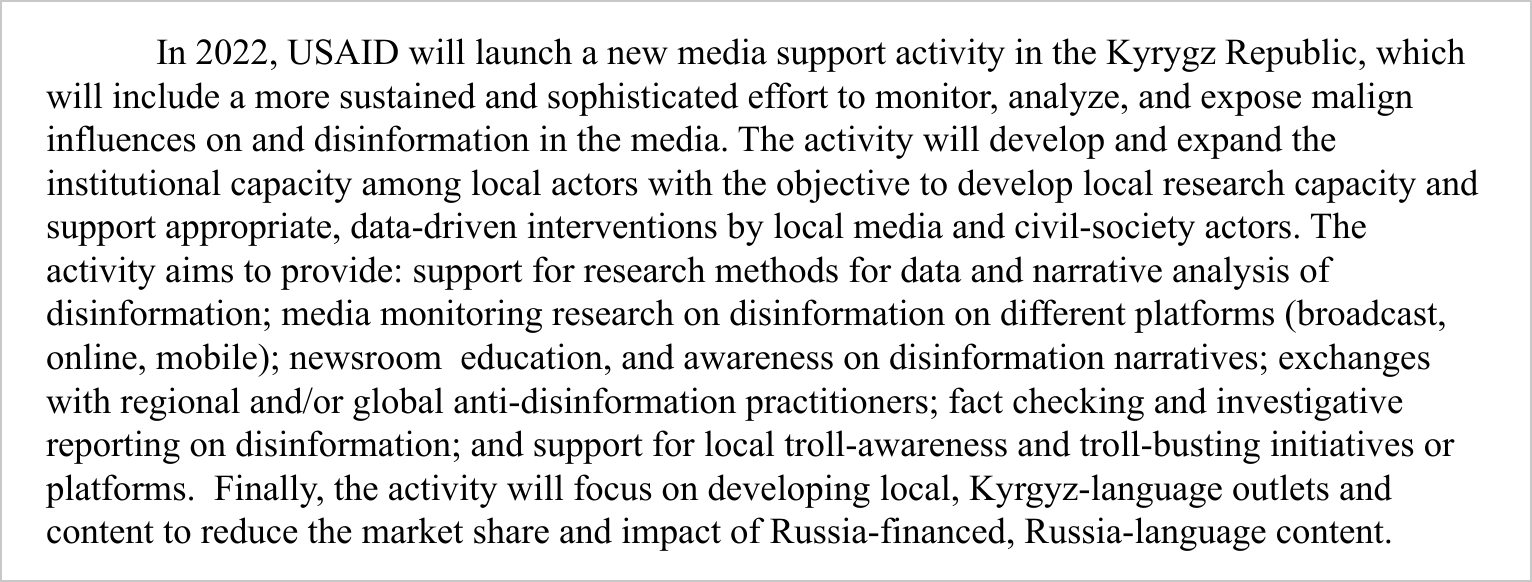
USAID also gave grants to a local Anti-Trolling Investigative Group and backed fact-checkers such as Factcheck.kg. The follow-on activity planned for 2022 was to monitor and expose harmful influence on the media, fund troll-busting projects and develop Kyrgyz-language outlets “to reduce the market share and impact of Russia-financed, Russia-language content”.
The memo says the US interagency had made alternatives to the Russian media narrative a priority action in the implementation plan of the US strategy for Central Asia for 2019 to 2025, a plan the National Security Council approved. One option it floated was for USAID to help promote free licences and translation of Western sources such as AP, which local outlets could then rebroadcast.
According to the memo, Kazakhstan and Uzbekistan were asking for help with media literacy and journalism, and Kyrgyzstan wanted more programming in Kyrgyz. Freeman describes China as late to the contest and records that People’s Daily now publishes in Kazakh and that 40 journalists from Shanghai Cooperation Organisation countries joined an online event titled “Seeing the Real Xinjiang”.
What came after
The memo’s next steps included a town hall with the Central Asia mission on 14 February 2022, at which Deputy Administrator Paloma Adams-Allen was to address the attacks on staff, and new MediaCAMP content on disinformation. It also planned a regional activity from October 2023 built around influencers, content creators and new fact-checkers.
A regional programme of that description appears in USAID’s fact sheets of November 2023 as the Central Asia Information Integrity Activity.
In February 2025 the White House press secretary, Karoline Leavitt, said $4.5 million had gone to fighting disinformation in Kazakhstan under the previous administration, a sum the fact-checking site PolitiFact traced to a 2023 USAID grant to Internews. The memo’s figure stops at April 2021 and covers four countries.
On the lists of active and terminated projects reported in March 2025, almost every USAID programme in Central Asia was among those cut, The Diplomat reported.