Asked by Euronews’s Maria Tadeo about banning parties, Kobakhidze said: “We have a very good example: Ukraine and Moldova. They banned political parties and are way ahead compared to us. Therefore, we intend to catch up with them.” The European approach is sometimes absurd, he said, because Ukraine banned 18 political parties, in Interpressnews’s transcript of 21:30 Tbilisi time.
Asked whether the case is a problem for continuing negotiations, he said the case is in the Constitutional Court, that Georgian Dream appealed on the constitutionality of “about five opposition parties”, and that he offers European bureaucrats to make legal comments. Nobody makes legal comments, he said, only political ones, and that is how they interfere in Georgia’s judicial system, which contradicts European standards.
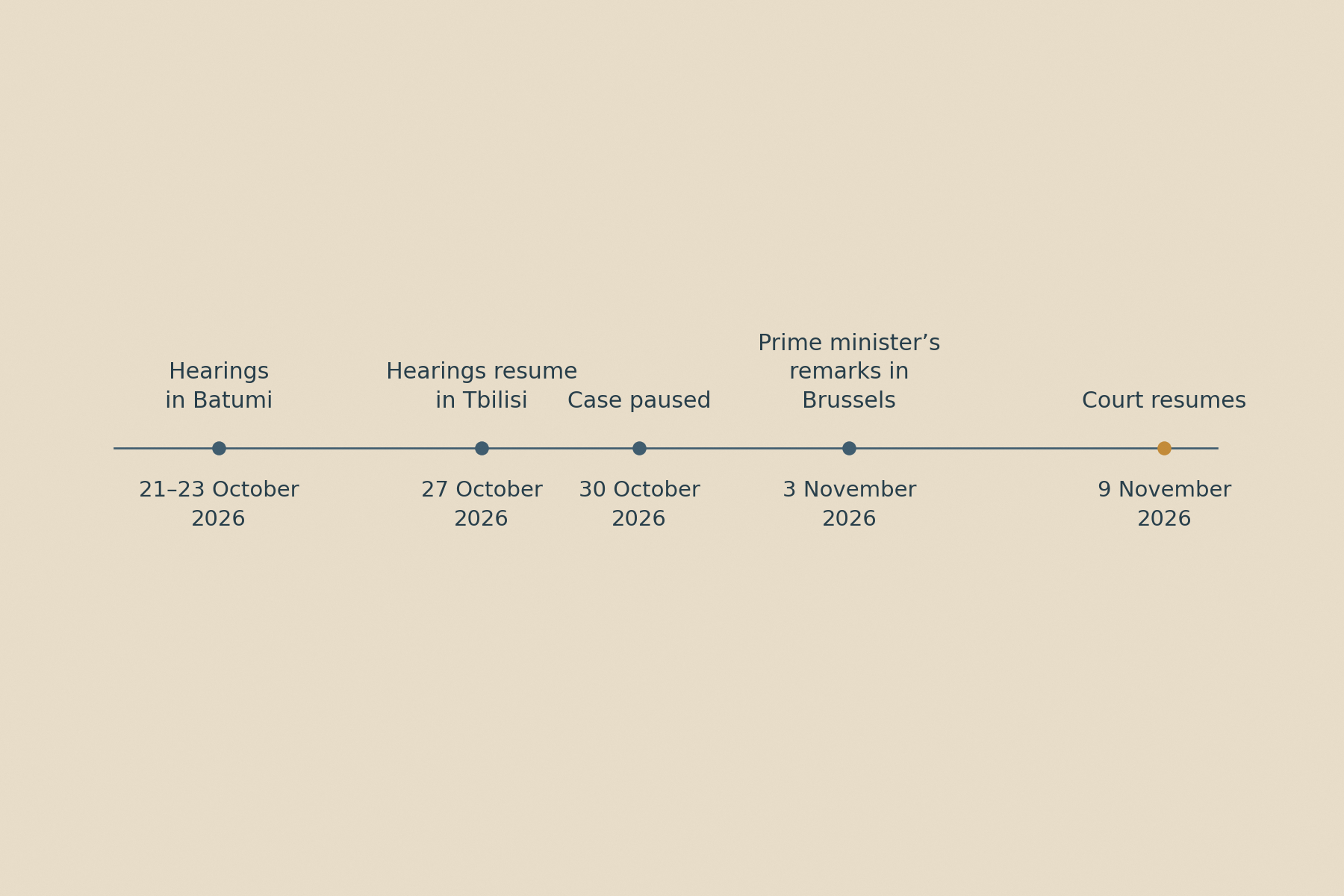
The suit by 88 Georgian Dream deputies under article 23 of the constitution asks the court’s plenum of seven judges to ban the United National Movement’s Unity coalition, the Coalition for Change, Strong Georgia, the Federalists and For Georgia. Hearings in Batumi on 21 to 23 October and in Tbilisi from 27 October were paused on 30 October until 9 November, as CAW reported on 2 November.
Interpressnews ran four more lines from the same evening: on European leaders who avoid a photo with him (“I have pictures taken with everyone”), on trust in the European Union against trust in its bureaucracy, and on the European Commission having “decided, and not we” to suspend political dialogue with Georgia. The Commission’s enlargement report, which the analyst Lasha Tughushi expects to be the sharpest yet, is pending.
The court resumes on Monday 9 November. Kobakhidze’s count of 18 parties banned in Ukraine is his own, and the transcript gives no source for it.