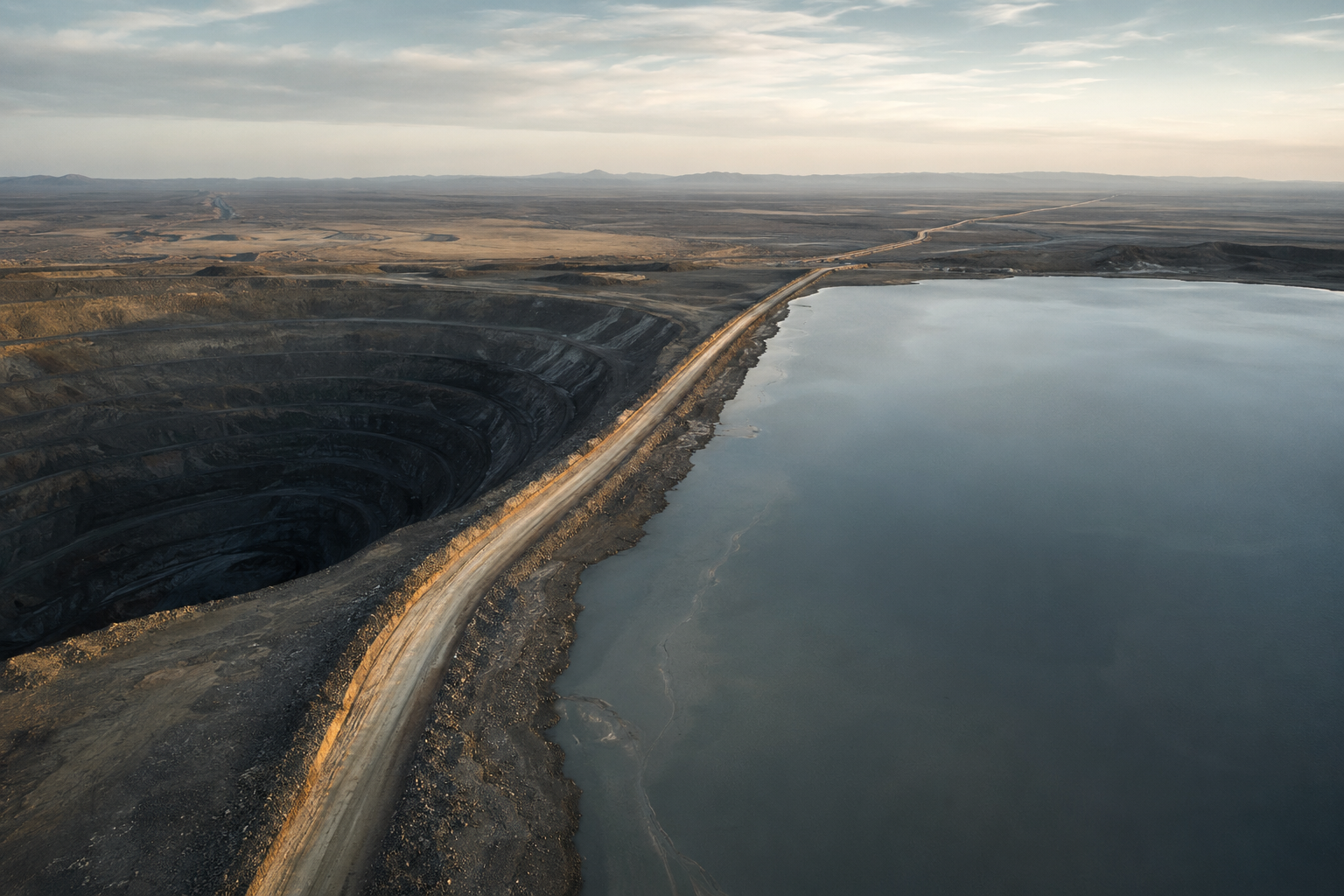
To dig the tungsten at Bayan, in the north of Kazakhstan, someone first has to move a national park. The deposit sits partly inside the protected land of Kokshetau, and the papers for carving out the piece went up for public hearing on the environment ministry’s own portal. They are unglamorous documents. They price the waste. Burying the plant’s tailings is set to cost about 134 million tenge in 2026, a little more the year after. A mine becomes real at this level of detail, the fee schedule for the spoil.
The metal under the park is having a remarkable year. Tungsten is the hard, dense one, the metal that goes into armour-piercing rounds and the tips of cutting tools, and its price ran up by something like 284% between the summer of 2025 and the start of 2026 while China, which makes most of the world’s supply, tightened its export controls. The rock beneath a Kazakh nature reserve has become one of the most contested materials on the planet.
Here is who holds it. The subsoil user is a company called Resource-2018, working a contract signed in 2018. According to the ministry’s own hearing documents, the beneficiaries are two of the wealthiest people in the country, Patokh Chodiev and Mukadaskhan Ibragimova, names that trace back to the founding of the Eurasian Resources Group. The concentrator comes with a Chinese partner, Shandong Xinhai, and the regional governor’s office calls the project a Kazakh-Chinese partnership worth about 100 billion tenge, roughly $210 million.
The numbers on file are not small. The ground holds about 68,571 tonnes of tungsten trioxide, and the plant is sized to grind 1 million tonnes of ore a year. The mining plan has sat on the environment portal since 2023, which set the first cut for 2025. It is 2026, and the partners are still meeting the governor to talk about building the complex. Kazakh mining time runs slowly at the front end, and, everyone hopes, quickly later.
Now the part that is easy to read past. What the plant is built to make is scheelite concentrate. A concentrate is what you get once you crush the ore and float off the waste. It is the rock, cleaned up, ready to be turned into something valuable somewhere else.
A country that keeps discovering it is upstream of someone else’s factory.
This is where the story rhymes with itself. Kazakhstan’s flagship tungsten project, Boguty in the south, switched on its concentrator in late 2024. It is run by a Chinese-and-Singaporean venture, and it too makes concentrate. On the strength of mines like it, Kazakhstan became in 2025 the largest supplier of tungsten concentrate to China. The state’s own strategy papers say the opposite of what the mines keep filing. They call for the value chain to be built at home, for the country to make ammonium paratungstate, the high-tech half-product, and not just dig the ore. The decrees ask for factories. The applications keep asking for pits.
There is a version that breaks the pattern, which is how you can tell the pattern is a choice. A few hundred kilometres south of Bayan, a project called Akmaya has filed to build a concentrator and, past it, a metallurgical line to pour ferrotungsten, and it says plainly that it could sell the alloy to the United States, Europe, Japan and Korea. One neighbour plans to make the metal and choose its customers. The other plans to make concentrate, and its filings name no customer at all. The same element, the same country, the two ends of one chain, decided deposit by deposit.
Which leaves an odd fact at the centre of a critical-minerals boom. The tungsten at Bayan is strategic to everyone except, so far, the ground it comes out of. The park will be moved. The pit will open. Then the concentrate travels the way concentrate has been travelling, and the thing everyone means when they say the word critical, the price, the leverage, the finished metal, gets added later and further along, by whoever buys the sacks. China restricts its own tungsten to hold exactly that advantage, and buys the concentrate that feeds it. Kazakhstan keeps the hole and the tailings pond. It has done this before, and it has the paperwork to do it again.
Peter Lidovsky writes on Eurasia and the politics of the spaces between empires. He contributes a weekly column to Central Asia Wire. The views expressed are his own.