“At such moments we have to limit the supply of electricity in some districts for one or two hours. The rest of the time electricity is supplied in full. We will try to solve this problem in two to two and a half years and give up imports,” Japarov said, in the words Economist.kg carried at 19:34 Bishkek time.
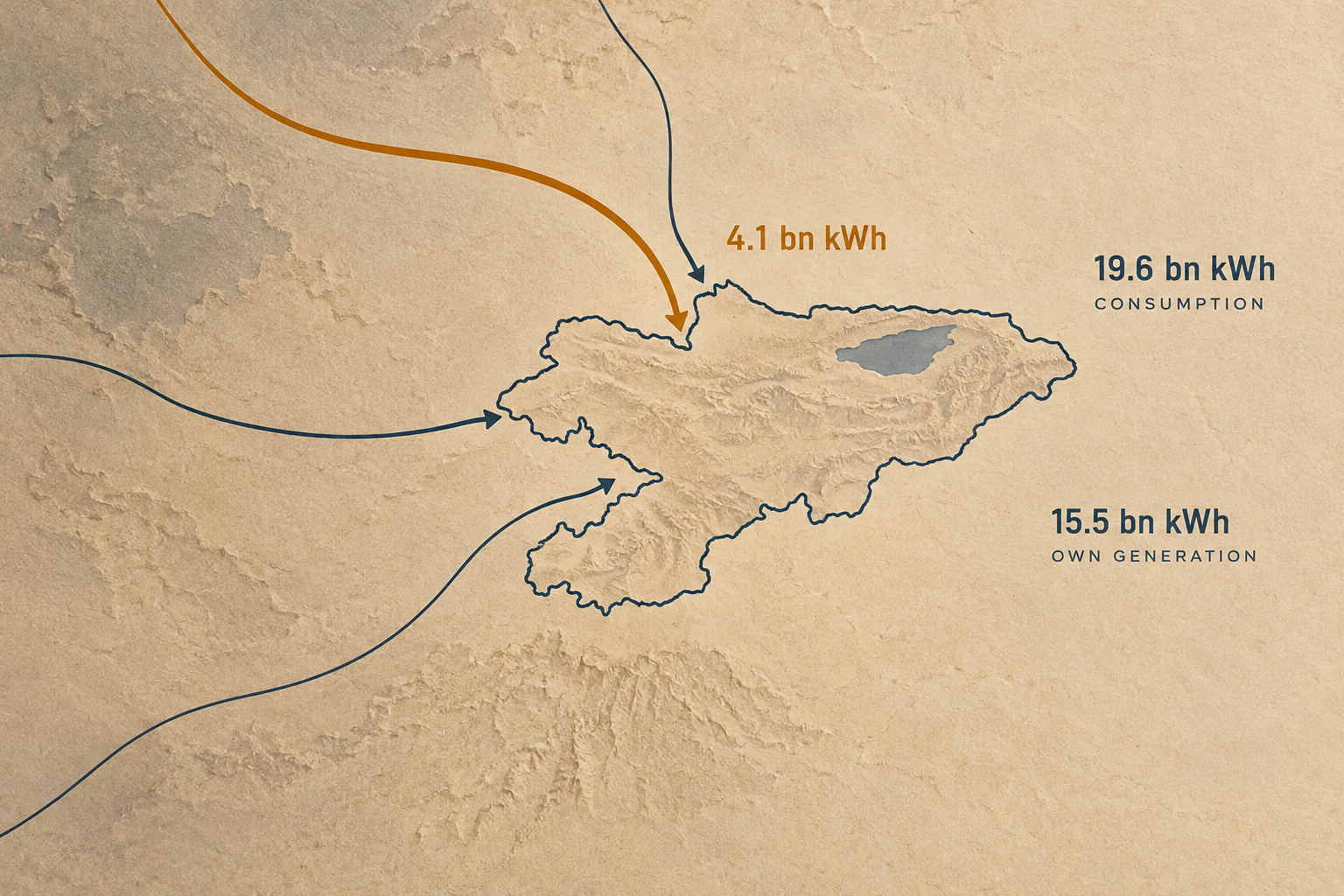
Forecast consumption for the 2026 to 2027 heating season is 19.6 billion kWh, against 15.5 billion of domestic generation and 4.1 billion to come from imports, by the government’s own figures. In 2025 consumption reached 19.3 billion kWh against 15.4 billion of own generation, Economist.kg wrote, a gap of 3.9 billion by CAW’s subtraction.
In June Japarov said consumption was growing with new industrial plants and social facilities while the building of generating capacity lagged behind demand.
Forecast consumption for the 2026 to 2027 heating season is 19.6 billion kWh, against 15.5 billion of domestic generation and 4.1 billion to come from imports, by the government’s own figures.
The remedies he named are the standing ones: modernisation of the existing hydropower plants, small hydropower, solar, and Kambar-Ata-1 at 1,860 MW, where preparatory works, access roads and a transport tunnel, are under way.
The timetable he set runs to the spring of 2029 at the latest, two heating seasons away.