Eight contenders took part and two stayed away, by the count of one of them, Klara Sooronkulova. Eleven people applied to run, Japarov among them.
Japarov promised equal conditions and said there was enough political will for a fair vote, the participants told Azattyk. Iskhak Masaliev said the president leans towards campaigning online. Aimen Kasenov said Japarov asked the contenders not to make the campaign personal and promised not to use state resources for his own.
The presidential administration issued no account of the meeting, 24.kg noted.
Japarov gave his own on his social media page the same day. He wrote that he has a personal interest in an honest, open and fair election and that the pressure, intimidation and artificial obstacles of previous elections must stay in the past. The contenders had voiced concerns, he wrote.
To state and municipal employees he wrote: “Your main duty is to serve the people and the state.” His candidacy obliges no one to work for him, he added, and misuse of office will bring liability under the law.
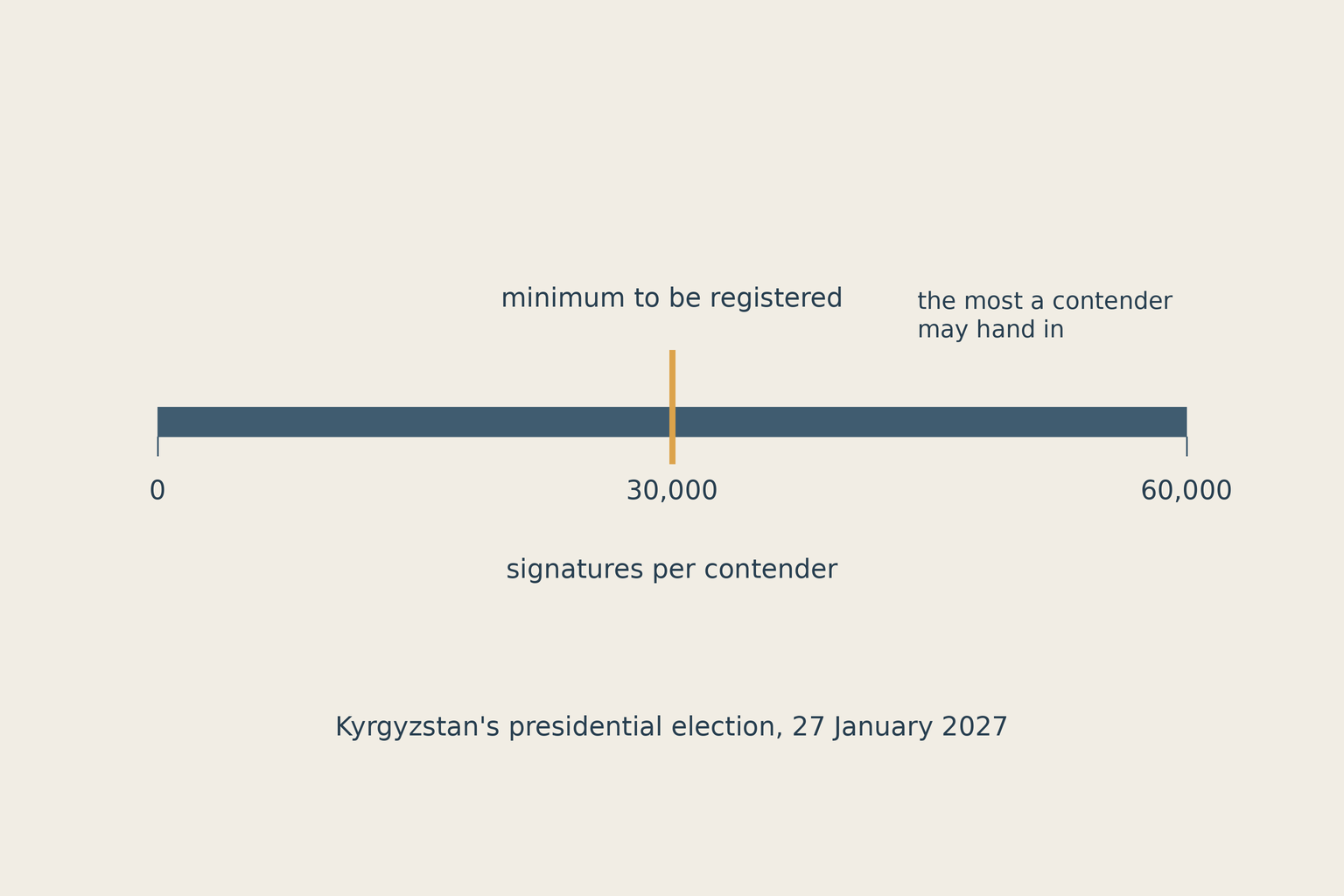
He also addressed the signature count. Collecting signatures through the Tunduk application does not count as a vote and is only the first stage, he wrote, and he asked citizens to use it to support contenders who have yet to reach 30,000.
Four contenders have passed that minimum, Japarov at the cap of 60,000, as CAW reported on 17 November. Signature collection ends on 8 December, according to 24.kg.
The Central Election Commission ran its nationwide test vote on 18 November at 2,492 polling stations and at a remote station in Bishkek’s Dordoi Plaza, the news site Kaktus reported. Its chair, Tynchtyk Shainazarov, said he hopes for a turnout of 50% to 70% in January.