Cabinet Chairman Adylbek Kasymaliev signed the Kyrgyz resolution, which takes effect 10 days after official publication. It exempts transit, re-export, sugar of the extra grade and rail consignments dispatched before the ban begins. The cabinet will monitor the market each month and may lift the ban early if a shortage appears.
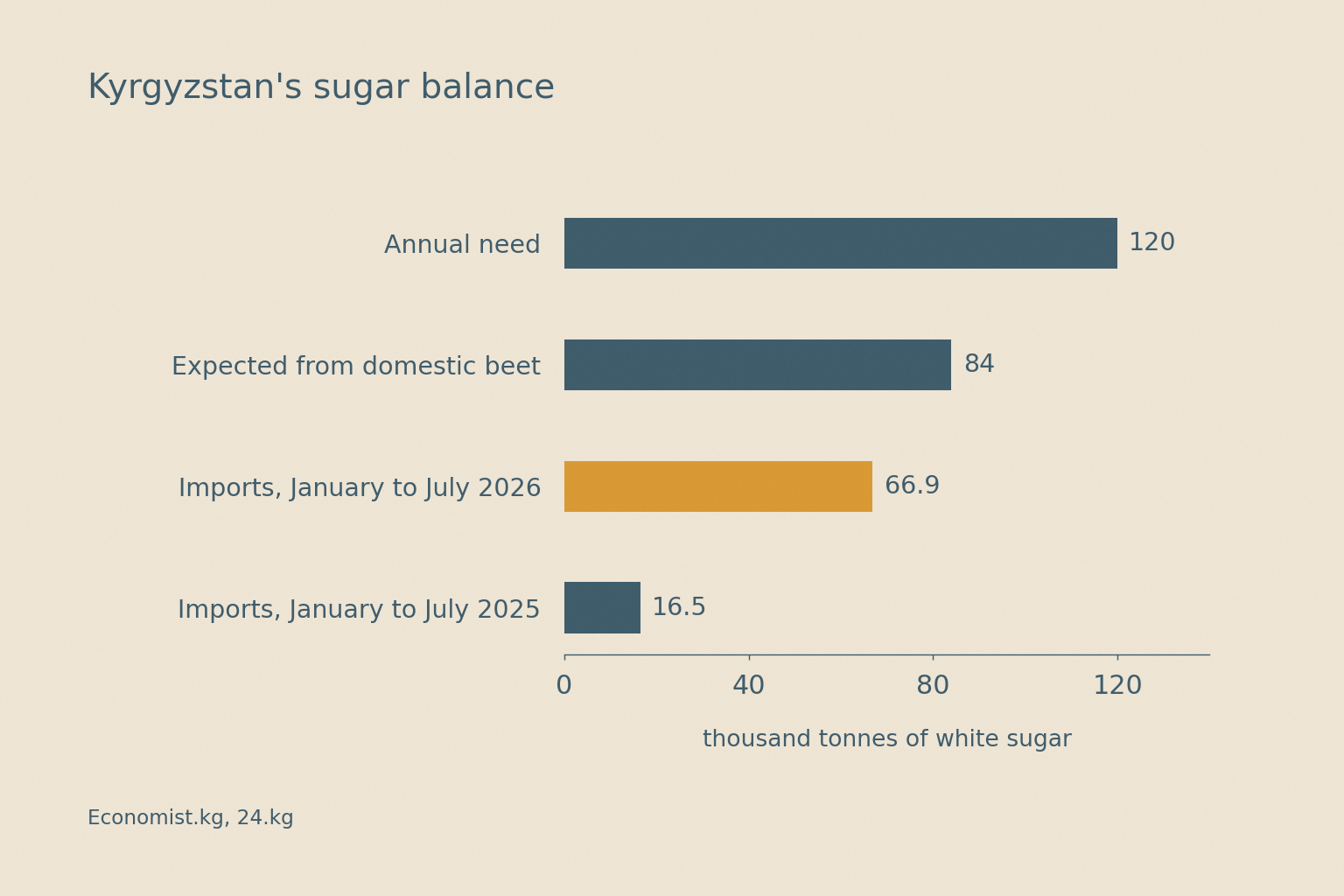
The trigger was a surge in imports. Kyrgyzstan brought in 66,900 tonnes of sugar in January to July 2026, 4.06 times the 16,500 tonnes of a year earlier, Economist.kg reported on 16 November. The largest suppliers were Brazil with 29,960 tonnes, Russia with 21,230, Azerbaijan with 8,630, Kazakhstan with 3,860 and Belarus with 2,030.
Economist.kg cites an agriculture ministry estimate that beet growers need a sugar price of about 60.38 soms a kilogram to cover their costs, against about 51 soms for Russian sugar delivered in September, and says the area under beet fell to 11,800 hectares from 13,400. The country needs about 120,000 tonnes a year and the sugar plants expect 84,000 from the domestic crop, which leaves 36,000 tonnes to find by CAW’s arithmetic. Imports in the first seven months were already almost twice that gap.
Russia’s economy ministry objected to the draft in October, Economist.kg reported on 22 October, citing the Union of Sugar Producers of Russia. The resolution provides for notifying the World Trade Organization’s Committee on Safeguards, the Eurasian Economic Commission and the Commonwealth of Independent States, according to 24.kg.
Kazakhstan’s order, signed by Agriculture Minister Aidarbek Saparov, bans imports of fresh chicken eggs by every mode of transport, with exceptions for transit and goods already shipped, Interfax reported on 16 November. The country bans egg imports from time to time to support local producers, the agency noted, and the previous ban ran for six months from April 2026. Kazakh farms produced 4.57 billion eggs in 2025 and cover 98% of the market.