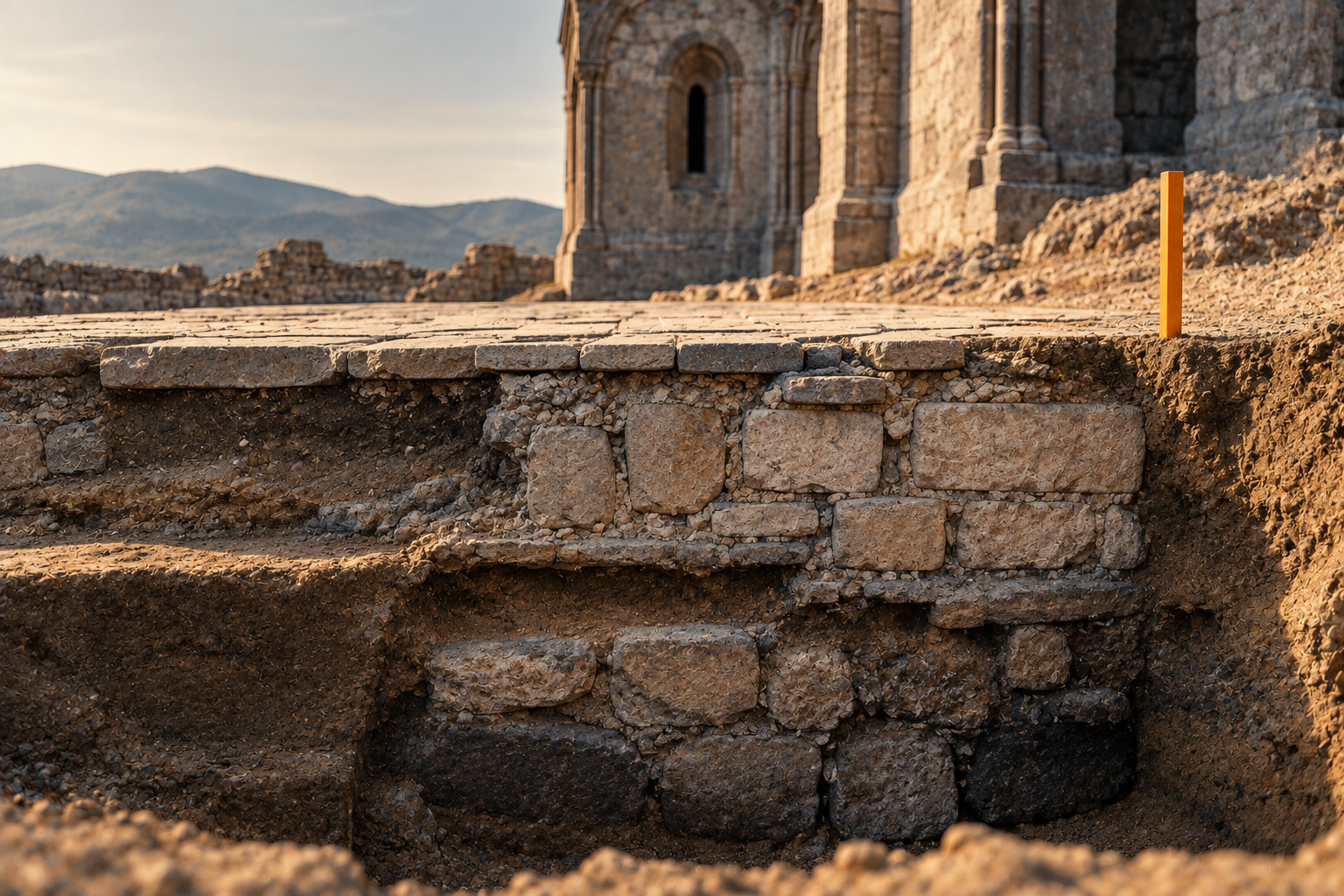
The Patriarchate’s statement came on Wednesday 24 September: disturbing reports, photographs and video had been circulating about work at the church of St George at Kurmukhi and on the ground around it, in what the statement calls historic Hereti. No Azerbaijani state body, it said, had told it what the works were. It asked Georgia’s state agencies to request official information from Baku and to bring its representatives and Georgian specialists into the process, and it wrote the sentence Baku would answer: although the church is today on the territory of the Azerbaijan Republic, it is an important monument of the historical and spiritual heritage of our country and church.
The reply came from the foreign ministry in Baku on Friday at 15:29 local time: Azerbaijan has always respected Georgia’s territorial integrity and sovereignty, and the same attitude from the Georgian side to Azerbaijan’s is one of the most important foundations of the strategic partnership between the two countries. All historical, cultural and religious monuments on Azerbaijan’s territory are an integral part of the national heritage of the Azerbaijani people and state; to call geographical and historical toponyms on Azerbaijan’s territory by other names is inadmissible; and the Patriarchate is advised against repeating the known approaches of the Armenian Church. The ministry called the Patriarchate’s position incomprehensible and said it contained territorial claims.
No Azerbaijani state body, it said, had told it what the works were.
Baku’s press explained the works the same afternoon. 1news.az described standard archaeological and survey work at what it calls the ancient Albanian temple complex of Kürmük, a building of 1892 to 1894 put up by the Society for the Restoration of Orthodox Christianity in the Caucasus over the foundations of an Albanian monastery of the 1st to 3rd centuries, where excavations in 2006 had found cultural layers and the foundations of early medieval buildings, and Georgian clergy, it added, hold services there twice a year on feast days. OC Media quoted the sign at the site: archaeological excavations in progress, entry prohibited.
The Georgian record reads the same stones differently. Its Patriarchate calls the church the second cathedral of its eparchy of Kakhi and Kurmukhi, in the region Georgians call Saingilo; the monument register dates the church to the 12th century and its rebuilding to 1890, under archimandrite Leonid. So the two accounts date one rebuilding two ways, 1890 against 1892 to 1894, and credit it two ways, to an archimandrite and to a society; two names for one valley, and a border between them.
Tbilisi’s government did not answer the ministry. By Friday evening, Novosti Gruzii noted, no official comment had come from the government on the Azerbaijani statement. On Saturday the leader of Georgian Dream’s parliamentary majority, Irakli Kirtskhalia, told reporters that all speculation around the statement and the monastery itself would be put to an end, that the question would be settled and events would develop in the interests of both peoples, and that Azerbaijan is Georgia’s closest historical and strategic partner and a very great friend.
Kobakhidze, the same day: “We have no tension whatsoever, with the government of Azerbaijan we have friendly relations. On the basis of that friendship we can very easily discuss any subject. It is in that key, in a friendly mode, that all questions between the governments of Georgia and Azerbaijan are considered.”
On Monday the argument moved from the government to the analysts. Kakha Gogolashvili, who directs the EU studies centre at the Rondeli Foundation, said in the headline Interpressnews gave him at 13:33 that everyone had made mistakes on the Kurmukhi question: Azerbaijan should at least have notified the Ministry of Culture, the Patriarchate should have taken the matter to the government, caution had been lacking, and Georgia had received an unpleasant reply.
The price of the silence is on the record. Azerbaijan supplies most of Georgia’s gas, its oil and gas cross Georgia to Turkey, and the corridor projects Kobakhidze priced at $7 billion to 2032 at the UN on 24 September run through both countries. The same government needs the Church at home and has not disowned the Patriarchate; what it has done is call the dispute settled before it is, and leave the Patriarchate’s request for official information from Baku without a public answer.
Baku’s frame is the one it built for Karabakh. The reference to the Armenian Church puts the Patriarchate’s heritage claim in the file where Baku keeps Armenian claims to churches it calls Caucasian Albanian, and the 1st to 3rd century monastery under the Kurmukhi floor is the same thesis applied at the northern border. The name is the second front: Hereti, in the ministry’s reading, is a toponym that asserts a claim, and 1news.az recalled the incident of several years ago at the monastery complex Baku calls Keshikchidag and Tbilisi calls David Gareja, on a stretch of the border still not delimited.
Three things will show how far this goes. Whether Georgia’s Ministry of Culture requests the information the Patriarchate asked for, as Gogolashvili said it should have been given; whether Georgian clergy are let in for the St George feast the faithful call Kurmukhoba, in November; and whether the speculation Kirtskhalia promised to end is the Patriarchate’s, the excavation’s, or both.