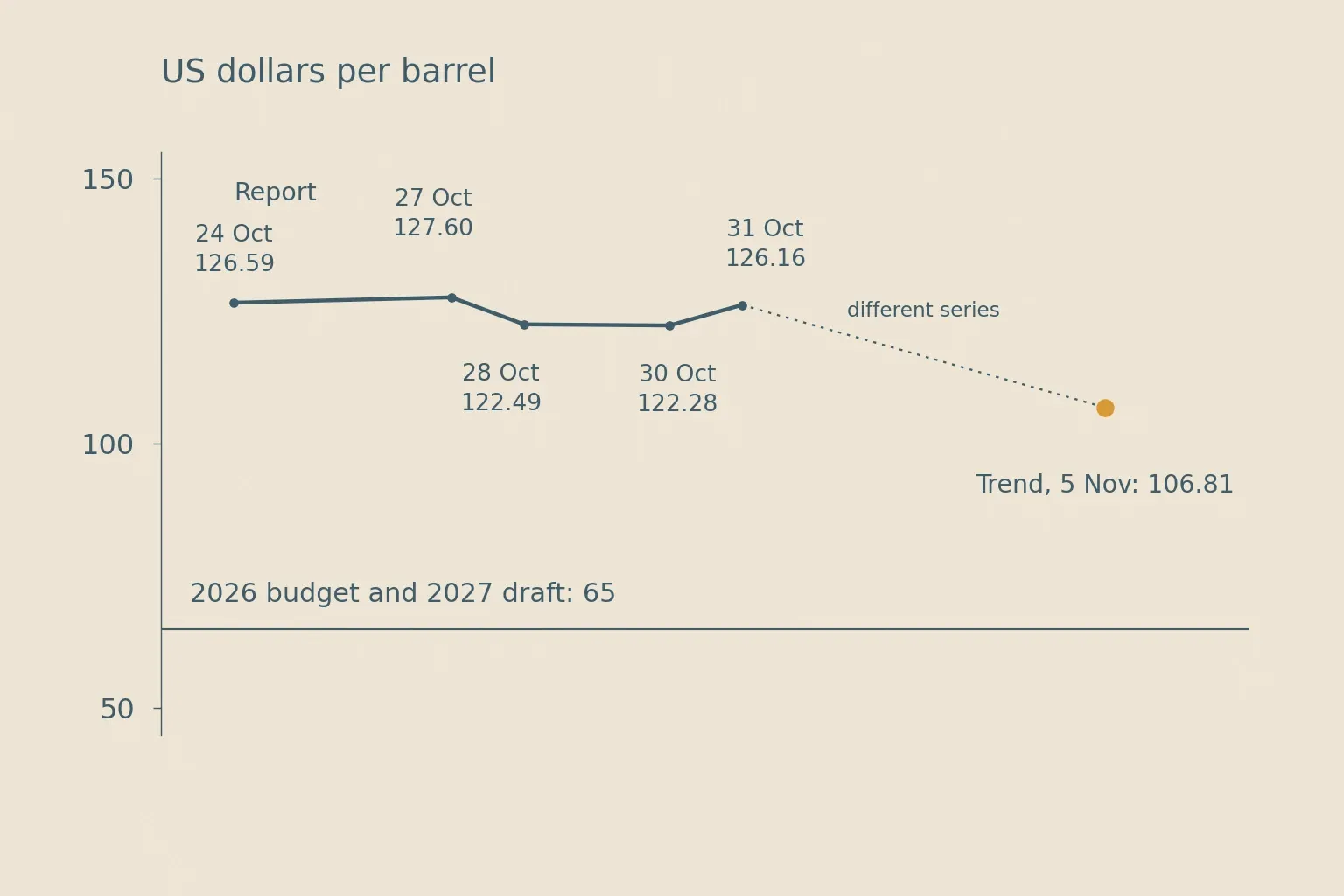
The print came at 09:33 Baku time from APA and at 09:40 from Trend: Azeri Light at $106.81 a barrel on a CIF basis at Augusta, down $6.64 or 5.85% on the previous print, and $99.90 FOB at Ceyhan, down $5.75 or 5.44%.
Report carried the same figures. The previous print, which neither agency dates, was $113.45 by APA’s figure. Report’s last print on its own series, on 31 October, was $126.16.
The move behind it was Wednesday’s. January Brent futures on ICE fell by $8.98, or 8.67%, to $94.62 a barrel, and traded at $93.79 at 08:16 Moscow time on Thursday, Interfax reported.
Trend quoted Trading Economics on the cause: “expectations that Democratic gains in the US midterm elections, which would give the party greater influence in Congress, will increase pressure on the Trump administration to end the war with Iran”. Exports from the Gulf, the same note said, “have begun to recover”.
In Baku the price move coincided with the budget hearing. On 4 November the Milli Majlis Committee on Economic Policy, Industry and Entrepreneurship discussed the draft law on the 2027 state budget: revenues of 39.2 billion manat, spending of 42.4 billion, both up 1.7% on the approved 2026 budget, and a deficit ceiling of about 3.2 billion manat, by the committee chairman Azer Amiraslanov’s summary as the parliament’s press service printed it.
The draft’s oil price is $65 a barrel, Finance Minister Sahil Babayev told the committee. Trend reports the line on profit tax: 320 million manat expected from Azeri-Chirag-Gunashli in 2027 and 1.42 billion from Shah Deniz. The ACG figure rises despite lower output, which Report ties to a projected 16.3% fall in operating expenses and to the $75 a barrel assumed in the state budget for the fourth quarter of 2026.
The 2026 budget, Report and Trend both note, was written at $65 as well. ACG’s daily output is projected at 316,400 barrels in 2027, down 0.5% on the 2026 forecast.
The budget package also prices the downside. By the draft’s baseline, the State Oil Fund’s assets reach $78.3 billion in 2030 from $74 billion in 2025 and about $74 to 75 billion expected for 2026, and the risk scenarios, built on deviations of $10, $15 and $20 from the baseline price, put 2030 between $70.3 billion and $86.3 billion. The document’s reading, as Trend summarises it, is that transfers to the budget fall over the medium term and that the fund’s assets “can be preserved even if crude oil prices fall to $65 per barrel”.
Vugar Gulmammadov, who chairs the Chamber of Accounts, told the committee that revenues rise next year while SOFAZ transfers fall, that the consolidated budget’s non-oil primary deficit is projected at 17.1% of non-oil GDP in 2027, down 1.7 points, and that the chamber proposes a cap on the growth of current spending as a second anchor beside the non-oil deficit rule. Social spending, by Amiraslanov, is 18.7 billion manat or 44.2% of the total, and capital spending 13.8 billion.
Kazakhstan’s numbers came from a government press conference in Astana on Wednesday. Energy minister Yerlan Akkenzhenov said the country is “going by plan” on 96 million tonnes of oil for 2026 and expects “in the region of 99 million tonnes” for 2027, Interfax reported. Output in January to September fell 8.3% to 69.4 million tonnes, after the attacks on the Caspian Pipeline Consortium’s infrastructure and the transformer fire at Tengiz early in the year, and the ministry has cut its forecast three times this year, from 100.5 million.
Holding 96 million would take about 26.6 million tonnes in the fourth quarter, by CAW’s arithmetic, against an average of 23.1 million a quarter so far this year.
Akkenzhenov also asked Moscow, in person, to reopen the Druzhba route. “The official request was addressed by me personally, tete-a-tete. The request has been passed on. The Kazakh side awaits the Russian side’s answer,” he said.
Russia stopped transit of Kazakh oil toward Germany in May. Kazakhstan shipped 2.1 million tonnes to the Schwedt refinery in 2025, planned about 3 million for 2026 and moved 1.02 million in January to April, Interfax’s background says, and the minister had said earlier that September, October and November would see no resumption.
Akkenzhenov also gave a timetable for refining. The three existing refineries go from 18 million to 27.7 million tonnes a year under a concept written this year, with fuel of the K5 class, Report’s Kazakhstan bureau reported. A 2 million tonne plant in Aktobe region, meant for the home market and Central Asian buyers, is under consideration, and a further refinery outside the 27.7 million is at the site-selection stage, with a decision expected soon by the minister’s account.
Baku and Astana face Thursday’s price from different positions. Baku’s 2026 budget was written at $65 and its 2027 draft at $65 as well. Thursday’s CIF print stands $41.81 above the draft’s assumption and the FOB Ceyhan print $34.90 above it, by CAW’s arithmetic.
Astana’s position is two numbers that do not yet agree. The 2027 draft budget counts on 96 million tonnes, with the Tengiz and Kashagan maintenance moved into next year, by the National Bank’s earlier statement that Interfax recalls, while the energy minister now names about 99 million for 2027. Its export route to Germany is a request awaiting an answer, and Report’s next daily print is due by about 10:00 Baku time on Friday.