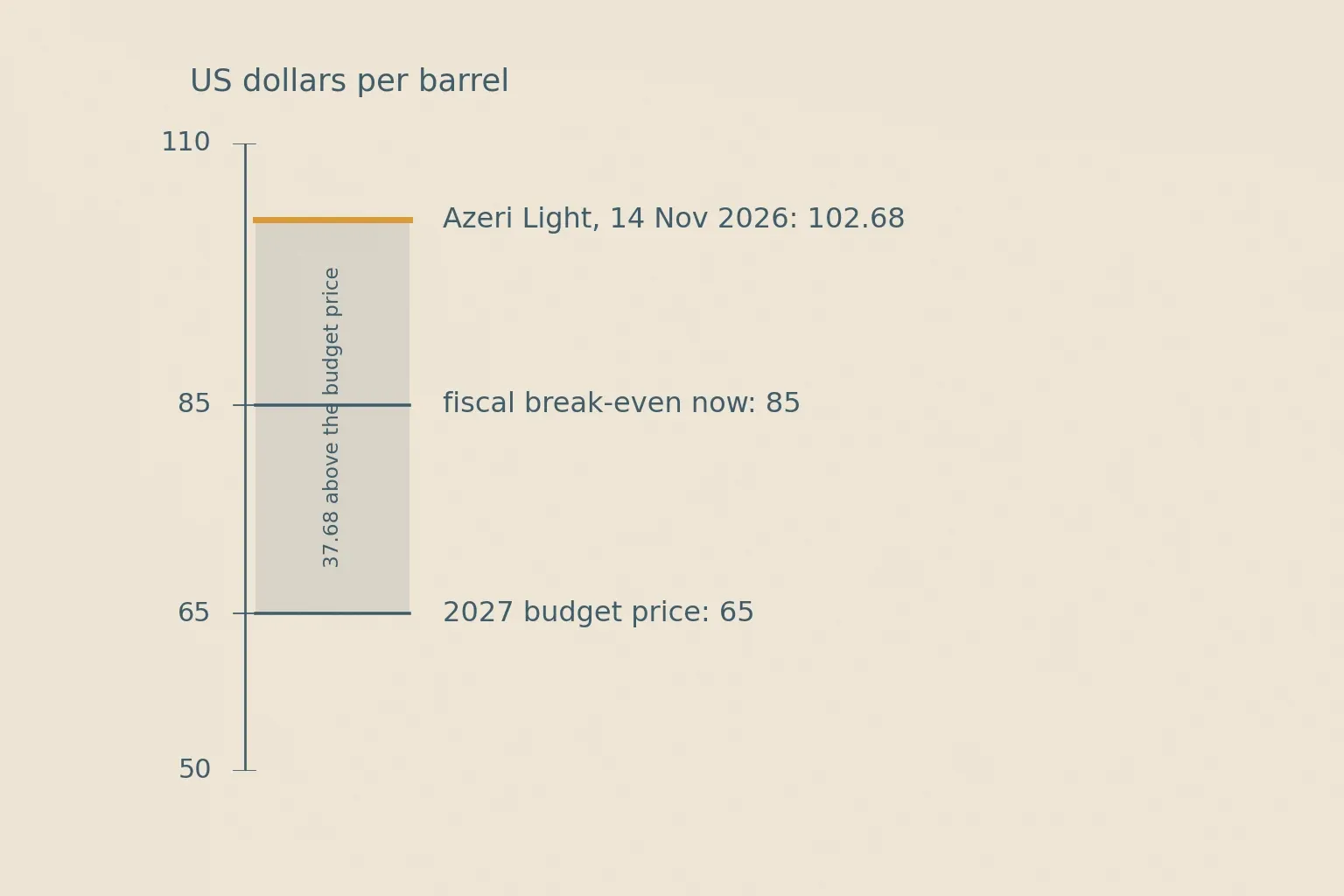
The Baku news agency Report put Azeri Light at $102.68 a barrel on 14 November, the CIF price at the Italian port of Augusta, up $2.80 or 2.8% on its previous quote. The price at Ceyhan on a free-on-board basis rose by $2.89, or 3.01%, to $98.79, and January Brent futures had closed at $96.11. This year’s state budget, Report noted, was written at $65.
Next year’s is written at the same price. Presenting the draft to the Milli Majlis committee on economic policy on 4 November, Babayev said the average annual price of crude for 2027 had been set at $65. He said higher prices were very likely and called the choice “a conservative approach”, Trend reported.
He repeated the assumptions a week later. At a joint meeting of four committees on 11 November he gave $65 a barrel, average inflation of 5.3% and an exchange rate of 1.7 manat to the dollar, according to Trend.
At the budget assumption of $65 a barrel the state budget collects 39.3 billion manat and spends 42.4 billion, a deficit of 3.1 billion manat or 2.2% of GDP. Oil and gas provide 15.5 billion manat and the rest of the economy 23.8 billion, or 60.6%. Babayev said that from next year more than 60% of state budget revenue would come from outside the oil sector.
The draft assumes nominal GDP of 141 billion manat, real growth of 2.7% and non-oil growth of 4.4%.
The State Oil Fund is where the state’s share of oil income accumulates. Babayev put the fund’s 2027 revenue at $7.8 billion and its spending at $7.1 billion, both at $65 a barrel. Its transfer to the state budget is set at $7 billion, $550 million less than this year’s forecast, and is to fall to $5.5 billion by 2030.
The budget documents present the falling transfer as protection for the fund. They put the fiscal break-even oil price at $85 today and expect it to reach $65 in 2030, APA-Economics reported on 4 November from the papers sent to the committee. At $65 the budget does not balance: the draft carries its 3.1 billion manat deficit after the fund’s transfer.
The documents call a fall of prices below $65 in the medium term unlikely. On the quote of 14 November Azeri Light stood $37.68 above the budget price and $17.68 above the break-even figure, by CAW’s arithmetic.
The country’s strategic foreign-exchange reserves were $89 billion on 1 October, Babayev said on 11 November. Public debt is 23.9 billion manat, of which 7.7 billion is external, he told the committee on 4 November.
A $75 figure in the budget documents refers to a different item. The forecast of profit tax from the Azeri-Chirag-Gunashli block, 320 million manat in 2027, rises by 6.7% on this year’s forecast although output is expected to slip by 0.5% to 316,400 barrels a day. The document attributes the rise to the $75 a barrel assumed in the state budget for the fourth quarter of 2026 and to lower operating and capital costs, in a passage Report quotes without explaining why that quarter carries a higher price than the year.
Output is running below quota. The International Energy Agency’s monthly report put Azerbaijan’s production in October at 440,000 barrels a day, 111,000 below its OPEC+ quota of 551,000, Report said on 14 November.
The budget documents plan investment of 7.933 billion manat in the oil and gas sector in 2027, 8.331 billion in 2028, 8.213 billion in 2029 and 7.503 billion in 2030, APA reported on 14 November. That is about 32 billion manat over four years, by CAW’s arithmetic.