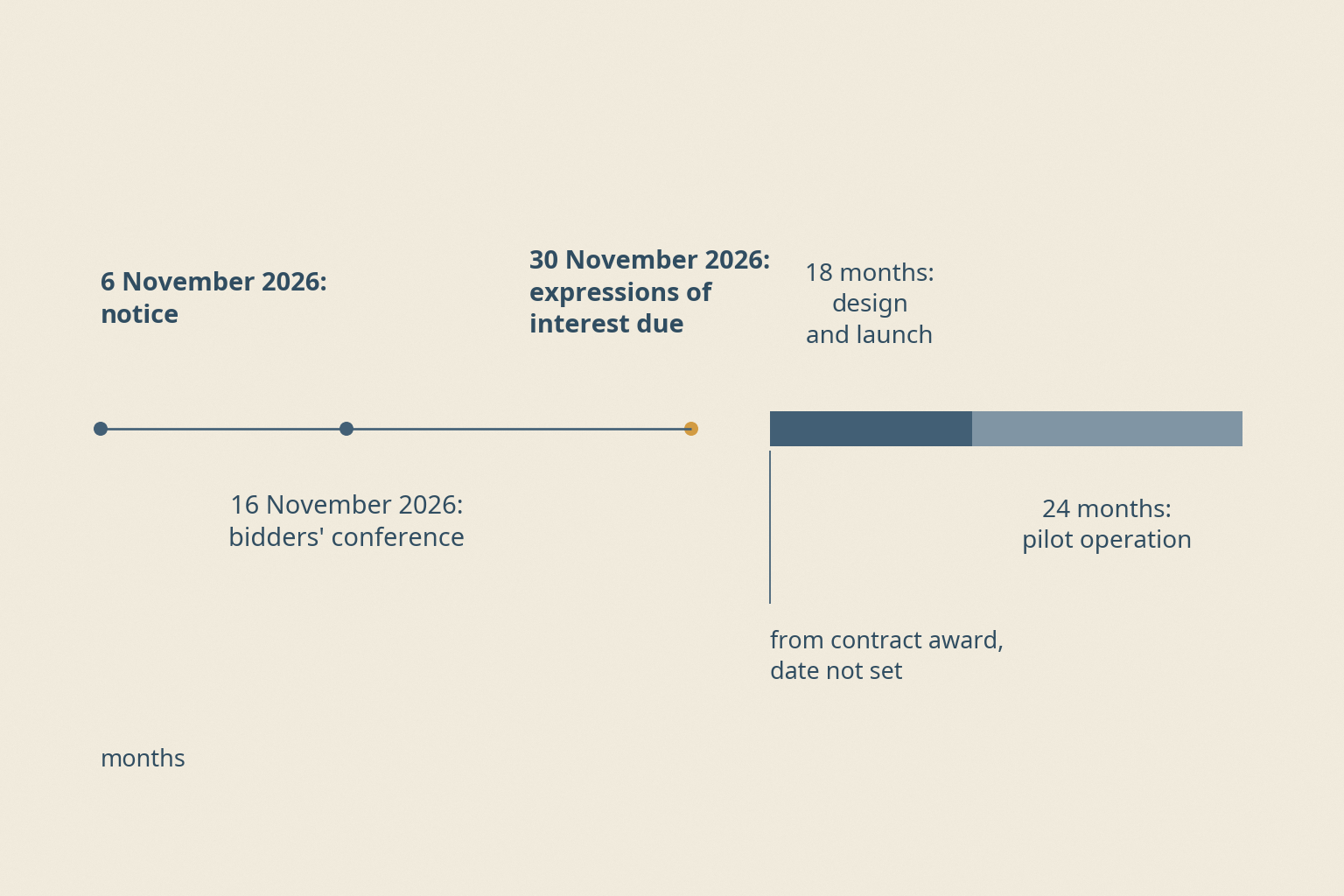
The tender runs under the World Bank-backed Regional Electricity Market Interconnectivity and Trade programme, known as REMIT. KEGOC’s notice lists the work: a legal and contractual base for the market, a trading platform and a settlement system, the launch of the pilot and its operation for 24 months after it goes live. Design and launch are allotted 18 months.
The terms of reference, as Asia-Plus summarised them on 12 November, describe a market in which sellers post surplus power and buyers bid to cover a shortfall. It would stand beside the long-term bilateral contracts that the four systems use now, and writing the rules, training staff and starting the trading are the consultant’s job as well.
The World Bank’s board approved a $60 million grant for Tajikistan under the first phase on 22 January 2026, with loans of $40 million each for Kyrgyzstan and Uzbekistan, Asia-Plus reported. That first phase holds $143.2 million in grants and concessional money for those three countries and the dispatch centre. Over ten years and three phases the whole programme is put at about $1.018 billion.
In Tajikistan the money pays for a new 500 kilovolt line between the Dushanbe and Regar substations and for modernising and expanding both, while Kazakhstan, whose grid operator published the notice, appears in none of the first-phase sums Asia-Plus lists.
Electricity trade now equals about 3% of the region’s demand and is to reach at least 15 billion kilowatt-hours a year within ten years, by the bank’s figures as the outlet gives them. Asia-Plus’s report gives no year for the 3% and no baseline in kilowatt-hours.
The Eurasian Development Bank, in a study CAW reported on 30 October, counted 12.1 billion kilowatt-hours traded inside the interconnected system in 2024. A rise from that level to 15 billion would be 24% in ten years if the two estimates cover the same electricity flows, by CAW’s arithmetic.
The tender matches the sequence that study proposed: metering, telemetry and rules for settling deviations first, then a pilot market for power delivered the next day. Balancing and system services come later in its plan, as does payment for the flexibility of Kyrgyz and Tajik hydropower.
Four governments will each decide who may trade, and all of them will settle in US dollars. The terms of reference leave it to every country to name its own participants, with national power companies, single buyers and system operators listed as possible candidates. Their utilities bill customers in tenge, som, somoni and soum, and Asia-Plus’s summary names no mechanism for the exchange-rate risk.
In the pilot, the first regional day-ahead price will be formed by whichever companies the four capitals admit. The tender allows 18 months to build the market and 24 to run it, with yearly extensions possible at the client’s request.
The deadline for expressions of interest is 15:00 Tashkent time on 30 November.