The figures come from a meeting on the main parameters of the 2027 budget chaired by President Shavkat Mirziyoyev, which the business news site Spot reported on the evening of 13 November with reference to the presidential press service. State budget revenue is planned at 416 trillion soums and spending at 464 trillion. The economy is forecast to grow by 7%, and the overall fiscal deficit is to stay within 3% of gross domestic product.
The gap between revenue and spending is 48 trillion soums. The budget law for 2026 set revenue at 368.9 trillion soums and spending at 402.6 trillion, the Uzbek edition of Kursiv reported when it was adopted in December 2025, a gap of 33.7 trillion. Next year’s gap is 42% wider, by CAW’s arithmetic.
The extra revenue is to come without higher tax rates. The main rates stay unchanged, the press service said, and collections are to grow through a wider tax base, a smaller shadow economy and digital tools in tax and customs administration.
Education and health take the largest named shares. Education receives 114.3 trillion soums and health 61.4 trillion, together about 176 trillion, a little over a third of all spending. Against the 100 trillion and 49 trillion in this year’s law, as Kursiv reported them, education gains 14.3 trillion soums and health 12.4 trillion.
A further 70 trillion soums is assigned to infrastructure in the regions and mahallas, to employment and to social protection. Mirziyoyev also ordered a pilot digital system to track what the investment programme spends on construction.
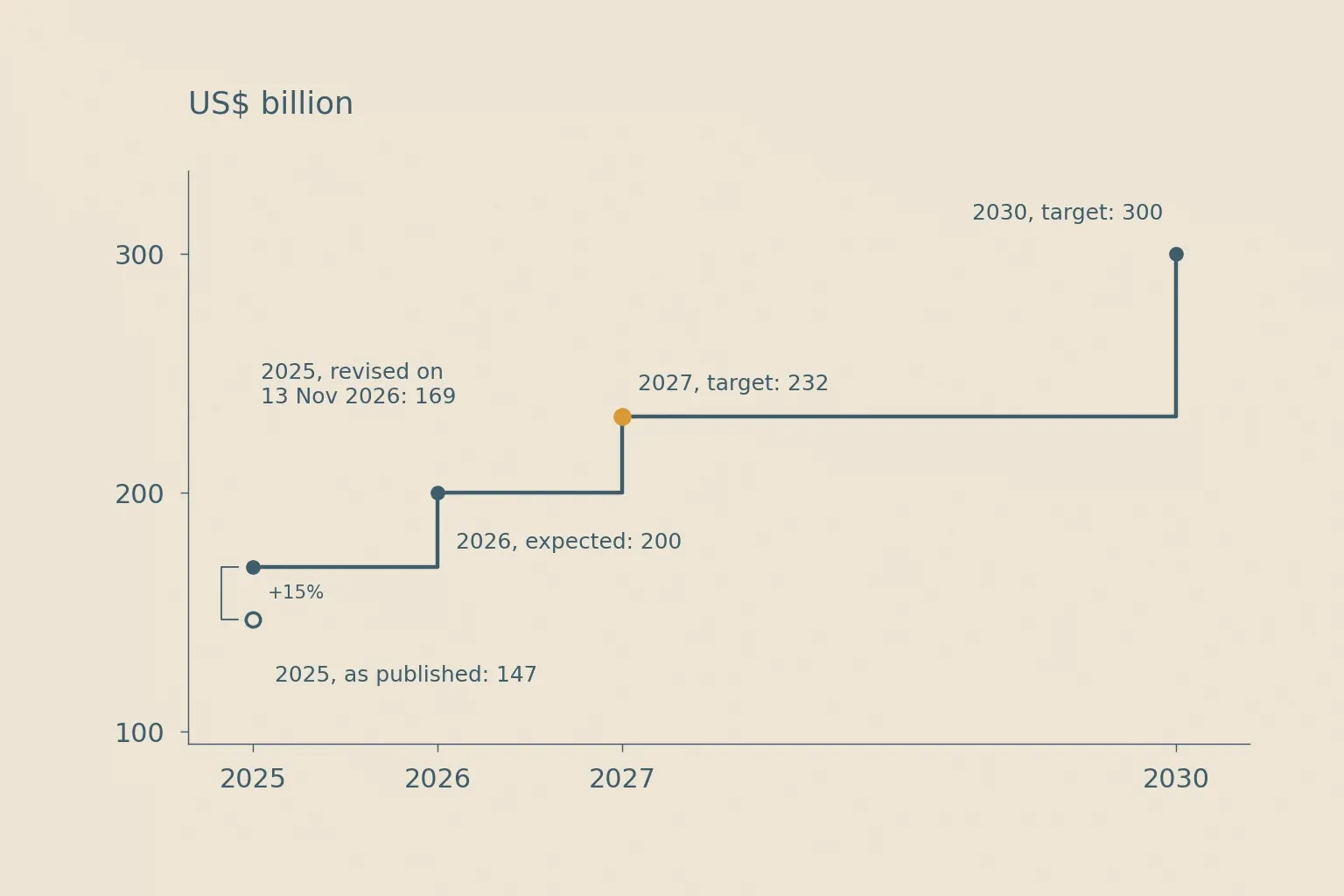
The targets in dollars reach further than the budget lines. For 2026 the president expects growth of at least 8%, GDP above $200 billion and income per head of $5,200. For 2027 the meeting put GDP at $232 billion, exports excluding gold at about $40 billion and inflation at 6%, falling to 5% in the two years after.
The longer targets are $300 billion of GDP by 2030 and $10,000 of income per head by 2036.
The base under those numbers moved on the same day. On 13 November the National Statistics Committee raised its figure for 2025 GDP from $147 billion to $169 billion, mostly through fuller reporting by enterprises and the results of a farm census and a population census, as CAW reported on 13 November. From the revised base, $200 billion in 2026 is a rise of at least 18%, and from the old one it would have been at least 36% in a year of 8% growth, so the targets sit on the new series and would be hard to reach from the old one, by CAW’s arithmetic.
Growth of 7% and consumer inflation of 6% add up to about 13% in soums, while $232 billion is about 16% above the $200 billion floor set for 2026. The gap would have to come from a firmer soum or from prices across the economy rising faster than consumer prices, and the press service’s account names neither.
The revision also changes what the deficit ceiling allows. Taking the current official rate of about 12,014 soums to the dollar as a guide, $232 billion is close to 2,790 trillion soums, and 3% of that is about 84 trillion, by CAW’s arithmetic. If the 15% revision carries into 2027, the same 3% ceiling allows a deficit about 11 trillion soums larger than the old series would have.
The state budget’s own lines look smaller against the new base. Revenue of 416 trillion soums is about 15% of that GDP figure, spending under 17% and the gap 1.7%, on the same arithmetic. The 3% ceiling is set for the overall fiscal deficit, a wider measure than these two lines: the 2026 law, for one, carries separate accounts for the state targeted funds.
The draft now goes to the local councils and then to the Legislative Chamber. The press service’s account does not give the deficit in soums or say which GDP series the ceiling is counted on.