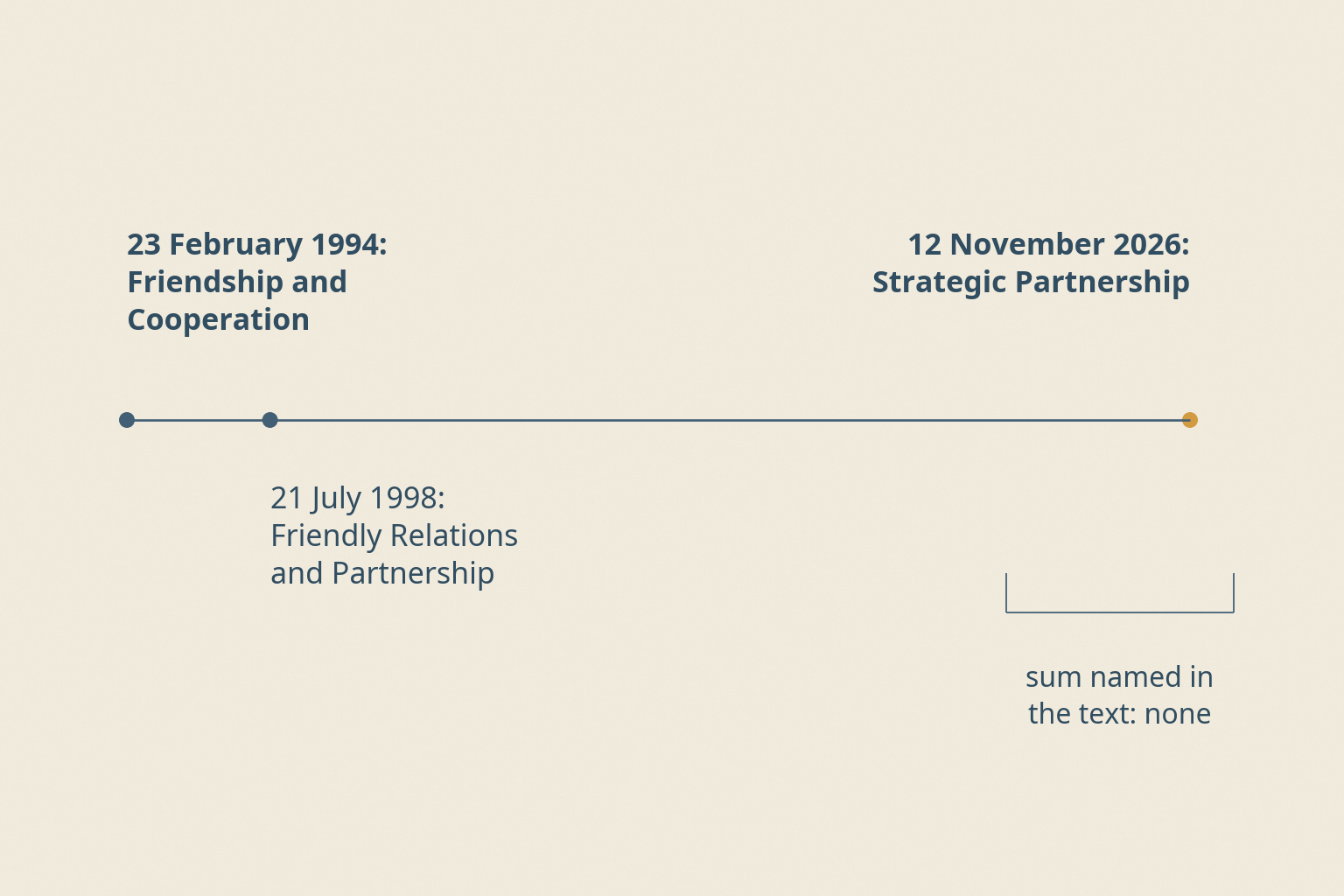
The declaration has three pillars: defence and security, trade, investment and growth, and education and innovation. It recalls two earlier texts, a declaration on friendship and cooperation of 23 February 1994 and one on friendly relations and partnership of 21 July 1998, and says the two governments now raise their relations to a strategic partnership.
On defence the commitments are to training, capacity building and interoperability, and in defence industry the two sides promise only to look for opportunities for joint initiatives. Law enforcement, border management and judicial cooperation are listed beside it.
On trade the text names renewable energy, infrastructure and services as priority sectors and promises support for the Middle Corridor. Cooperation in financial and capital markets is likewise something to be explored. The work will run through an existing body: the Joint Intergovernmental Commission on Trade and Economic Cooperation is named as the main platform, and no new fund, facility or office is created.
Oil and gas are absent by name. Aliyev told Burnham that Britain is the largest European investor in Azerbaijan after more than 30 years of energy cooperation, according to APA’s report of the meeting, but the declaration speaks only of clean energy, energy security and energy cooperation. UK Export Finance does not appear in it.
A figure exists outside the text: in Baku on 6 October Anas Sarwar, the minister of state for trade, said UK Export Finance had the capacity to take on at least £5 billion in risk for Azerbaijan, as CAW reported on 2 November. Five weeks later the document signed by the two leaders repeats neither the number nor the agency. A leaders’ declaration is a different kind of text from a minister’s remark, and nothing in it withdraws the figure.
The final provisions attach a condition: cooperation is “subject to the availability of resources” and to each side’s laws.
Britain’s second text of the day was about Armenia. Downing Street published a statement of a group it calls the Armenia Core Group, which met in Dublin and brings together Britain, Estonia, France, Lithuania and the European Union’s foreign policy chief. Germany, Norway, Poland and the presidents of the European Council and the European Commission joined the statement.
The statement says Russia’s political and economic pressure on Armenia has increased since the parliamentary election five months ago, that Moscow has restricted Armenian exports and that it is threatening to use energy supplies as “a means of intimidation”. The signatories promise to help Armenia diversify its partnerships in trade and energy. Neither of the two texts published on 12 November carries a British sum, loan or guarantee.
The only instrument the Armenia statement names belongs to Brussels. The support it promises rests on a step the European Union has already taken, which the statement describes as the suspension of duties on 80% of Armenian exports to the bloc. What Britain itself will add, the statement does not say.
Both texts lean on the same peace process. The declaration with Baku refers to the Washington summit declaration of 8 August 2025 and restates British support for peace through bilateral dialogue, and the Armenia statement backs the same process together with normalisation between Armenia and Turkey. Aliyev and Armenian Prime Minister Nikol Pashinyan met in Dublin the same day and discussed transit and a link between the two countries’ power grids, APA reported.
For Baku the declaration is a mark of status. Britain’s ambassador in Baku, Duncan Norman, called it a historic milestone, APA reported on 13 November, and the agency’s account of the leaders’ meeting says the relationship already had a strategic character before the paper was adopted.
The declaration’s one mechanism is an annual meeting to review progress across the three pillars. The text gives no date for the first.