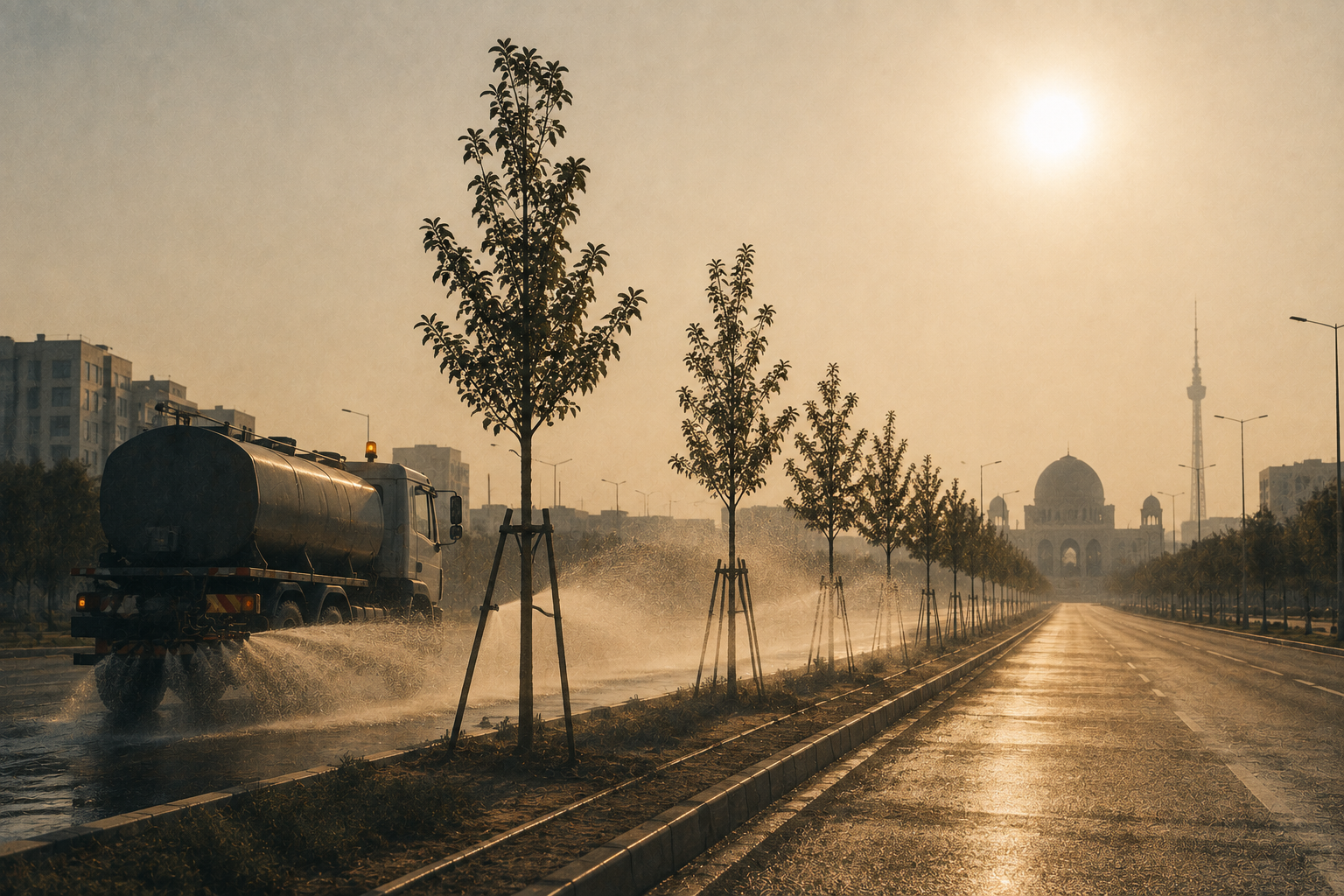
The 16 July measures, per the National Committee on Ecology and Climate Change, put watering of trees and greenery on an intensified schedule in every region, run in morning, evening and night hours to cut evaporation. Tashkent’s central streets have been watered since the week’s start and the fountains switched to non-stop operation; kindergartens stand suspended in Karakalpakstan and Khorezm and in parts of Navoi region, and Surkhandarya has limited daytime truck traffic.
The escalation tracks the forecast rather than outrunning it: Uzhydromet’s extreme warning holds through 17 July, with +41 to +43 across most of the country and +44 to +46 in the north, south and desert zone. CAW’s Monday piece called the week a load test for the power system, and the first result arrived Wednesday, a national electricity-consumption record.
The watch items carry over: whether the record peak produces localized outages in the Aral-zone districts where the closures started, what the heat does to the irrigation draw in the census-revised fields, and whether the emergency footing outlasts Friday’s formal end of the warning. A state that waters its trees at night to save evaporation is a state doing arithmetic with water, and that arithmetic is the region’s standing story.