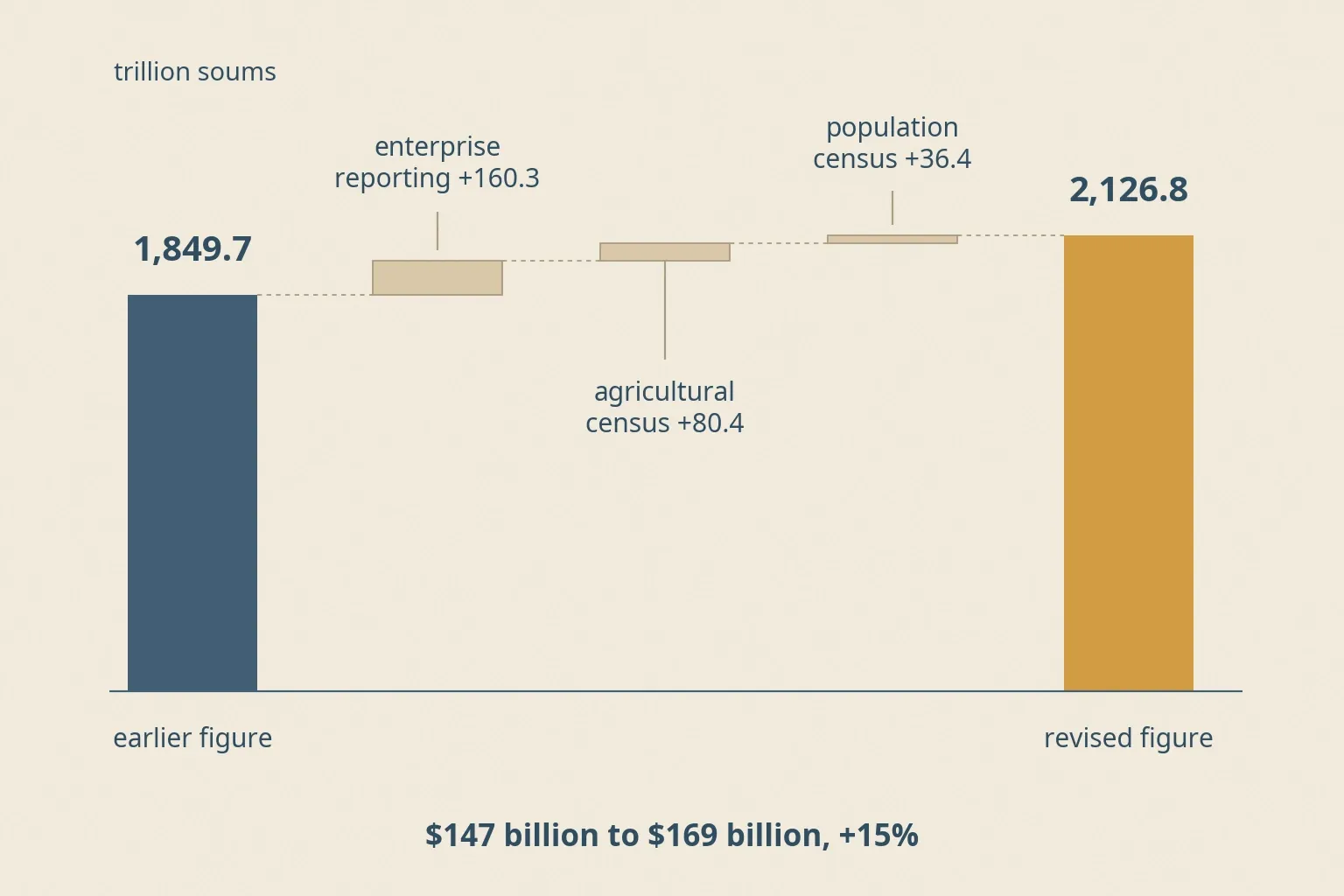
The revision covers every year from 2017 to 2025, annual and quarterly, Gazeta.uz reported from the committee’s press conference. Nominal GDP for 2025 is now 2,126.8 trillion soums against the 1,849.7 trillion published earlier, a difference of 277.1 trillion soums, or $22 billion. The dollar figures imply a rate of about 12,600 soums to the dollar, by CAW’s arithmetic.
Deputy chairman Zohidjon Ziyayev told reporters the higher number should not be read as extra growth. It is the result, he said, of a more complete and accurate count of economic activity. Real growth for 2025 moves from 7.7% to 7.8%.
Three sources explain the gap. Updated reporting by enterprises and organisations adds 160.3 trillion soums, or 57.9% of the difference. The first general agricultural census adds 80.4 trillion, and the population census 36.4 trillion.
Sorted by sector, services account for 138 trillion soums of the addition, almost half, industry for 52.9 trillion, farming, forestry and fishing for 44.6 trillion and construction for 41.6 trillion.
Trade, a service, shows the most visible change. Reporting forms in force since 1 January 2026 let the committee compute trade margins from sales, purchase costs and stocks, where it had relied on mark-ups the firms declared.
The output of trade services for 2025 rises from 165.9 trillion to 260.1 trillion soums, or by 56.8%. Output is a gross measure, and Gazeta.uz’s account does not say how much of that rise reaches GDP.
Housing is where the population census enters the accounts. The count found 1.032 billion square metres of housing at the end of 2025 where administrative records showed 734 million, about 41% more, because it recorded rooms and buildings that owners had added without registering them. Floor space per person rises from 19.4 to 26.7 square metres.
That feeds two lines of the national accounts: construction that households carry out for themselves is revalued from 60.5 trillion to 80.7 trillion soums for 2025, and the imputed rent of owner-occupied homes from 83.9 trillion to 112.5 trillion. Imputed rent is a statistical convention and involves no payment or new tax, the committee said.
The farm census cut as well as added. It found about 985,400 hectares that the statistics had missed, and crop output is revised up by 19.6%. It also found almost 2.3 million fewer cattle than the statistics carried, and beef output is revised down by 13.1% and milk by 19.2%.
Output per head rises as well, since the economy is revised up by 15% and the average population for the year only from 37.9 million to 38.7 million. GDP per capita for 2025 goes from $3,881 to $4,373, a rise of 12.7% by CAW’s arithmetic.
Earlier years move similarly. The 2017 figure rises by 15.7%, the largest relative change, and 2024 by 14.3%. Growth rates barely shift: the biggest change is for 2022, from 6.1% to 6.4%, and 2024 stays at 6.7%.
The census itself put the permanent population at 39,047,321 on 15 January 2026, against a running estimate of 38.24 million for 1 January and about 19.9 million at the Soviet count of 1989. The urban share is revised from 50.9% to 54.5%, and life expectancy at birth from 75.4 to 76.4 years. Ziyayev put such gaps down to the absence of a full count since 1989, Gazeta.uz reported.
Every ratio measured against GDP now has a larger denominator. Gazeta.uz’s account of the press conference gives no revised figure for public debt or the budget deficit as a share of GDP and carries no comment from the IMF, whose experts’ recommendations the work took into account, according to the same report.
Further revisions are possible. Umarjon Obidov, who heads the committee’s national accounts department, said a market-price valuation of property now under way in Tashkent would change the value of imputed rent once data exist for every region. A census of businesses is still to be completed, and the committee said a new recalculation would depend on what it finds.