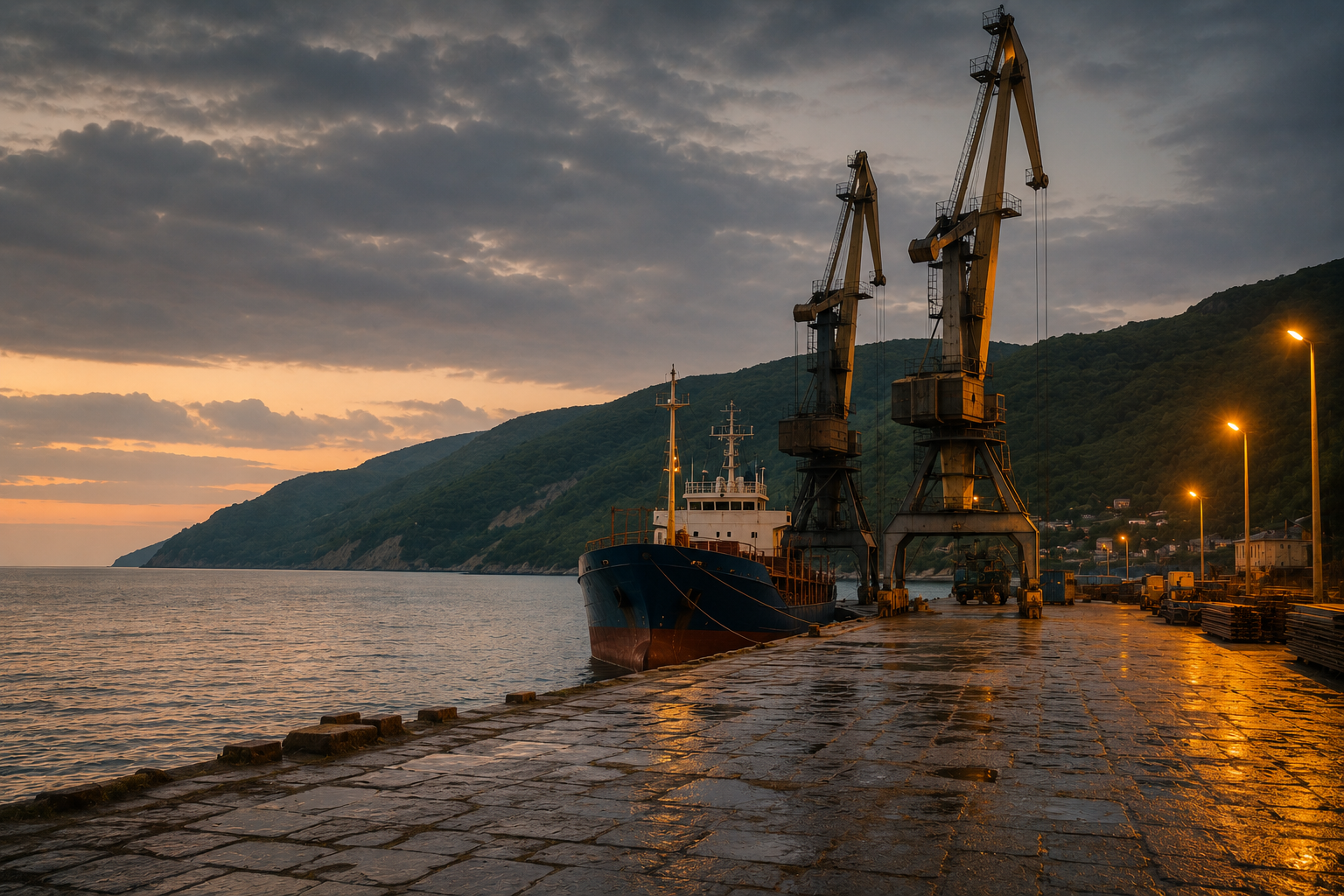
The line came in the president’s speech to the Turkmen-Georgian business forum, in the state agency TDH’s own text: negotiations are underway on a Turkmen cargo terminal on the Georgian coast, and the business communities of both countries are invited to build it as a public-private partnership. The same speech set the frame Ashgabat wants read alongside it: a 2026 Investment Program targeting 6.3% GDP growth, and the start of the fourth phase at the Galkynysh gas field.
The sequence is nine days long. On 9 July Turkmenistan opened talks with the Dutch dredger Damen on Turkmenbashi port, against a Caspian down roughly 2 meters since 2006. Its joint commission with Azerbaijan has named Turkmenbashi to Baku as the transit spine, so far as protocol. Now a terminal of its own at the corridor’s Black Sea mouth. Three moves, one east-west line.
A negotiation is a promise, smaller even than a signed page.
The skeptical register applies in full. No port is named, no operator, no financing, no tonnage. Georgia’s harbors differ sharply in depth, ownership and politics, and which one Ashgabat means will decide most of what this is worth. Conversion looks like a named site, a concession term, a first tender.
The posture is still new information. Turkmenistan has monetized its geography eastward, as gas to China, for a decade and a half. A westward freight bet priced in its own infrastructure is a different posture, and it lands in the same month war risk repriced the southern route through Iran. If the terminal converts, the region’s most closed economy joins the Middle Corridor as an owner of gates, with the pricing power that brings.