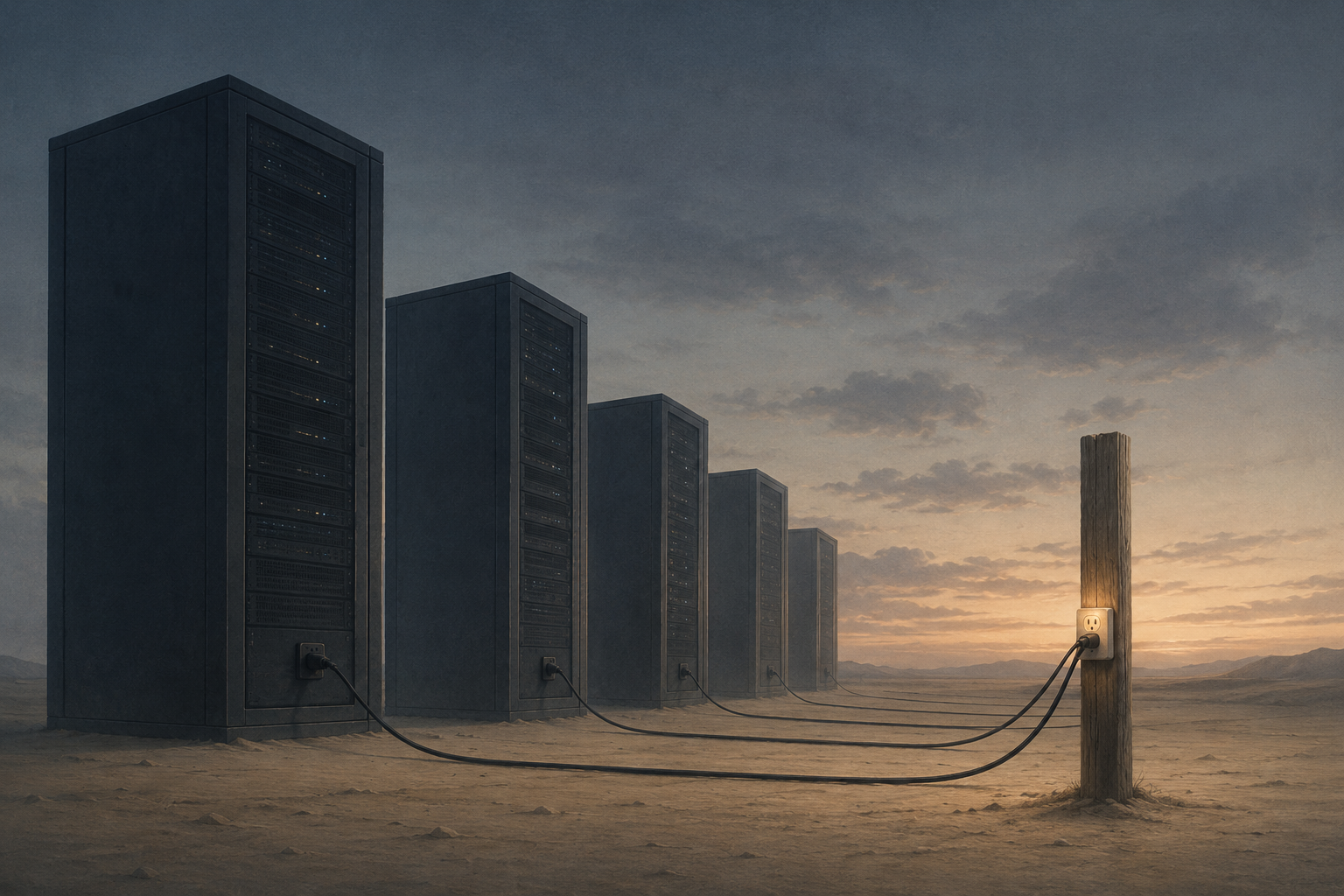
Between 27 June and 2 July, Kazakhstan joined a US-led bloc on artificial intelligence and critical minerals, hosted a company scoping a 1 GW data centre, broke ground on a $1.4 billion wind farm marketed as power for future server halls, and told its Foreign Investors’ Council that the national future is AI and digital sovereignty. Last winter, on the grid operator’s own forecast, the power system was 0.9 GW short at peak, with the gap covered from Russia and Uzbekistan. Both sets of facts are official. They describe the same country.
The promises first, because they are specific and recent. On 27 June Kazakhstan acceded to Pax Silica, Washington’s attempt to organise an AI and minerals bloc. SuperX is considering a 1 GW AI data centre. Alatau City carries a $6 billion agreement with Shenzhen. An Ekibastuz “Data Center Valley” is due online in 2027. On 30 June, Masdar broke ground in Zhambyl region on 1 GW of wind tied from the outset to data-centre demand. And on 2 July the 38th Foreign Investors’ Council met under the theme of artificial intelligence and digital sovereignty, where the president presented all of it as a single doctrine: compute, refined minerals and algorithms, assembled on Kazakh soil.
Now the other ledger, from the same official sources. In 2025 Kazakhstan generated 123.1 billion kilowatt-hours and consumed 124.6 billion; imports covered the difference. At the winter peak, available generation was about 16.7 GW against a load of 17.6 GW. Nameplate capacity stands at 26.7 GW; much of the 10 GW between the plate and the plug is age and repairs. The energy ministry’s forecast put the 2025 deficit at up to 5.7 billion kWh, narrowing through 2026 if large projects stay on schedule, reaching self-sufficiency in 2027 and surplus by 2029.
Hold those two dates together. The surplus is promised for 2029. The first data-centre campus is promised for 2027, in Ekibastuz, with others queued behind it. If both schedules hold, the demand arrives 2 years before the cushion.
The unit math is unforgiving in a quiet way. A 1 GW campus running around the clock draws roughly 8.8 billion kWh a year, about 7% of everything Kazakhstan generated in 2025 and more than the ministry’s worst-case national deficit. The single project SuperX is discussing would, by itself, consume the planned surplus of the early 2030s. Wind will not close that gap alone: a 1 GW wind farm delivers a fraction of a gigawatt around the clock, and a server hall wants its power flat, day and night, in January.
On current schedules, the compute arrives most of a decade before the reactors that could feed it.
The baseload answer has a date, and the date is far. The Balkhash nuclear plant, two VVER-1200 units totalling 2.4 GW, was formalised in an intergovernmental agreement during President Putin’s visit in May; Rosatom leads the consortium, and Russian export credit is reported to cover about 85% of the $16.5 billion cost. Construction is planned from 2027; first power is scheduled for the mid-2030s. On current schedules, the compute arrives most of a decade before the reactors that could feed it.
Most observers stop at this arithmetic and score the projects as likely or unlikely. The more consequential question sits one level down. When supply runs short, allocation becomes politics, and the region has already shown what electricity politics looks like. In June, officials in Turkmenistan’s Mary region were dismissed after residents protested daily blackouts in 40-degree heat, amid claims that supply had been diverted to paying commercial customers. Kyrgyzstan has run an official energy-emergency regime since 2023. A data centre with a 20-year supply contract on the same feeder as a residential district turns every hot evening into a question of priority. Governments that answer blackouts by dismissing local officials will find a foreign-owned server hall a far harder thing to explain.
The arithmetic hides a second thing: where digital sovereignty plugs in. The week’s stack is sovereign in name and imported in every layer. Gulf capital sits in the wind, Chinese hardware in the halls, American bloc rules over the chips, and a Russian state loan under the only baseload on the drawing board. Every financier of generation acquires a quiet claim on the compute above it. The grid is where multi-vector policy will settle its accounts, kilowatt by kilowatt.
Sketch 2031 as scenario rather than forecast. In the first version, the schedules slip together: the surplus arrives late, the campuses arrive late, and Kazakhstan backs into balance, selling power and compute both. In the second, the compute lands first, and the halls run on rising imports from the Russian north; the sovereignty pitch then rests on the goodwill of the neighbour it was designed to dilute. In the third, conversion fails quietly on both sides: the memoranda age, the turbines feed the ordinary grid, and the AI decade is remembered as a well-organised council theme. The first version requires nearly everything named in this column to happen on time. The region’s record with signed pages counsels patience.
The doctrine itself is defensible. Kazakhstan holds real advantages: land, cold winters that computing likes, uranium, cheap northern generation, and a state that can move permits quickly when it chooses. Grids can be built; the steppe was electrified once before, on harder terms. But sequencing is now the whole game. By 2031 the country will know which it built faster, the machines that consume electricity or the machines that make it. The question that will decide the decade is already on the table, and it is cheapest to answer now: on the evening the power runs short, who gets it?
Adrian Cross writes the weekly column Five Years Ahead for Central Asia Wire. The views expressed are his own.