Both accounts describe one meeting, a sitting of the Russian-Mongolian Expert Group at the Academy in Moscow on 19 November. Montsame, citing the project team, wrote that the participants “concluded that the project is feasible to implement” and handed the Academy a final report.
The Academy’s press service describes preliminary results. Bychkov, who directs the Matrosov Institute of System Dynamics and Control Theory in the Academy’s Siberian Branch, said the report sums up two years of work and holds detailed calculations for the design agreed with the Mongolian side. The research is to continue in 2027 and 2028.
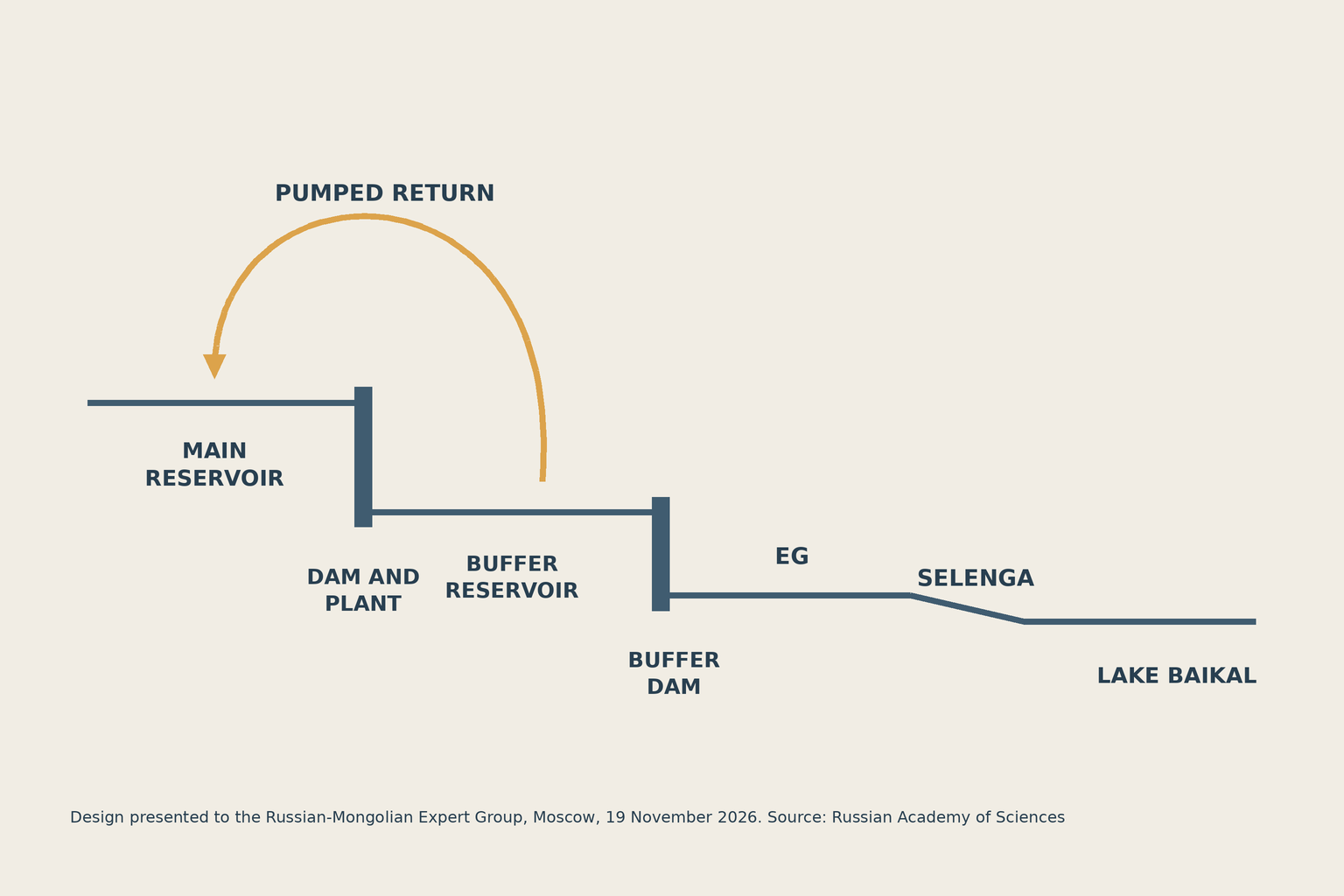
That design has changed since 2016 and 2017, when an assessment by the Irkutsk Scientific Centre found possible risks. Besides the dam and its main reservoir the project now has a buffer dam with a reservoir of its own, and pumps that return water from the buffer reservoir to the main one.
With such a scheme it is technically possible to keep the regulated flow close to the natural one, Bychkov said, and if that holds the risks to the environment, Lake Baikal included, are minimised. He added that further studies are needed.
The work included six joint expeditions in two years, four on biota and two on hydrology and river morphology, with scientists of both countries using the same equipment and methods. The research identified a number of significant effects: higher winter flows, a lower and smoother spring flood peak and a change in water temperature.
These can substantially affect aquatic organisms, spawning grounds and the ecosystems of the floodplain and the delta, the release says, and the most sensitive periods are the low water of autumn and winter and the spring flood.
The study showed that environmental requirements can be met for the proposed technical solutions, the Academy says, if the flow is regulated and the plant’s operating regimes are set accordingly, and on condition that no water is withdrawn from the river irretrievably. Confirming this requires additional research.
Montsame describes a 315-megawatt plant on the Eg river, the Egiin Gol of the project’s name, in Bulgan province, with a dam 103 metres high and a reservoir of 5.7 billion cubic metres. Its report says the plant will also supply water to mining operations, industry and residents in the Gobi. The Academy’s release mentions no such use.
Mikhail Bolgov of the Academy’s Institute of Water Problems, executive secretary of the Russian part of the group, told the meeting that there is no clear method for assessing the environmental impact. Different models usually give different results and the documents should record that, he said. Russian and Mongolian experts confirmed that their modelling of the plant’s regimes on different models gave close and consistent results, the release adds.
Still ahead are a scientific basis for monitoring every stage of the project, hydrological and hydrobiological studies in winter, spring and summer to catalogue the spawning grounds in the Selenga’s main channel, and measurements of evaporation from the reservoirs and from stretches of the river in both countries. A study of seismic conditions at the reservoir and the plant is on the Academy’s list of research still to be done.
Rules for operating the reservoir that take environmental requirements into account, and proposals for managing the plant’s regimes across the border, are also needed, according to Bychkov.
Natural Resources Minister Alexander Kozlov said the two academies must make the right strategic decision about how people are to live and develop in the area. In closing he called for decisions that are economically grounded and take seismic requirements into account, and for the scientists’ work to continue beyond recommendations.
S. Odontuya, the member of Mongolia’s parliament whom Montsame names as the project’s initiator, said the question had shifted from political dispute and years of conjecture to scientific study.
Academy president Gennady Krasnikov tied the work to a memorandum on protecting Lake Baikal and the Selenga that the two countries signed in September 2024, during Vladimir Putin’s official visit to Mongolia.
The Eg feeds the Selenga, which brings Lake Baikal about half its river inflow. Mongolia’s environment ministry announced the handover of the report on 19 November and said favourable conditions were forming to start the project, as CAW reported on 20 November.
The group’s recommendations go to the 28th meeting of the Russian-Mongolian intergovernmental commission, in Moscow on 15 to 17 December. Russia’s own report on the state of Lake Baikal is due at UNESCO’s World Heritage Centre by 1 December.