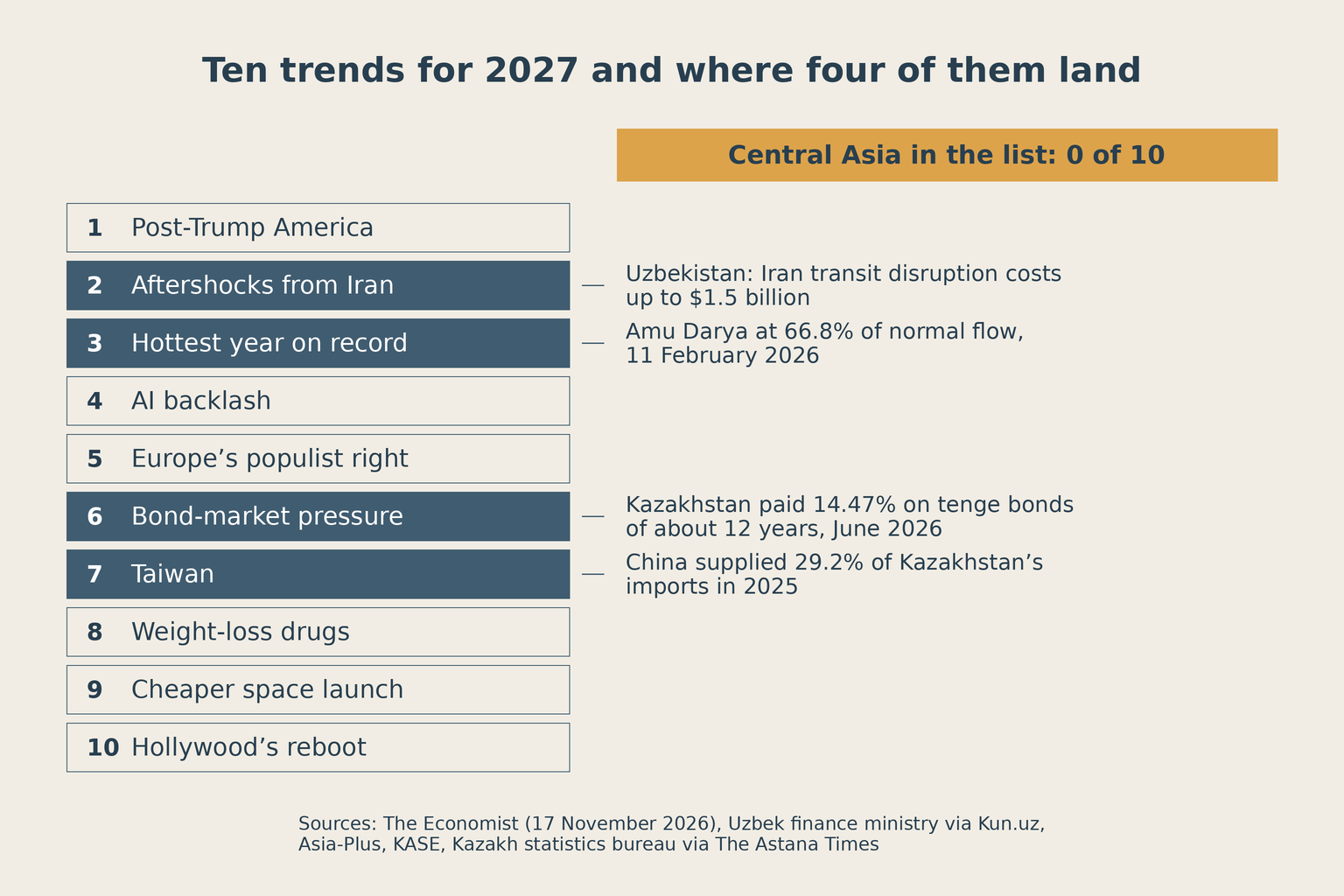
Tom Standage, editor of The World Ahead, set out the list in a letter published on 17 November. Its other six entries are the post-Trump era in America, a backlash against artificial intelligence, the populist right in Europe, weight-loss drugs, cheaper space launches and Hollywood’s reboot.
Neither Central Asia nor Russia is named in the letter. The edition’s country forecasts, dated 18 November, cover 81 economies and include Kazakhstan, with growth of 4.3% in 2027, and Uzbekistan, with 6.1%, while Kyrgyzstan, Tajikistan and Turkmenistan have no entry. How the four trends reach the region is set out in other documents: the forecasts of the IMF and the EBRD and the governments’ own numbers.
The region’s baseline is a slowdown from a high level: in its September forecast the European Bank for Reconstruction and Development has Central Asia, with Mongolia in the aggregate, growing 5.8% in 2026 and 5.3% in 2027. The IMF’s October tables put Kazakhstan at 4.9% and Uzbekistan at 6.5% in 2027, both above The Economist’s figures, and Kyrgyzstan at 7% and Tajikistan at 6.8%.
Only the Iran war is already written into the region’s forecasts and budgets. The IMF assumes oil at $95.74 a barrel in 2026 and $87.39 in 2027, and its baseline has the Strait of Hormuz starting to reopen in March 2027 and back to prewar conditions by October, The National reported on 13 October. The other three trends arrive through water, interest rates and trade with China.
Kazakhstan’s exposure is the oil price and one export route. Allianz Trade, the credit insurer, projects the 2026 budget deficit narrowing to 2.7% of GDP, an outcome it ties to oil above $85 a barrel and withdrawals from the National Fund, the state’s oil savings. About 80% of Kazakh crude leaves through Novorossiysk, where Ukrainian drone strikes on tankers from 17 to 20 July suspended loadings and, by the insurer’s account, led Kazakhstan to halve its daily output.
The insurer estimates that a shutdown of four to six weeks on that route could widen the deficit by 0.5 to 1 percentage point of GDP. Kazakhstan’s oil and gas output fell 8.9% in January to July after disruptions on the Caspian pipeline route and incidents at the Tengiz field, by the EBRD’s count. Direct trade with Iran is small, about $430 million in 2025 or roughly 0.3% of Kazakhstan’s total trade, The Times of Central Asia reported.
The crossings on Turkmenistan’s 1,148 km border with Iran were open in March only for the evacuation of third-country nationals, Asia-Plus reported, citing RFE/RL. Turkmen gas no longer moves through Iran to Turkey: the Turkish energy minister, Alparslan Bayraktar, told Middle East Eye in November that the imports stopped because of the US Treasury’s sanctions office, and a swap to Iraq stalled without Washington’s approval, according to The Times of Central Asia.
Uzbekistan has put a price on its exposure. Its fiscal strategy for 2027 to 2029 counts $3.9 billion of 2025 imports, about 9% of the total, and $1.4 billion of exports moving through Iran, and puts the cost of disruption at $1 billion to $1.5 billion, or 0.7% to 1% of GDP, Kun.uz reported in August. About 30% of Uzbek cotton exports use Iranian routes, the outlet reported in March.
Fertiliser is the part of the Iran bill that falls due in 2027. Prices stabilised about 30% above their 2015 to 2017 average, the EBRD said in September, and it expects the full effect on farm costs in 2027. The Economist’s letter expects the war’s aftershocks to keep “reconfiguring energy flows and threatening food security, with fertiliser in short supply”.
Kazakhstan produces no urea and imports it, Fertilizer Daily reported in June, and the government’s answer, an ammonia and urea complex at Aktau, is due in 2030. Fertiliser prices in Kyrgyzstan had risen 10% to 20% by early April, with Uzbekistan the main supplier, the business site Akchabar reported. Uzbekistan is on the selling side: EU buyers took $233.5 million of its fertiliser in 2025, by UN Comtrade figures that Fertilizer Daily cited, and Tashkent wants $500 million a year.
The third trend is a record-hot year. On 9 November the World Meteorological Organization said the current El Niño is expected to be the strongest on record by December and to last into early 2027, and its secretary-general, Celeste Saulo, has told the world to “prepare for another record-breaking year in 2027”.
In Central Asia a hot year is a question of water. The Amu Darya entered 2026 short: on 11 February it carried 66.8% of its normal flow, against 101.8% a year earlier, by regional water-commission figures that Asia-Plus reported. The Tuyamuyun reservoir on the same river held 4,349 million cubic metres a day earlier, against 4,959 million a year before.
Uzbekistan draws 80% of its water from beyond its borders and spends 90% of it on farming, bne IntelliNews reported in June. A second claim on the river has a date: Afghanistan’s Qosh Tepa canal, due for completion in 2028, is expected to take 16% to 20% of the flow that passes Tajikistan, according to The Times of Central Asia.
Bond-market pressure, in The Economist’s telling, is a rich-world problem of rising borrowing costs, and the IMF’s October outlook warns of “elevated debt, rising sovereign yields” worldwide. Central Asia comes to it with little debt: the IMF projected in April that public debt across the Caucasus and Central Asia, taken together, would stand at 23.4% of GDP in 2026. The EBRD found in September that sovereign spreads, which widened across its regions in March, were back at or under their prewar levels in most of its economies.
The exposure is the price of new borrowing, and Kazakhstan borrows cheaply in dollars and dearly in tenge. Its five-year Eurobond of October 2025 was sold at 4.412%, a record low and 85 basis points over US Treasuries, The Astana Times reported, citing the finance ministry. In tenge the ministry paid 14.47% in June 2026 for bonds of about 12 years, and the overnight rate stood at 15.80% in late October, according to Kazakhstan Stock Exchange data.
A bond priced over Treasuries moves with them, which is how rich-world yields reach Astana. The finance minister, Madi Takiyev, said on 25 June that the state planned up to $1.5 billion of Eurobonds and up to $500 million of yen-denominated Samurai bonds by the end of 2026, Interfax-Kazakhstan reported.
Uzbekistan’s terms have improved. It sold soum bonds abroad at 12.25% in April, the economy and finance ministry said, after 15.5% in 2025 and 16.625% in 2024. ING’s chief economist for the region, Dmitry Dolgin, expects markets to price Uzbekistan as investment grade before the rating agencies do, from a rating two notches below that level.
The Taiwan trend rests on reports that Xi Jinping has set 2027 as the date for China’s armed forces to be ready, and for Central Asia the question is concentration. China supplied 29.2% of Kazakhstan’s imports in 2025, level with Russia’s 29.7%, by the national statistics bureau’s figures. In Kyrgyzstan it accounted for 31.4% of all foreign trade, exports and imports together, by the Eurasian Development Bank’s count.
China’s ambassador, Ji Shumin, has put Turkmenistan’s gas exports to China in 2025 at 30 billion cubic metres, and Gurbanguly Berdimuhamedov, who chairs the People’s Council, has told Chinese television the figure is about 40 billion a year, according to the Jamestown Foundation. The EBRD lists weaker Chinese demand first among the downside risks for Turkmenistan and among the key ones for Mongolia.
A crisis in the Taiwan Strait would reach Kazakhstan through the supplier of 29.2% of its imports and Turkmenistan through its main gas buyer. The letter asks whether Beijing will wait for Taiwan’s elections in 2028.