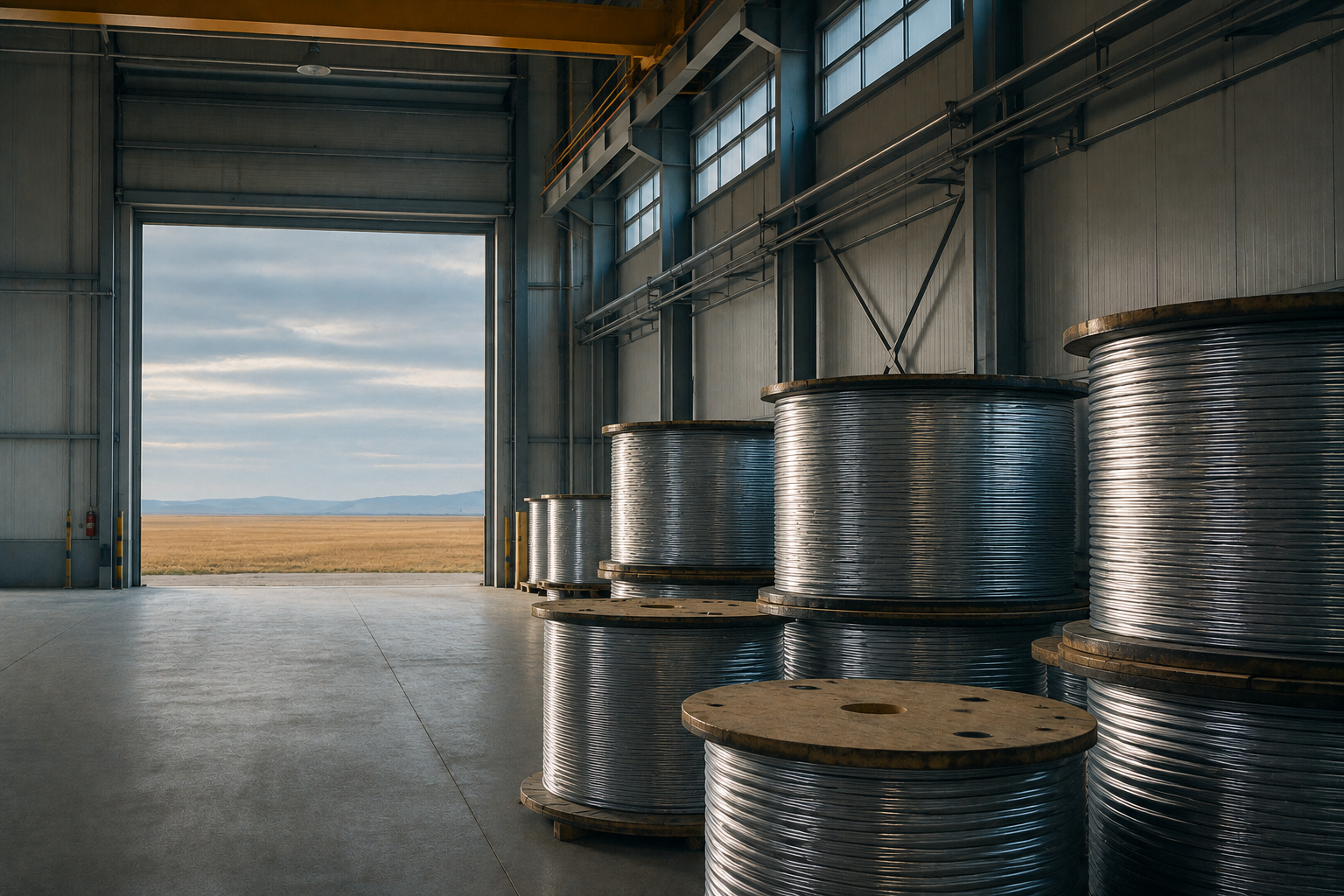
Rusal, the largest aluminium producer outside China, plans to build a cable and wire plant in Mongolia, Central Asia Wire has learned. Investment is put at about $20 million, with annual capacity of 4,500 tonnes of finished product and a second phase of the same size envisaged.
The plant would sit near Ulaanbaatar and create 150 jobs. The product range covers flexible power cables with aluminium-alloy conductors, as well as bare aluminium-alloy conductors, all destined for the domestic market: Mongolia’s power, mining and construction sectors.
The plant would run on aluminium wire rod supplied from Russia. Its planners frame the project as final-stage processing that keeps added value inside Mongolia and as a step in Russian-Mongolian economic cooperation; for Rusal it would open a new sales market. The developers say the technology chosen would rule out harmful environmental impact.
Imports of finished cable would be partly replaced by imports of Russian wire rod.
Mongolia remains heavily reliant on imported cable despite earlier attempts to establish local production. China reported nearly $68 million of exports to Mongolia in 2024 under HS 8544, a broad category covering insulated electrical conductors and optical-fibre cables, UN Comtrade data show.
Demand is likely to grow as Mongolia expands and modernises its power network. Peak electricity demand has risen by an average 5.7% a year since 2000, and the government forecasts annual growth of 10.5% through 2035. Nearly 22% of the electricity supplied in 2023 came from Russia, according to the World Bank, and the generation fleet is dominated by combined heat and power plants whose newest unit is more than 40 years old.
Rusal has a close precedent at home. Its Bogoslovsky cable plant in Russia’s Sverdlovsk region, a 50/50 venture with the ELKA-Kabel group set up in 2016, was built for about $19 million around 4,300 tonnes a year of Rusal-supplied wire rod, and makes the same class of product, from flexible power cable to self-supporting insulated wire. The Mongolian numbers, $20 million and 4,500 tonnes, track that template almost exactly.
The company is under pressure to find new outlets. Rusal posted a $455 million net loss for 2025 as costs rose; the EU’s import quota for Russian primary aluminium stands at 50,000 tonnes through 31 December, and only for contracts signed before February 2025. Asia already provides over half of Rusal’s revenue.
For Mongolia, the plant would localise downstream manufacturing rather than eliminate external dependence: imports of finished cable would be partly replaced by imports of Russian wire rod. It would also deepen an economic relationship that already includes the jointly owned Ulaanbaatar Railway, Russian electricity and fuel supplies, and plans to modernise Ulaanbaatar’s TPP-3 power plant.
Rusal has so far made no public comment on the project.