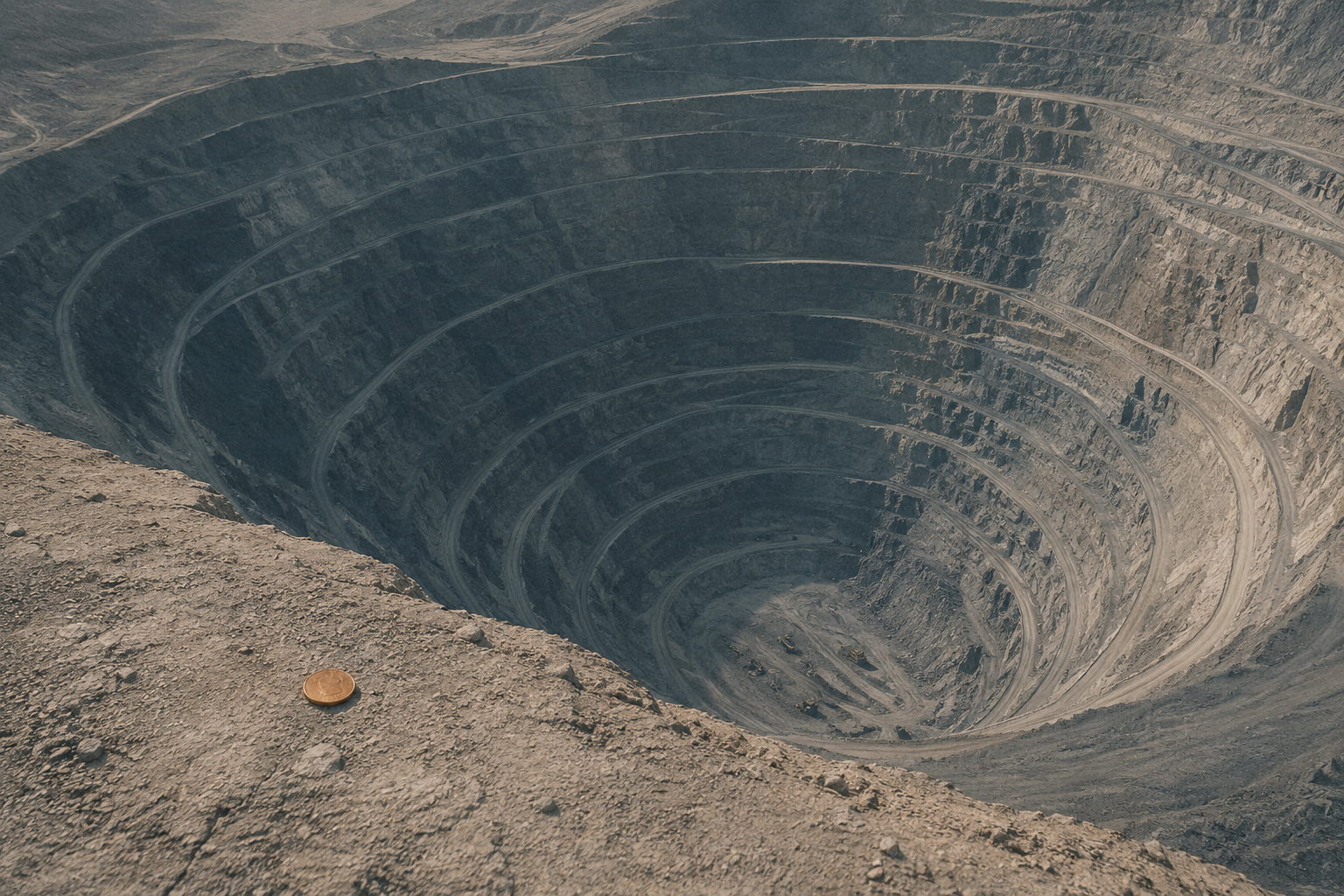
Rio Tinto and the government said on 30 June that they had agreed to adjust the interest rate on the Oyu Tolgoi shareholder loan, following the halving of management fees agreed in principle in May. The two sides also promised to work together on the Entrée lease areas and to bring forward distributions to shareholders. Rio's copper chief, Katie Jackson, cast the change as a forward-looking read of a project moving to lower-risk, steady-state operation.
Weigh that against the list Ulaanbaatar has carried since 2025. The government and parliament demanded a benefit share above the original 53% target, with some voices pressing for 60%, a sharp cut to the loan rate, management independence for Oyu Tolgoi from 2030, dividends paid by 2026, the Entrée licences settled under Article 6.2 of the constitution, and export revenue routed through Mongolian banks. Set beside that, a rate adjustment and a fee cut is the slice that was reachable.
On the rate itself the record is thin, and we will not fill it with invention. Neither Rio Tinto's statement nor the government named the new figure. A legal reading published by the Mongolian site gogo.mn on 2 July warned against claiming the rate had fallen to any given number, because none was stated. The figure that has since circulated, a cut of about 2.5 percentage points, comes from secondary financial coverage rather than either party, while the protest demands that preceded the deal had called for the rate to drop from above 11% to below 6%. The public is left comparing a loud demand with a result nobody has quantified.
The structure the critics attack is still standing. Roughly $16.3 billion of Oyu Tolgoi's $20.2 billion in debt is shareholder loans from Rio Tinto. A lower rate trims the cost of that pile; it does not shrink it. The tax dispute over the 2013 to 2015 assessment, worth about $155 million, has sat in London arbitration since 2020. A 2023 report by the Centre for Research on Multinational Corporations accused Rio of cutting withholding tax by $232 million through Dutch and Luxembourg structures, a suspicion Rio calls unfounded. A government working group reviewing the project has calculated that, under the base agreements, Mongolia would see no dividends until 2051 and would stay around $22 billion in debt.
Read the timing, because that is where the meaning sits. Parliamentary elections fall in 2027, and resource nationalism is the loudest note in Mongolian politics. A government needed a win it could hold up, and a 66% owner offered one it could afford: cheaper money and smaller fees leave the core economics intact, the ownership split, the loan architecture, the timing of the underground ramp-up. One member of parliament, S. Ganbaatar, went on hunger strike to demand a counterclaim against Rio. The working group meant to renegotiate, by its own critics' account, barely met.
The victory lap is aimed inward.
What moved is the cost of the debt and, for now, the heat of the argument. The shape of the bargain struck in 2009 and 2011, when Mongolia negotiated from weakness after the financial crisis, held. Copper near record prices and a planned 500,000 tonnes a year from 2028 give Ulaanbaatar a stronger hand than it had then. This deal spent a sliver of it.
For the region the signal cuts both ways. Host states from Mongolia to Kazakhstan are pressing foreign majors to share more and to process at home, and high copper and uranium prices give them the moment. Oyu Tolgoi shows the reach of that pressure and its ceiling at once: a major will trade margin at the edges to keep the centre of a deal intact.
The real test comes next. It is whether the government turns record copper and its 34% stake into the benefit share, the dividends and the tax settlement it says it wants, before the 2027 campaign turns the mine into a slogan again. On 30 June it took the win that was on offer. The questions it raised itself are still open.