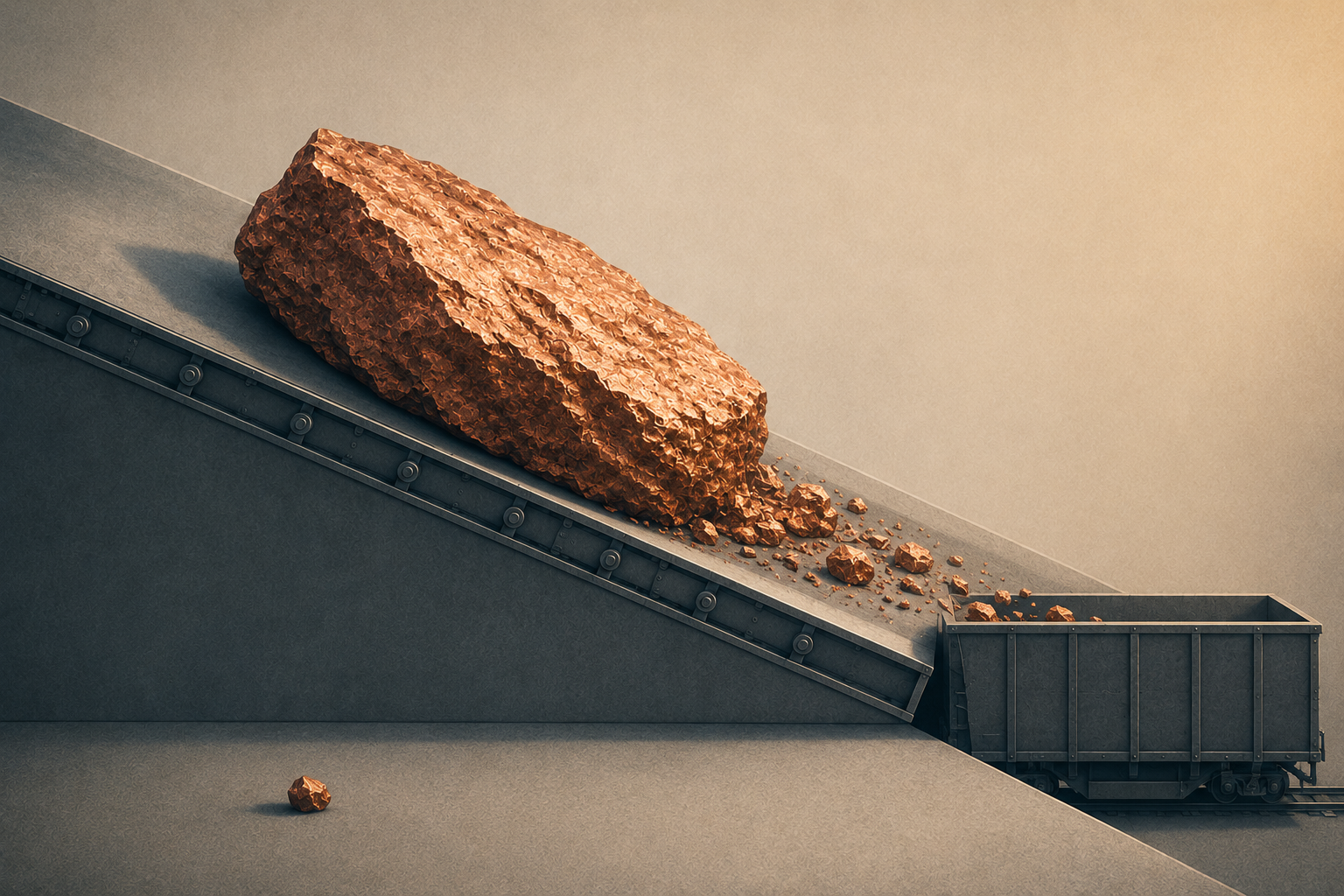
On 17 June a white banner reading "Stop Rio Tinto" hung from a tree branch over a two-lane highway in the Gobi. Behind it, a wall of stacked tires. In front of it, trucks loaded with copper concentrate, idling, unable to reach the Chinese border. A few dozen people from a group called the Radical Reform Movement had closed one of the most valuable export routes on the continent with rope, rubber and a bedsheet.
By the next morning the road was clear and the concentrate was moving again. The share price dipped 1.6% and recovered. Everyone went back to work. This is the form Mongolian resource nationalism usually takes: a day of theater, a flicker on a screen in London, and then the copper goes south exactly as before.
* * *
It helps to know what the protesters were standing in front of. Oyu Tolgoi is one of the largest copper deposits on the planet, on track to become the world's fourth-largest copper mine by 2030. Rio Tinto owns 66% of it and runs it. Mongolia owns 34%, through a state company, on paper.
On paper is the operative phrase. Mongolia did not have the cash to pay for its third of the mine, so it borrowed the money from its partner. From Rio. At an interest rate that has sat around 11.3%. The deal is built so the loan and its interest are cleared before the junior owner sees a meaningful dividend, and the interest compounds fast enough that the running total can outgrow the sum borrowed. Current estimates put Mongolia's first real payout somewhere in the late 2030s, possibly the 2040s.
So the structure is this. You own a third of the house. You borrowed the down payment from the man who owns the other two-thirds. You pay him interest. You also pay him a management fee, somewhere between $150 and $200 million a year, to run the house you co-own. And you are told you will start seeing rent from your own rooms at around the time your newborn finishes university.
* * *
Put that next to the placards and the whole performance comes into focus. Every Mongolian government since the deal was signed has promised to fix it. In December the State Great Khural passed a resolution, unanimously, demanding lower interest, the management fee gone, a larger share of the benefit, export revenue routed through Mongolian banks, an investigation into how the contracts were awarded. Parliament keeps a standing committee on the single mine. It has called hundreds of witnesses. A Russian court has ordered Rio to pay $1.32 billion in a related dispute. None of it has yet moved the structure.
The structure does not move because it was designed not to. A loan-before-dividend deal signed by a small country that needed the capital and held no cards is not a contract that renegotiates itself because a crowd in the Gobi is angry. It renegotiates when copper is scarce and the buyer needs the seller more than the other way round. That moment may be arriving, with copper near record highs and a thin global pipeline of new large mines. But the upper hand, when it comes, will be captured by the people in the room, not the people on the road.
* * *
Whatever Mongolia claws back from Rio, the copper still has one way out of the country. Landlocked between Russia and China, the concentrate rolls to a single border. The fight over Oyu Tolgoi is loud and real and entirely about percentages. Geography settled the destination long ago. You can renationalize the math. You cannot renationalize the map.
So they will mark the anniversary this week. There will be speeches about the people's wealth, which is the correct phrase, and a fresh round of demands, which are the correct demands. The mine will keep running. The trucks will keep rolling south. And the dividend Mongolia is owed on the richest thing it owns will stay where it has sat for fifteen years: out past the horizon, payable later, to someone else's government.
You do not hold an anniversary for a problem you solved. You hold one for a problem you are still living inside.
Peter Lidovsky writes on Eurasia and the politics of the spaces between empires. He contributes a weekly column to Central Asia Wire. The views expressed are his own.