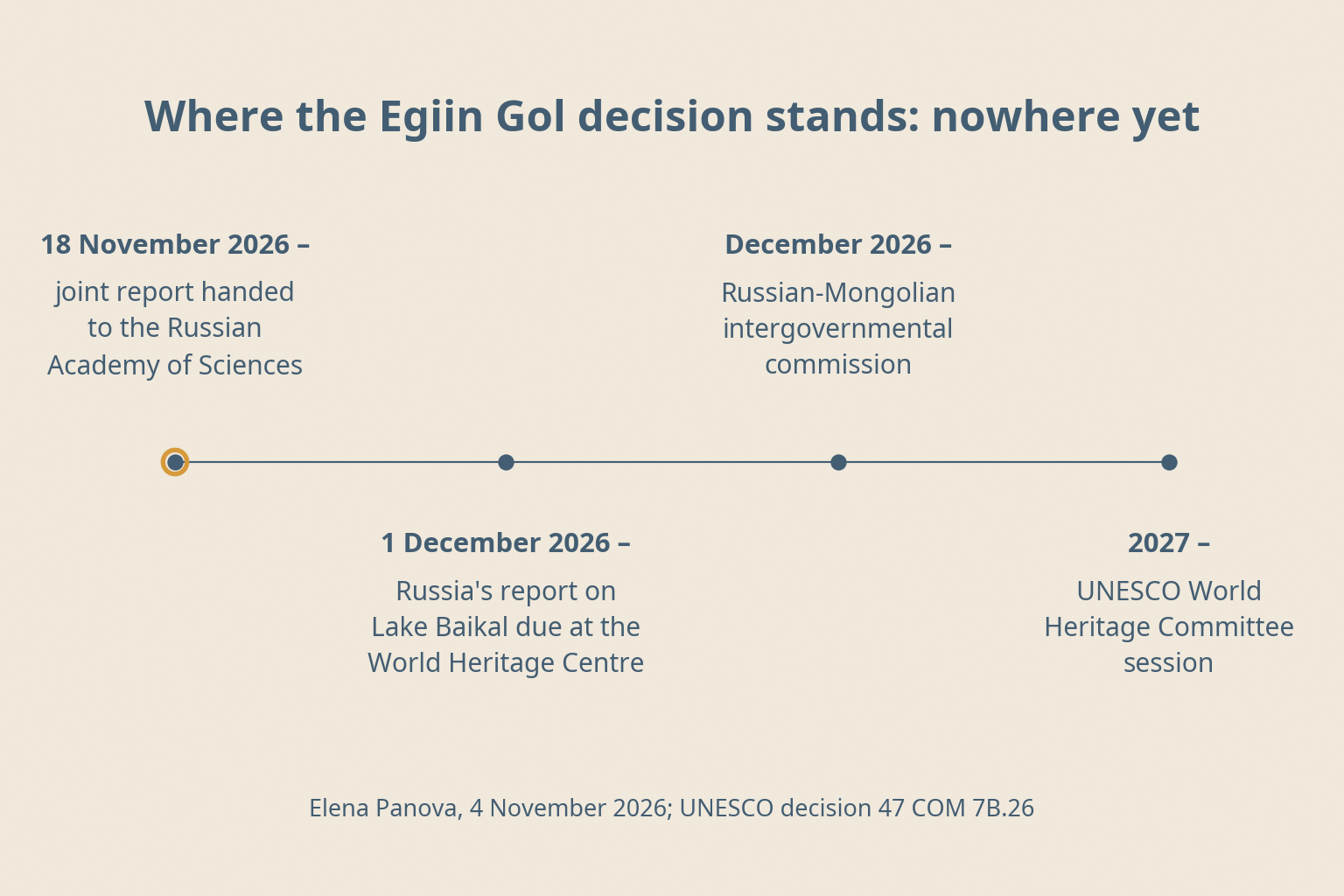
On 18 November the scientists hand their report to the Russian Academy of Sciences, Elena Panova, who chairs the State Duma's ecology committee, wrote on Telegram on 4 November. In December the report goes to the Russian-Mongolian intergovernmental commission.
Ulaanbaatar did not wait for either date. On 20 October Mongolia's Ministry of Economy and Development said at its weekly briefing that the joint study of the two academies had concluded the project "can be implemented in line with the ecological requirements of the Selenga River and Lake Baikal ecosystems", and that this created "an important basis for advancing" a project delayed for many years. What the requirements are, the ministry did not say.
The ministry was the second voice in a week. On 15 October the energy minister B. Naidalaa had told Russian Energy Week in Moscow that the dam should help protect Baikal and the Selenga, and presented no calculations to show how.
On 27 October the Mongolian Academy of Sciences published the paper behind the briefing. The joint working group, 11 Mongolian scientists under the Academy's president S. Demberel and 16 Russians under academician Igor Bychkov, met in Irkutsk on 15 and 16 October and signed a protocol. It endorses a preliminary version of the joint report and records that, on the basis of the structures and operating regime Mongolia proposed, the team found the project meets the ecological requirements of the Selenga and Baikal and agreed the plant can in principle be built.
A protocol of a working group is a recommendation by scientists. In the words of the head of the Russian expert group, academician Bychkov, their mandate is "not to allow or to ban, but to assess the impact", and the Russian team wrote in December 2025 that the study is an assessment, with the decisions left to others.
Panova's post is the one Russian official voice so far, and it goes no further than the protocol. The group's preliminary results, she wrote, confirm "the possibility in principle" of building a plant on the Eg, and which ecological requirements and technical solutions the report carries will be clear once it reaches the Academy. Russia's concern, in her words, is that a large dam could change the Selenga's flow and with it the life of Baikal.
Every decision sits elsewhere, and none has been taken. In December the intergovernmental commission sees the report. The UNESCO World Heritage Committee, which has asked about Mongolian dams since 2014, decided in 2024 that Mongolia's impact assessment must go to the World Heritage Centre for review by the International Union for Conservation of Nature before any decision on the project.
Russia owes the committee a report on the state of Baikal by 1 December, and the committee itself takes up the lake in 2027.
The protocol is public. Everything it rests on is unpublished: the full report, in either country, the ecological requirements the team says the project meets, the flow limits behind them and the operating regime Mongolia proposed.
No comment from the Russian Academy, its Siberian branch or the natural resources ministry had appeared on their news pages by 10 November.
What is at risk is the river that makes Baikal. The Eg runs into the Selenga, which rises in Mongolia, crosses the Russian border at Naushki and brings the lake about half of all the water its rivers deliver. The Baikal omul, an endemic whitefish whose commercial catch has been banned since 2017, runs up the Selenga to spawn, and its larvae drift down to the Selenga delta, a wetland protected under the Ramsar convention.
Egiin Gol is a 315 MW station on the Eg, a tributary of the Selenga, with a dam 103 m high, about 300 km from the Russian border and 580 from Baikal. It is a peaking plant: it stores water and runs the turbines when demand is highest, mainly from January to March and in the evening hours.
Mongolia's argument has always been distance. Its project presentation of June 2026 puts the dam's effect on Baikal at 0.020% to 0.023%, a share the summary does not define, and calls it imperceptible. The project's director gave the same 0.023% in 2016.
Tractebel Engineering, the Belgian consultancy that modelled the river for the developer in 2015, put the shift in the seasonal distribution of flow at no more than 1% of the Selenga's annual inflow to Baikal. The same study carries a larger number that Ulaanbaatar does not repeat. While the reservoir fills, the Selenga would bring Baikal 9% less water a year for three years in a dry period, the IUCN mission that read the study reported in 2015, adding that a longer filling period could reduce the loss.
The risk from a peaking plant lies in how it moves water around the year. It holds water back in summer, when the reservoir refills, and lets it through in winter, when the turbines run. The Melentiev Energy Systems Institute in Irkutsk, which models the river for the Russian side, projects that under the regime it examined the dam would push the Selenga's winter flow on the Russian stretch to several times the natural level, hardest at the border.
Winter is when the omul's eggs lie in the river gravel, and a stronger current can lift them off the bottom and carry them away. In summer the floodplain and the delta would see smaller floods, and the meadows along the river would dry towards steppe. These are the institute's model results for the regime it examined, and the researchers themselves call for more study and for adjusted regimes.
The institute set limits on how far the flow may swing and said holding them would be extremely hard for a plant built to chase the evening peak. The Russian team's December 2025 paper goes further: even if the limits at the border are honoured in full, natural conditions "will not be fully preserved". Mongolia is now proposing a second structure, a pumped-storage station beside the dam, to hold back winter releases, and the Russian scientists wrote that they could not go further without updated Mongolian plans and a list of the measures Mongolia will take to soften the damage.
No public account of the joint work names a single species of fish. The Eg keeps intact populations of rare fish, among them the Siberian taimen, and reaches the Selenga through land largely untouched by mining or cities, the river ecologist Evgeny Simonov has said.
In 2015 the IUCN mission asked the developer what would happen to the taimen, a large migratory predator of the Selenga, and was offered a trap below the dam and a van to carry the fish upstream. The mission wrote that it got no satisfactory answer on the return migration. Neither the Academy's protocol nor the ministry's briefing mentions the omul, the taimen or the Siberian sturgeon.
Ulaanbaatar has announced Russian consent before. In June 2016 the project's director, D. Odkhuu, said Russia had agreed the plant was safe for Baikal, and the Russian embassy in Ulaanbaatar answered through the Mongolian press that there were no grounds to say so and that the Russian delegation had no mandate to agree anything of principle.
This time there is a signed protocol. It is a document of scientists, and the governments have yet to act on it.
The hurry has not changed either. In April 2025 the prime minister of the day inspected the site and asked for faster progress, and the state news agency Montsame wrote that preparatory work to begin construction would run alongside the studies. The June presentation names the result Ulaanbaatar expects from the joint study: conditions for a favourable decision on building the plant at the next session of the World Heritage Committee.
For the report to mean anything for the lake, it has to carry numbers that can be checked against a gauge: the minimum and maximum monthly flows at Naushki, the permitted daily swing, the rule for low-water years, the filling schedule and the obligatory releases during it. It has to describe the second structure and say what happens to the fish, the shallows and the delta. The protocol says the project meets the ecological requirements, and the requirements themselves have not been published.
The Russian Academy of Sciences receives the joint report on 18 November. Russia's report on the state of Lake Baikal is due at the World Heritage Centre by 1 December.