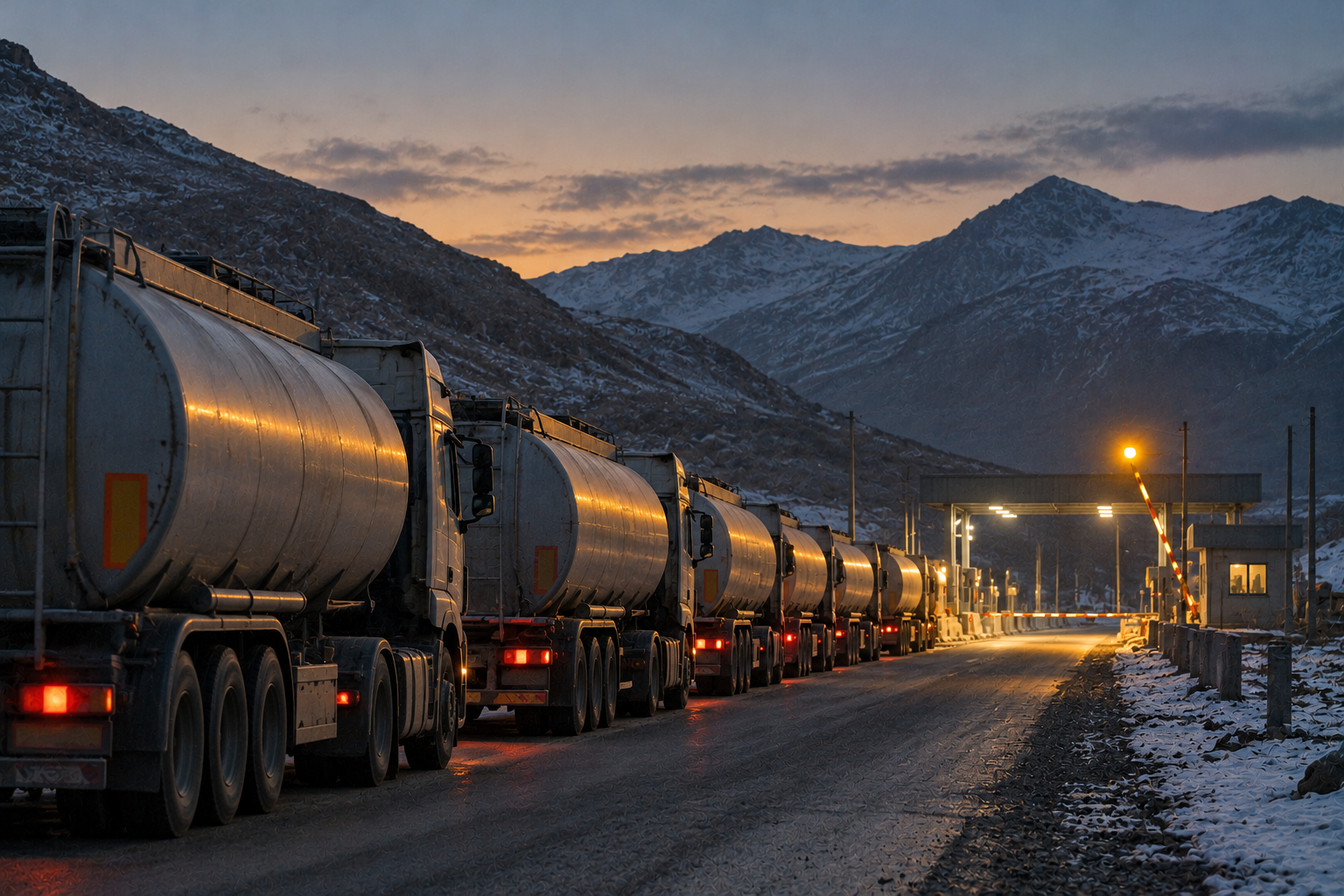
The subsidy compensates companies for the difference in the price of fuel and runs from 25 May to 31 December, with payments set by the contracts signed, the cabinet said in the Russian text kaktus.media carried on Monday evening. More than 11.389 billion som is provided in the republican budget for it, so less than a quarter has been paid out with two months of the scheme left, by CAW’s arithmetic.
The meeting, chaired by the head of the cabinet, Adylbek Kasymaliev, counted stocks of AI-92 and AI-95 petrol, diesel and liquefied gas used as motor fuel at the depots of oil traders, the Junda and Kyrgyzneftegaz plants, and in cargoes in transit, and found them sufficient to the end of the year. It gave no volumes. Kasymaliev ordered timely payment of the subsidies, a fix for logistics problems at the border, a continued search for new sources of supply, uninterrupted work of filling stations in all regions at the prices the government has set, and faster modernisation of the existing refineries and construction of new ones.
Annual consumption of petrol, diesel and liquefied gas in Kyrgyzstan is 1.4 to 1.85 million tonnes, by the cabinet’s figure. At 11.389 billion som the subsidy line comes to roughly 6,000 to 8,000 som a tonne of that consumption, by CAW’s arithmetic.
Electricity has its own limit. At a meeting with residents of Toktogul district reported by 24.kg on Monday, a villager asked Japarov to lift the 5 kilowatt cap on household consumption, above which supply is cut off, or raise it to 8 to 10 kilowatts.
Annual consumption of petrol, diesel and liquefied gas in Kyrgyzstan is 1.4 to 1.85 million tonnes, by the cabinet’s figure.
“I think another two to two and a half years will be needed,” the president answered, in 24.kg’s Russian text. “We are now building, together with investors, a 1,200 megawatt thermal power plant at Kara-Keche. After that the restrictions will be lifted. And when the construction of Kambarata-1 is complete we will, on the contrary, be able to export electricity.”
Japarov put the shortage down to rising consumption and slow construction of large plants: one large hydropower plant, Kambarata-2, built since independence, about 50 small ones since 2020, 240 megawatts added by the modernisation of Toktogul, and the 100 megawatt Kulanak plant due to start in 2027. “If we had not built schools, plants and factories, had not opened new enterprises, today we would not have had to introduce restrictions and import electricity,” he said.