The minister spoke at a government press conference in Astana on 4 November. “So far we are going by plan. 96 million are declared,” he said, in Interfax’s Russian rendering, and put next year “in the region of 99 million tonnes”, a figure still being set.
January to September production was 69.4 million tonnes, down 8.3% on a year earlier, after the attacks on the Caspian Pipeline Consortium’s infrastructure and the suspension at Tengiz early in the year, when transformers at the field’s power plant caught fire. The ministry has revised its 2026 forecast three times this year, from 100.5 million tonnes to 96 million.
On Druzhba he said the request had gone to Moscow personally. “The official request was addressed by me personally, tete-a-tete. The request has been passed on. The Kazakh side awaits the Russian side’s answer,” he said, and added that Kazakhstan has the technical capacity to resume.
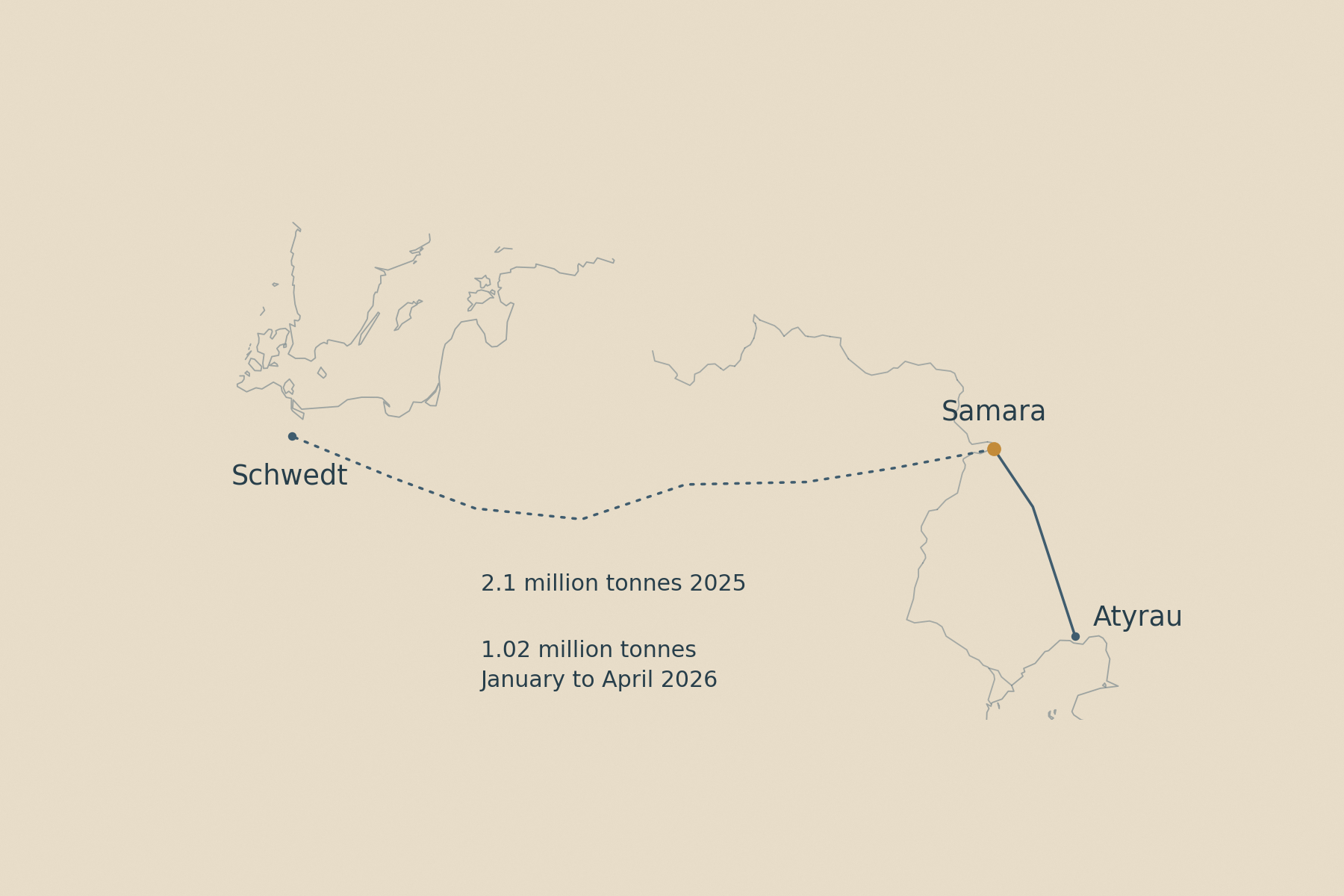
Russia stopped the transit of Kazakh oil through the Druzhba system toward Germany in May, Interfax’s background says. Kazakhstan shipped 2.1 million tonnes to the Schwedt refinery by that route in 2025, planned about 3 million tonnes for 2026 and moved 1.02 million tonnes in January to April, and the minister had said earlier that September, October and November would bring no resumption.
Refining has a number too. The three existing refineries go from 18 million to 27.7 million tonnes a year under a concept drawn up this year, with motor fuel to the K5 standard, Report’s Kazakhstan bureau reported from the same press conference, and a 2 million tonne plant in Aktobe region is under consideration for the home market and Central Asian buyers.
First Deputy Prime Minister Nurlybek Nalibayev, at the same briefing, said the country will commission about 200 new industrial enterprises worth around 1.7 trillion tenge by the end of 2026, Xinhua reported, citing Kazinform.