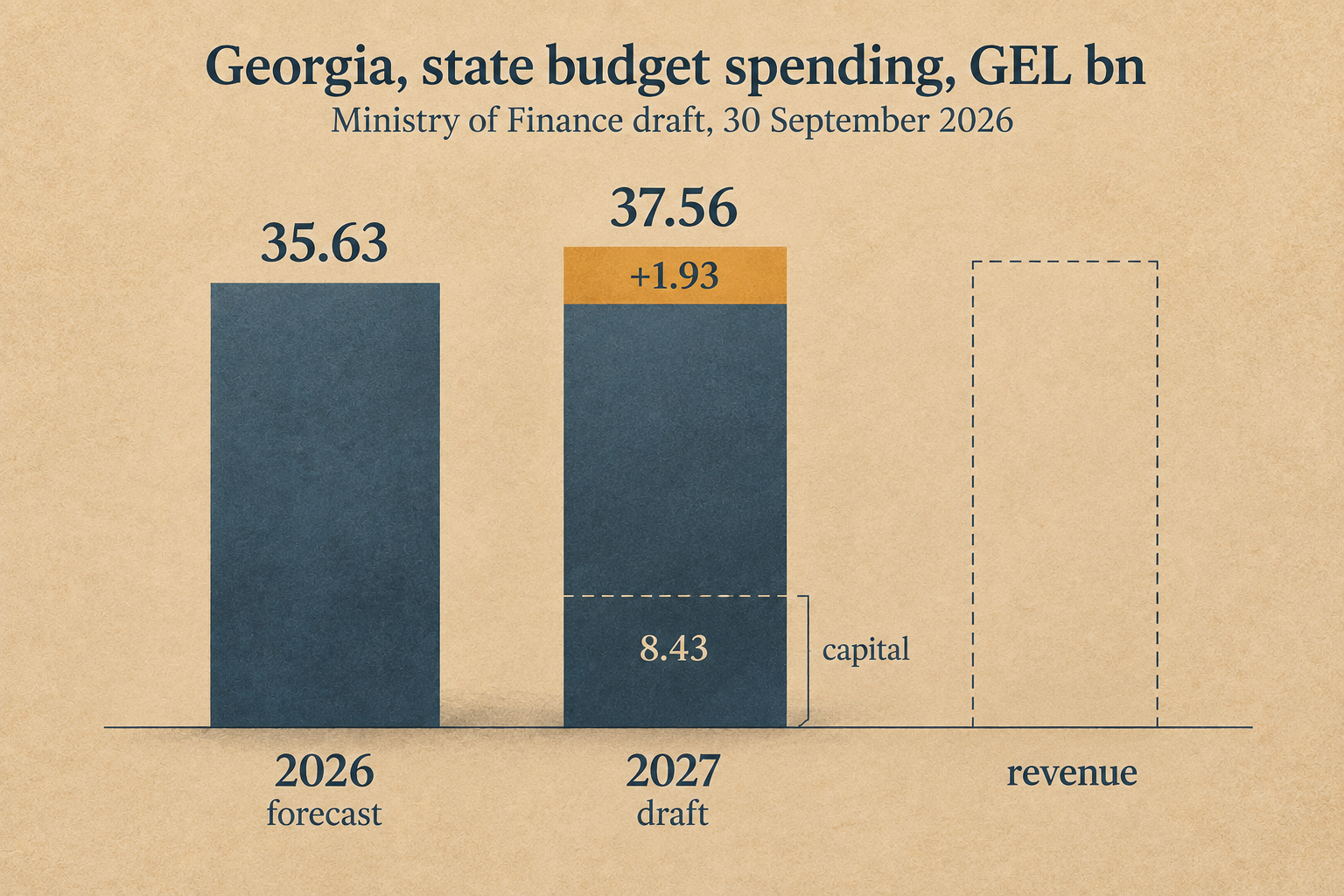
The first version of Georgia's 2027 state budget reached parliament on 30 September with its spending side published and its income side still unseen. Expenditure is set at GEL 37.562 billion, almost GEL 1.93 billion above the 2026 forecast, on an assumption of 5% real growth, nominal GDP of GEL 126.4 billion and output per head of $12,000, with inflation returning to the 3% target.
The ministry's release, as BM.GE carried it in Georgian and English, names no revenue total, no deficit and no debt path, and the full document with those tables has not been published. Committees now review the draft, revisions follow and the final vote is expected in December.
The first version of Georgia's 2027 state budget reached parliament on 30 September with its spending side published and its income side still unseen.
The spending lines are detailed. Pensions rise by GEL 60 to GEL 555 a month for people over 70 and by GEL 20 to GEL 390 for younger pensioners. Public-sector pay rises 8.4%, with GEL 395 million added to the wage fund.
Capital and infrastructure spending is GEL 8.43 billion, of which GEL 2.7 billion goes to municipal projects, GEL 1.33 billion to roads, GEL 800 million to school buildings, GEL 701 million to law-enforcement capital spending, GEL 432 million to water supply, GEL 404 million to energy projects, GEL 268 million to housing for displaced people, GEL 250 million to Georgian Railway capacity, and GEL 125 million each to the Anaklia port and the Tbilisi metro. Health and social programmes get GEL 830 million more, education GEL 400 million.
The missing side matters because of the rule the spending has to fit. Georgia's fiscal rule caps the deficit at 3% of GDP and public debt at 60%, so on the ministry's own GDP figure the 2027 gap between spending and revenue may not exceed about GEL 3.8 billion. Interpressnews put the consolidated budget at GEL 37.531 billion in its headline, a different aggregate from the ministry's state-budget total and GEL 31 million below it, and neither outlet printed the tax side.
Growth of 6.3% in August, Geostat's latest print, gives the ministry its 5% with room to spare on paper. What the first draft does not show is how much of the GEL 37.56 billion is tax and how much is borrowing.
The National Bank was answering a different question the same afternoon. It will extend its stricter 25% payment-to-income ceiling up the income scale in two steps, to borrowers earning up to GEL 2,000 a month from 1 February 2027 and up to GEL 2,500 from 1 September 2027. Today those earners sit under a 50% limit.
Its own example makes the size of the change plain: a borrower on GEL 1,500 who can now carry a three-year loan of about GEL 21,650 at 15% will be able to borrow roughly GEL 10,825. The existing thresholds, the bank said, rest on 2017 data updated in 2022 and no longer reflect income levels after years of nominal wage growth, and the aim is to reduce excessive indebtedness. Opposition politicians Roman Gotsiridze and Giorgi Kepuladze read it as an admission that the lari buys less than it did, Interpressnews reported.
Read together, the two documents pull on the same household from opposite sides. The budget raises pensions and public wages and puts GEL 8.43 billion into construction, which is demand. The bank halves the credit available to the earners just above the minimum, which is demand withdrawn.
Parliament added a third move on 30 September, passing at final reading a property-tax exemption for individuals earning up to GEL 100,000, BM.GE reported. Take a household on GEL 1,500 a month: it gets a higher pension for a parent, a tax exemption on the flat and a car loan half the size.
Three things will fill in the picture. The ministry's full budget document, with revenue, deficit and debt tables, is due when the detailed draft is tabled for the committees. The National Bank has promised an explanation of how many borrowers the new ceiling touches, which its vice-governor David Utiashvili began giving on the evening of 30 September.
Third-quarter data in late October will test the growth assumption itself. Until then the 2027 budget is a spending plan whose income side nobody outside the ministry has seen.