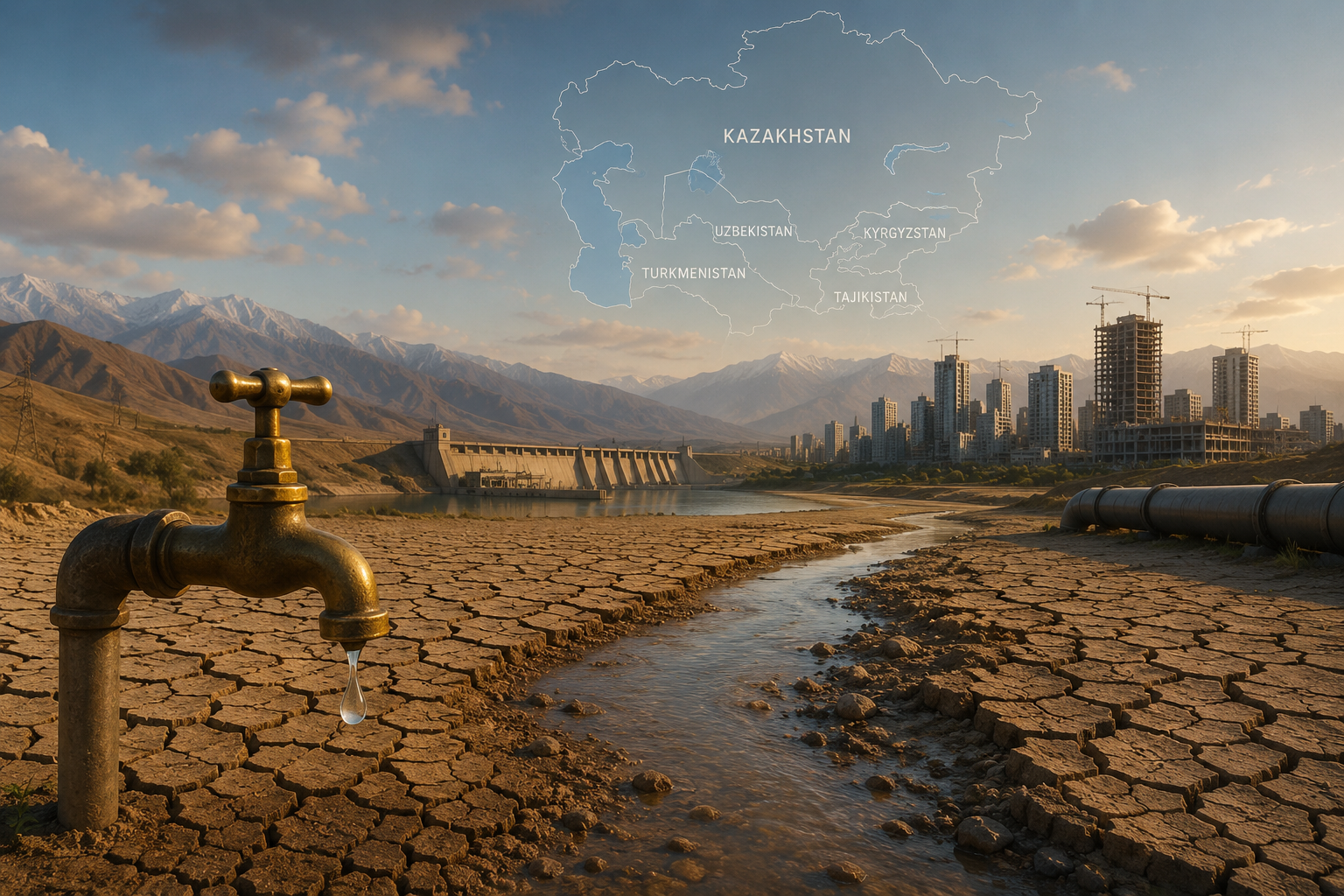
For three decades, any conversation about strategic resources in Central Asia followed the same script. It opened with oil, moved to gas, paused on uranium, and stopped there.
The script made sense. Hydrocarbons built the fortunes of Kazakhstan and Turkmenistan. Pipelines shaped foreign policy. Energy exports paid for governments, infrastructure and political calm.
Over the next decade the resource that decides the most may be water. Not as the backdrop it has always been, but as the constraint that sets the limit on everything else a government wants to build.
That sounds almost too obvious to say. Water has always mattered here. Rivers crossed these borders before the borders existed. Farms have always drawn on them, and so has every power station on every dam.
Governments, investors and many analysts still file water under environment. The next few years will make that filing hard to maintain.
• • •
Several slow trends are starting to touch each other at once. Population climbs. Cities spread. Electricity demand rises every year. Industry expands. The climate presses harder. And the glaciers that feed the great rivers are losing mass, a few meters of ice at a time.
None of these is new on its own. What is new is the interaction. For years, water in Central Asia was a problem of balancing national interests across a season. Upstream wanted winter power. Downstream wanted summer irrigation. The trade was imperfect and broadly understood, and the region still runs it by hand, basin by basin, every year.
The next phase looks different, because a new player has entered the Amu Darya and did not sign the old rules.
A new player has entered the Amu Darya, and it never signed the rules the rest of the region runs on.
Afghanistan's Qosh Tepa Canal is the clearest sign. The main channel runs 285 kilometers across the northern provinces, roughly 100 meters wide. By the end of 2025 the second phase was past 90 percent complete, years faster than outside observers expected. Uzbekistan's own water ministry estimates the canal will let Afghanistan pull an additional 4 to 4.5 billion cubic meters from the river each year. Independent studies put the diversion at 15 to 20 percent of the Amu Darya's total flow.
Kabul is outside the regional water framework entirely. It never signed the 1992 Almaty agreement that still governs how the ex-Soviet republics split the rivers, and it sits under no quota. The canal is being dug fast and cheaply, long stretches cut through sand without lining, which means heavy seepage on top of the planned draw. The volume matters. The bigger shift is that a thirty-year-old set of assumptions about who gets the Amu Darya is being rewritten by a government no one at the table can outvote.
Upstream, the picture rhymes. Tajikistan is completing the Rogun dam on the Vakhsh, a tributary of the Amu Darya. At a planned 335 meters it will be the tallest dam in the world, with 3,600 megawatts of capacity and a reservoir holding 13.3 cubic kilometers of water, at a cost now estimated near $6.2 billion. Kyrgyzstan is pushing the $4.2 billion Kambarata-1 project on the Naryn, with Kazakhstan and Uzbekistan each taking a third of the ownership so they can sit at the table that controls the releases. These are discussed as energy projects. They are also claims on who controls the timing of water for everyone downstream.
• • •
The reporting treats each of these as a separate story: a canal in Afghanistan, a dam in Tajikistan, a financing round in Kyrgyzstan. Read together, they describe one process. Control of Central Asian water is being fixed in concrete right now, by whoever builds first and biggest, and the structures going up this decade will set the terms for the next fifty years.
Climate change is quietly moving the floor under all of it. Much of the region's water is stored as glacier ice that took centuries to accumulate. That store is shrinking slowly enough to stay out of the headlines and fast enough to matter. A system that was already a tight seasonal trade is being asked to divide a total that is starting to fall.
The political weight of this is easy to underrate, because water behaves unlike the resources the region is used to managing. A government can import fuel. It can build a solar field or a gas plant. It can court a foreign investor for almost anything. It cannot import a river, cannot negotiate more snowpack into the mountains, and cannot move where the water falls. The value of water climbs precisely as it tightens.
A government can import fuel and build power stations. It cannot import a river.
Which is why water is turning into a multiplier. Electricity generation needs it, food production needs it, industry and cities need it, and the region's hopes for data centers and advanced manufacturing will need it too, for power and for cooling. Its reach now runs well past the farm sector it has always been filed under.
• • •
None of this points to a future of water wars. Those forecasts are usually overdrawn and rarely useful. The likelier path is quieter and harder to see.
Water will increasingly shape decisions that look, on the surface, like something else. The important negotiations may never carry the word water in the title. They will be framed as electricity exports, industrial zones, agricultural modernization, regional infrastructure. Water will sit underneath each of them, setting the ceiling.
That is the strategic map worth drawing for the next five years. Oil stays important. Gas stays important. Critical minerals will pull in more foreign attention than either. And underneath all three, the resource that quietly decides what a government can actually build, produce and export may be the one drawing the least notice today.
So the question to carry forward is not whether Central Asia has enough water. It is who will own the structures that decide where the water goes, and what the rest of the region will trade to sit at that table. The concrete is being poured now. Who is reading the map five years ahead?
Adrian Cross writes Five Years Ahead for Central Asia Wire, a weekly column on the long-term forces shaping Central Asia, Mongolia, the Caucasus and the surrounding regions. The views expressed are his own.