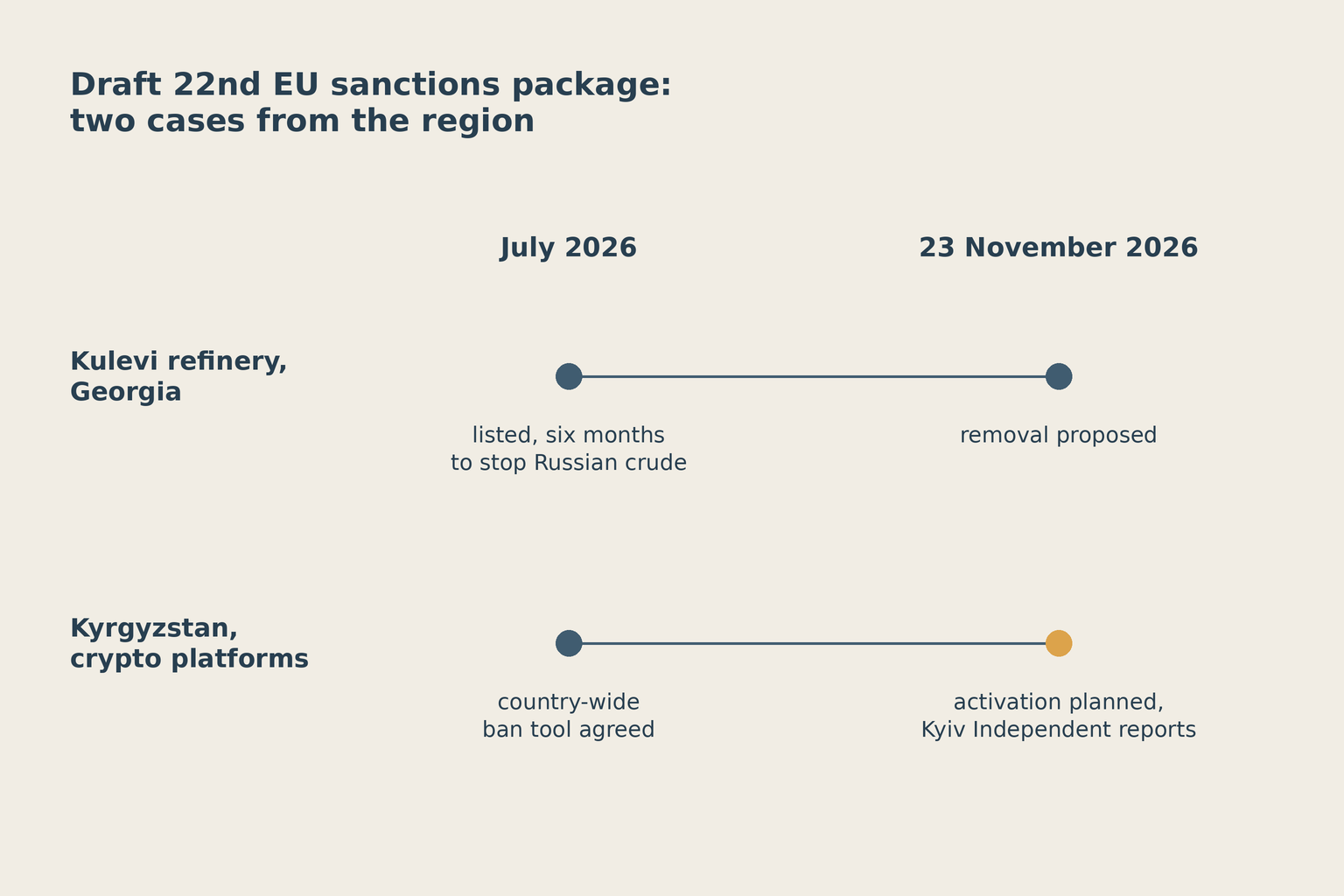
Crypto is a major focus of the package, the Kyiv Independent wrote on 23 November. A crypto task force began work earlier in the month, and after it, the outlet reported, “the Commission now plans to take special action against Kyrgyzstan”.
The tool dates from the 21st package, adopted in July, in which member states agreed a mechanism for wholesale bans on countries where several crypto platforms are found to be undermining the bloc’s sanctions, the same report says.
Ursula von der Leyen, the Commission’s president, said on 23 November that the EU was cracking down on crypto and payment networks, with a focus on Russia that would also take in “third countries that help Russia to evade our sanctions”. Kyrgyzstan’s name comes from the Kyiv Independent, which cites an EU official.
That official told the outlet the previous week that Bishkek had largely brushed aside the bloc’s private approaches, which, the official said, left the Commission to propose switching the tool on.
Georgia’s case runs the other way. The Kulevi refinery, operated by Black Sea Petroleum on the Black Sea coast, was sanctioned conditionally in July and given six months to stop processing Russian crude, OC Media reported on 24 November. Now the draft recommends that member states remove it from the list.
The six months run to January, and Kulevi says it has met the condition since late October. It took about 352,000 tonnes of Libyan crude in three months and expects a fifth Libyan cargo in December, according to OC Media, which writes that the Commission presents the refinery as proof that the threat of sanctions can work and sets it against Kyrgyzstan.
Prime Minister Irakli Kobakhidze welcomed the Commission’s call on 24 November and said the listing had been “based on a lie”, Interpressnews reported.
The plant opened this year and first ran on Russian crude. Its first 5,500 tonnes of Kazakh crude arrived in July, and the operator said in August that Libyan cargoes would follow under a contract running to the end of 2027, as CAW reported on 21 August.
Kyrgyzstan comes into the draft with a history of listings. The 21st package of 24 July placed three Kyrgyz companies under tightened export controls and banned transactions with EcoIslamicBank from 13 August over its connection to SPFS, Russia’s financial messaging system, as CAW reported on 28 July. That report counted 31 Kyrgyz companies under Western sanctions as of June, five of them banks.
Bishkek has responded with measures of its own. Officials said in July that they had identified about 40 companies carrying heightened sanctions risk, closed three and revoked one cryptocurrency licence. In October the cabinet rewrote its rules for virtual-asset firms, so that beneficial owners are vetted by the financial intelligence service and every cash exchange requires identification, as CAW reported on 2 October.
This week brought two more steps: on 24 November the budget committee of the Jogorku Kenesh, Kyrgyzstan’s parliament, approved the cabinet’s order to liquidate Processing KG, the state payment company that Britain put on its Russia sanctions list on 8 October, 24.kg reported. A law signed by President Sadyr Japarov on 19 November and published on 24 November lets investigators seize virtual assets in criminal cases.
The departing US ambassador has said the effort falls short. Lesslie Viguerie, who has ended almost four years in the post, told 24.kg that sanctions risks in Kyrgyz banks and the crypto market threaten the country’s reputation and that the government’s steps are insufficient, as CAW reported on 23 November.
Earlier EU packages named Kyrgyz companies and a bank, and the mechanism in the draft is written for a country. Adoption of the draft would switch it on.
The sequence in the two cases is the same up to the last step. Kulevi received a conditional listing and a deadline, changed its crude supply and is now proposed for removal, while Kyrgyzstan received private approaches after July, and the next step in the draft is the tool itself.
The rest of the package is aimed at Russia: it extends a transaction ban to some 60 Russian banks, lists more than 70 additional vessels of the shadow fleet, bars tankers insured in Russia and widens a ban on energy services to electricity, von der Leyen said.
Adoption requires unanimity among the 27 member states, and Ireland chairs the Council until the end of the year.