The deal itself is firm. On 28 June, QazExportPromotion and Hormozgan’s ports authority signed a 27-year build-operate-transfer agreement for a Kazakh logistics terminal at Shahid Rajaee in Bandar Abbas: two years to build, 25 to operate, first commercial cargo expected in year three. The investment is $25 million for a 15-hectare centre rated at 1.5 million tonnes a year, meant to plug Kazakhstan into the International North-South Transport Corridor and open access toward the Gulf, South Asia and East Africa. Deputy Prime Minister Serik Zhumangarin said it uses private capital, not state funds, and pointed to a $3 billion bilateral-trade goal against $430.2 million in 2025.
Then the security picture turned. On 8 July, after attacks on three cargo ships in the Strait of Hormuz, Washington declared the interim agreement to end the Iran war over and launched a fresh round of strikes; Iran fired on U.S. sites in Bahrain, Kuwait and Qatar. By 9 July the U.S. military reported 170 Iranian targets hit in 48 hours, the strikes reached Bandar Abbas, and crude rose about 5%.
The paper terminal is intact. The working railway took the hit.
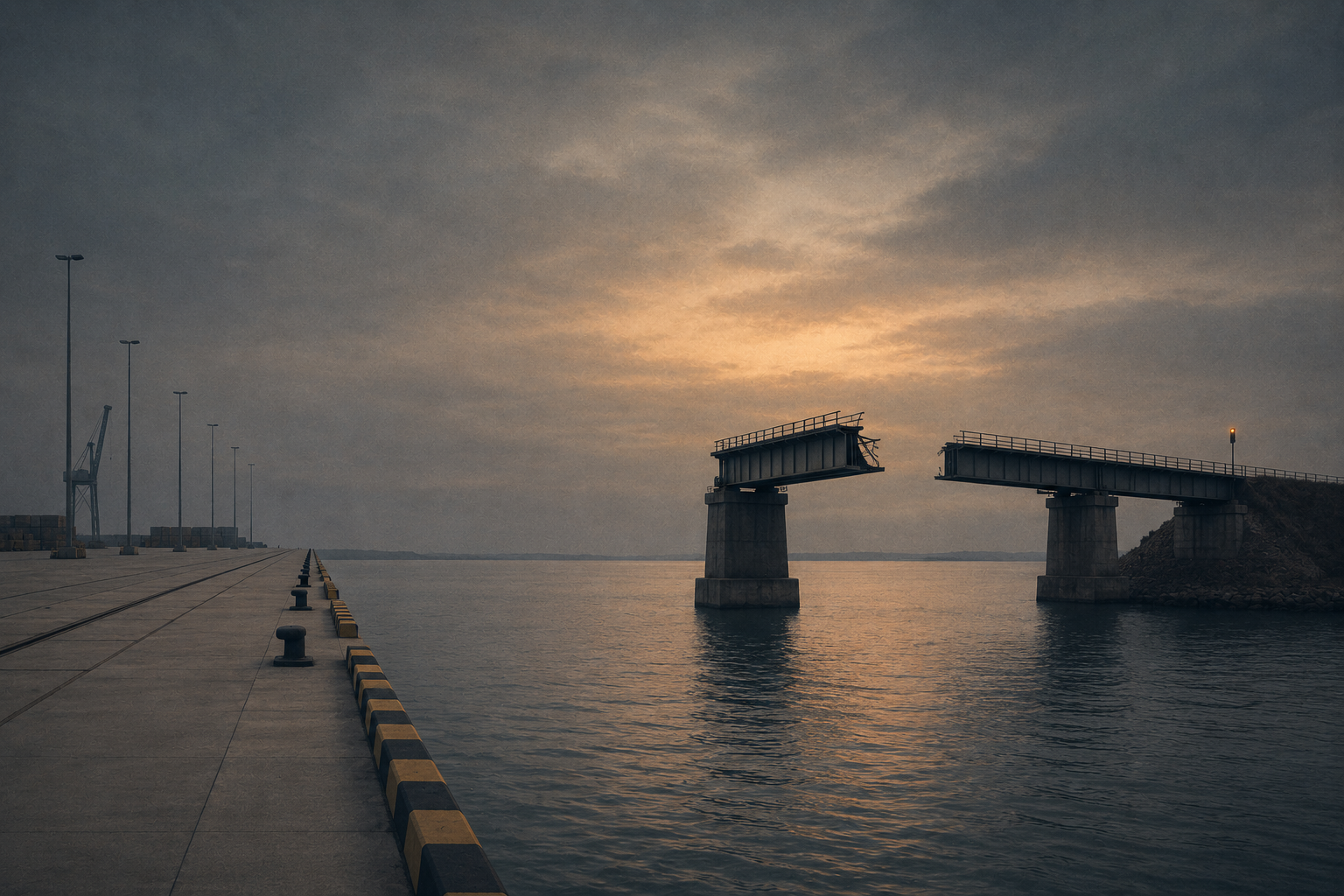
For an asset that carries nothing yet, the immediate loss is not at the terminal. A 27-year lease with a two-year build is a claim on the future, and today’s war is a risk to a plan rather than to throughput. The concrete blow landed on the part of the corridor already moving cargo: the Financial Times reported a cruise-missile strike on a railway bridge on the Gorgan line, the rail link that runs toward Turkmenistan and forms part of the Kazakhstan-Turkmenistan-Iran route opened in 2014. The paper terminal is intact; the working railway took the hit.
Astana’s answer is to hold every route at once. It is pursuing Shahid Rajaee and Chabahar, Iran’s Gulf-of-Oman port, while offering Iranian firms space at Aktau and Kuryk on the Caspian, and it keeps expanding the Middle Corridor, where Trans-Caspian freight through Kazakhstan rose from 0.8 to 4.5 million tonnes in seven years and the EU put $462 million into road, port and shipping links in June. The southern route buys reach the western one cannot, toward the Gulf and the Indian Ocean; the western route buys a political safety the southern one cannot.
The number that decides this is the war-risk premium that banks, insurers and shippers now price into every Bandar Abbas shipment. Private capital lowers Astana’s fiscal exposure and does nothing about insurance and sanctions exposure; some carriers will simply avoid the route while the strikes continue. Until that premium settles, the terminal is a lease on optionality, and the corridor that actually carries the cargo runs on the rail line that just took a missile.