China's foreign minister, Wang Yi, spent three days in Ulaanbaatar from 13 to 15 June, opening with a joint press conference alongside his Mongolian counterpart, Battsetseg Batmunkh, and going on to meet President Ukhnaagiin Khurelsukh and Prime Minister Nyam-Osor Uchral. The language was the warm boilerplate of a relationship Beijing means to keep close: a 'community with a shared future', mutual support on core interests, a second cross-border railway billed as a coming artery of trade, and a pledge to align China's Belt and Road with Mongolia's own Steppe Road transit plan. Mongolia reaffirmed the one-China principle. Chinese state media summed the visit up as a partnership built on tangible interests rather than slogans.
That description is more revealing than it was meant to be. The interests are tangible, and they nearly all run in one direction.
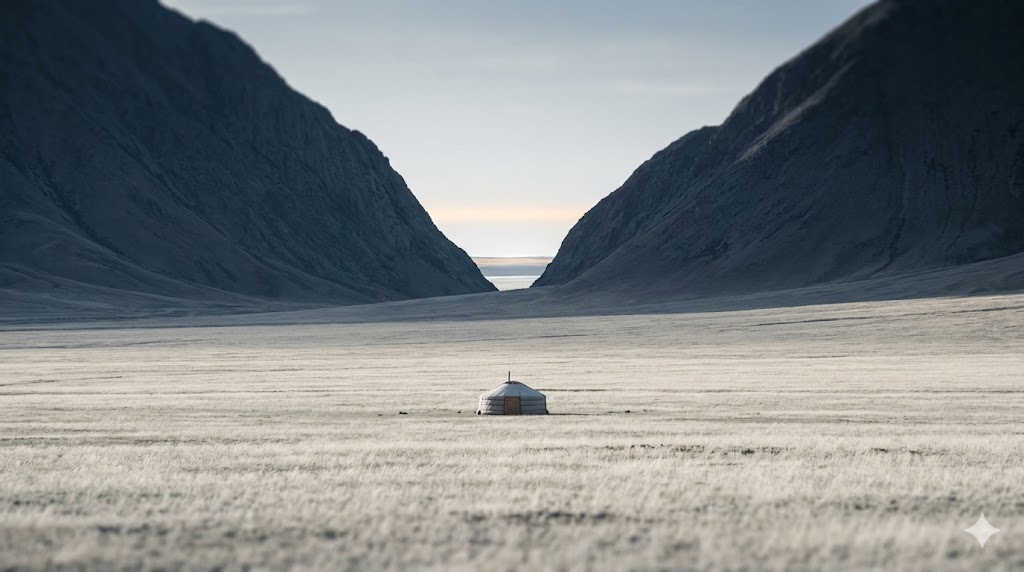
Mongolia is the starkest version of a problem the whole of Central Asia knows in milder form. It has two neighbors, Russia and China, and no others. Almost every asset that should give Ulaanbaatar bargaining power, its minerals, its place on the map, its role in a planned gas pipeline, is worth only what Moscow or Beijing decides to pay for it. A card you cannot play is just dependence with a podium.
Start with the economy, because everything else rests on it. Mongolia’s growth, forecast near 5.6 percent in 2026, is driven by mining, and mining means China. The country’s coking coal feeds Chinese steel mills, and when Beijing curbs steel output, as it has, Mongolian export revenue falls with it. The most reliable indicator of Mongolia’s economic year is the strength of Chinese industrial demand, a figure decided well outside Ulaanbaatar. Wang Yi’s hosts did not need reminding that Chinese growth lifts Mongolian exports; their budget assumes it.
The clearest measure of Mongolia's narrow room is the pipeline meant to turn it into a transit power. Power of Siberia 2 would carry up to 50 billion cubic meters of Russian gas a year from the Yamal Peninsula across Mongolia to China, the Mongolian section named Soyuz Vostok. In September 2025, at a trilateral summit in Beijing, the three governments signed a memorandum on the route, and then-Prime Minister Gombojavyn Zandanshatar pledged Mongolia's comprehensive support. On paper, Ulaanbaatar sits in the middle of one of the decade's largest energy projects and stands to collect the transit fees.
In practice the project has been stuck for years, and Mongolia cannot unstick it. Gazprom and China’s CNPC remain apart on price, with Beijing pressing for something close to Russia’s domestic rate. The financing scheme was left to be settled in 2026 and has not been. Beijing is in no hurry: its own gas output is large and rising, it holds long-term Qatari supply and Central Asian pipelines, and it treats the project as a negotiation rather than a need. Mongolia, which wanted firmer transit terms, was reported to have quietly dropped the pipeline from its 2025 to 2027 priority list. This week a Russian envoy attributed the holdup to logistics and played down price. Either way, the decision does not sit in Ulaanbaatar. Mongolia’s biggest card is one it can hold but cannot play.
The deliverables Wang Yi did bring, the second rail crossing and the Belt and Road to Steppe Road link, are real and useful. They also pull the wrong way for a country that says it wants balance. Each new line of track binds Mongolia’s trade more tightly to the neighbor that already takes most of it. Connectivity with China is offered as development, and it is, while it deepens the dependence Ulaanbaatar says it wants to ease.
Easing it is the job of Mongolia’s third-neighbor policy, the long effort to cultivate partners beyond the two giants: the United States, Japan, South Korea, France, the European Union. The currency of that policy now is critical minerals. Mongolia, once nicknamed Minegolia, holds copper, gold, coal and rare earths, and the West is hunting for rare earths that do not pass through China. Washington and Ulaanbaatar have signed a rare-earths memorandum and Mongolia is a candidate for the Minerals Security Partnership; Japan and South Korea have their own frameworks; a recent prime minister called the United States an important strategic third neighbor. Mongolia is also changing how it sells its resources, shifting from the equity-heavy model of the Oyu Tolgoi copper mine toward royalty-based deals that capture more revenue at less political cost.
Here the policy meets a wall it cannot argue with. Mongolia is landlocked between the two countries it is trying to diversify away from, and its minerals have to leave the same way. A rare-earth deposit signed over to an American or Japanese consortium still has to reach a port, and every port lies on the far side of Russia or China. No Mongolian rare-earth mine is yet in production, the known deposits are lower-grade and costly, and even a finished mine would ship its output through the neighbors it was meant to bypass.
The third neighbor can sign the check. It cannot move the ore.
None of this unfolds in a calm political season. In May 2025, youth-led protests over corruption brought down the government of Prime Minister Oyun-Erdene; Zandanshatar’s cabinet followed, under a presidency, Khurelsukh’s, that has grown more assertive. Anti-corruption cases run beside factional maneuvering ahead of presidential elections in 2027 and parliamentary ones in 2028. A government that needs revenue, stability and quick wins is poorly placed to hold out for better transit terms or to wave away Chinese rail money. Weakness at home narrows the room abroad.
Set the warm visit and the stalled pipeline side by side and they tell one story. Mongolia performs the multi-vector dance that Kazakhstan and Uzbekistan made famous, but on a stage with two real chairs and a third that exists mostly on paper. For the larger Central Asian states, diversification means playing several routes and patrons against one another. For Mongolia it means signing agreements with distant friends while the goods keep moving north and south.
The things worth watching are concrete. Whether Power of Siberia 2 reaches a financing decision, and on whose terms. Whether any third-neighbor minerals project actually starts producing and finds a route to market. Whether the royalty model raises the revenue the equity deals did not. And whether a government with elections coming can resist the easy path of taking what the neighbors offer. On this week’s evidence, the warm words come easily and the hard things stay where they were. That gap is the truest description of Mongolia’s position, and the reason its story belongs at the center of this region’s coverage, which is where we are now placing it.