Berdimuhamedov chaired the summit with Aliyev, Pezeshkian, Tokayev and Putin at the table. Yuri Ushakov had promised a declaration on Thursday night, and the document adopted is a decision of the five heads of state, by the host’s foreign ministry readout, the Kremlin’s post and APA’s text. It establishes a commission of the deputy heads of government of Azerbaijan, Kazakhstan and Turkmenistan and high-ranking representatives of Iran and Russia, charged with establishing the causes of the fall in the sea’s level and with drawing up and carrying out an agreed set of measures against the effects of the shallowing, by APA’s rendering of its five points.
Working groups of officials, experts and specialists sit under the commission, the governments have three months to name their representatives, the first meeting in the first half of 2027 in Azerbaijan is to adopt the rules of procedure, and later meetings rotate through the littoral states in the order of the English alphabet, which sends them to Iran, Kazakhstan, Russia and Turkmenistan in turn. Putin welcomed the decision as an initiative of the Turkmen hosts, and APA traced it to Aliyev’s proposal of 29 June 2022 at the sixth Caspian summit in Ashgabat.
Twenty thousand square kilometres is the number both presidents used, each for a different measure, Aliyev for the whole sea’s surface and Putin for his country’s shore.
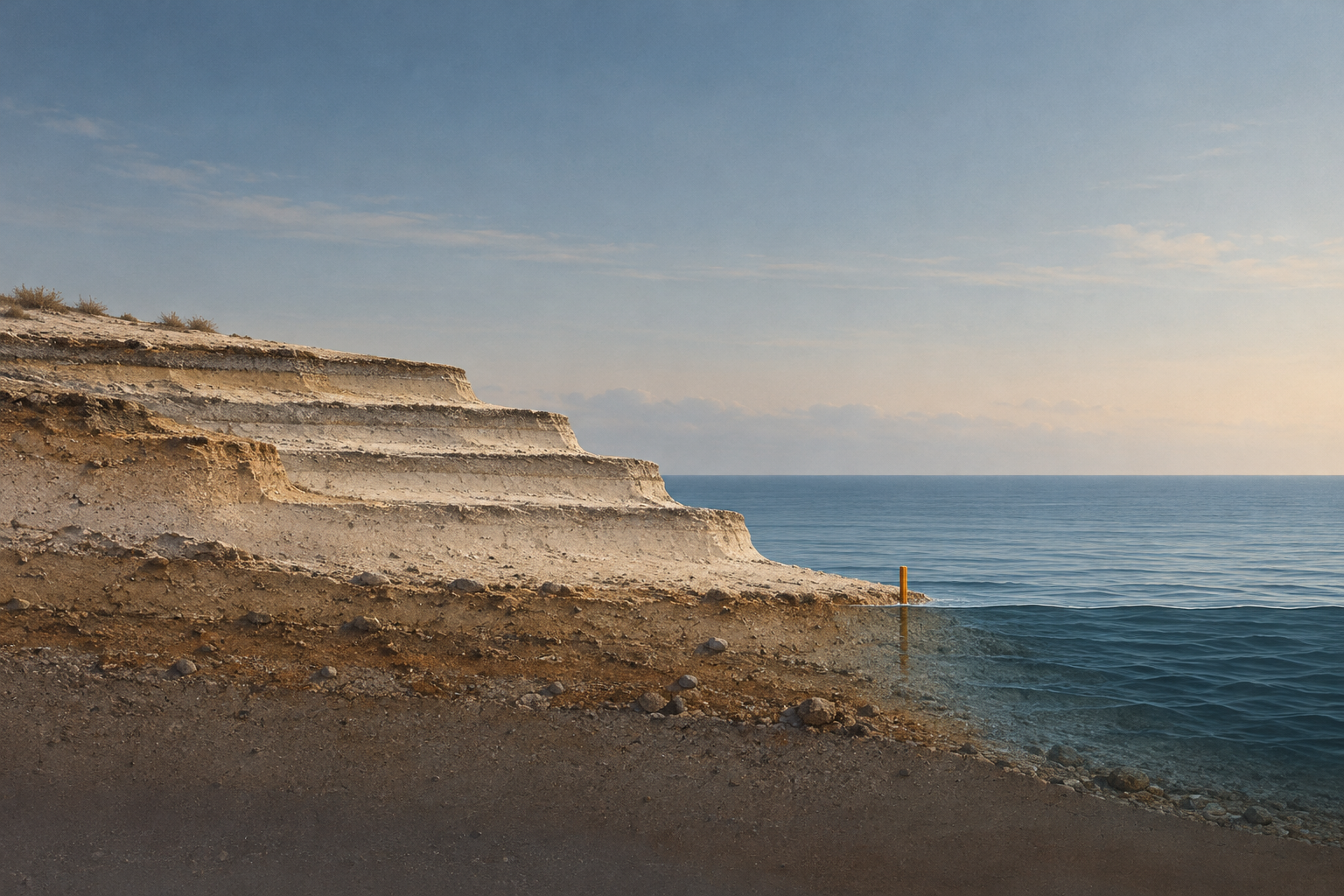
Aliyev’s speech, printed in full by APA at 14:20 Baku time, put the loss of water surface at more than 20,000 square kilometres and the new land in the Azerbaijani sector alone at about 30,000 hectares. The decline has gone on for many years and has noticeably quickened of late, ports and coastal infrastructure are already in trouble, and the consequences could be catastrophic if the trend holds, he said. The fall is linked not only to climate change, with reduced river flow and man-made factors tied to economic activity among the main causes, and the five must move from general discussion to a standing mechanism of cooperation and control over the decisions taken, he added.
Putin weighed the causes differently. Research by Russian and foreign experts points to climate change as the main reason, with rising temperatures, changed precipitation and river inflow, and a wind rose in which hot dry air from Central Asia replaces the Atlantic air masses that once dominated, he said, according to the Kremlin’s transcript.
The drying of the Russian shoreline alone over the past 20 years amounts to 20,000 square kilometres by Russian estimates, the level falls an average of nine centimetres a year by Russian data, and the budget pays every year for dredging to keep shipping moving, Putin said. Twenty thousand square kilometres is the number both presidents used, each for a different measure, Aliyev for the whole sea’s surface and Putin for his country’s shore. Lower investment appeal of the trans-Caspian corridors, lost jobs and eroded shores followed on his list.
Russia’s proposals went through existing bodies. The conference of the parties to the 2003 Tehran convention, which met in Tehran two weeks ago, agreed to finish a plan of action on level fluctuations to 2036, and Moscow backs a protocol on monitoring under that convention. Putin also proposed a climate working group inside the Caspian hydrometeorology committee, whose 30th session meets in Ashgabat in December, to forecast the level 50 years ahead, announced a Russian government programme to 2030 on the level’s change, offered a digital twin of the sea built with artificial intelligence, and opened an international Caspian programme at the Sirius university to young specialists from the five countries.
Berdimuhamedov answered Aliyev’s speech by placing the sea’s ecological state among the priorities of Turkmen domestic and foreign policy and offering cooperation across the whole Caspian agenda, by APA’s transcript of the exchange. The host’s ministry recalled Turkmenistan’s Caspian Ecological Initiative, presented on the sidelines of the 78th UN General Assembly in 2023, the first Caspian summit in Ashgabat in 2002 and the first Caspian economic forum at Avaza in August 2019, and called Friday’s meeting the first Caspian ecological summit.
Tokayev and Pezeshkian were at the table, by the Kremlin’s list, and the two texts in hand on Friday evening were Putin’s and Aliyev’s. The commission’s rules of procedure wait for the first meeting in Azerbaijan, and its first reading of the causes will be its own.