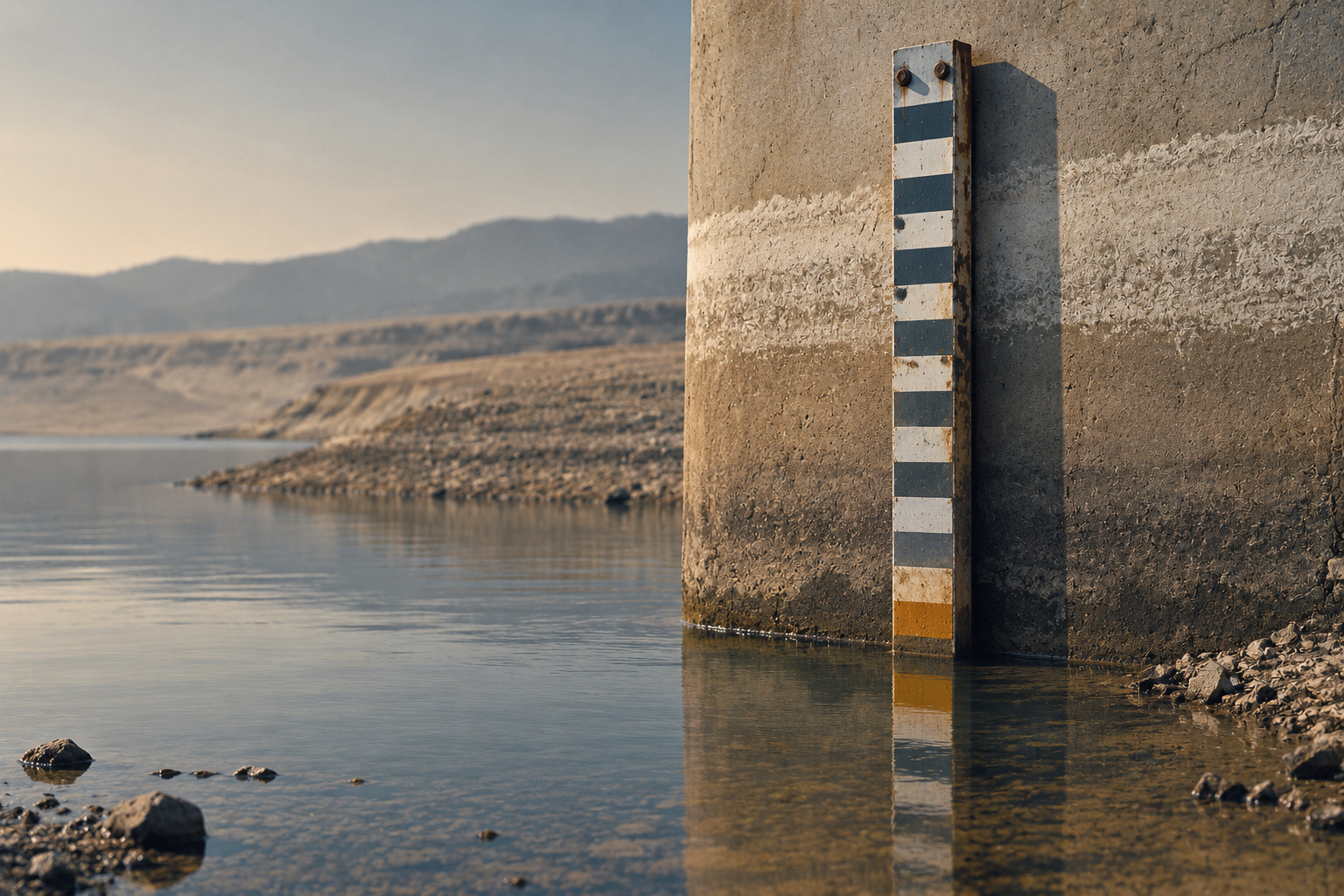
Its headings are short. 2025 was one of the driest years for river discharge in 35 years. The past 7 years have seen abnormal river flows. Water storage on the land surface has decreased over the past 10 years. Glacier loss was widespread across all regions for the 4th consecutive year. Four years running. Asia and Africa are the regions most affected by water-related disasters.
Behind the headings, in Asia-Plus's reading of the report on Friday morning, the global arithmetic runs: on 36% of the world's river-basin area discharge was below normal, on 36% it was normal, on 21% above. In 42% of the areas measured, water storage was below or well below normal. Glaciers lost 408 billion tonnes of ice in the hydrological year, give or take 132 billion; about 1,400 billion tonnes since 2023; 6.2% of mountain-glacier mass since 2000.
Regional lines are the ones that matter here. In 2025 inflow to the reservoirs of Tajikistan, Uzbekistan, Kyrgyzstan and Afghanistan was below or significantly below normal, and the Aral Sea basin, which holds the region's main river systems, recorded a decline in flow. On the world scale the 5 years from 2021 to 2025 were among the driest for river flow since the 1991 start of the record. Central Asia's glacier mass balance for the hydrological year from October 2024 to September 2025 sits among the 3 most negative ever observed. Vlast's reading of the same report puts Central Asia with Eastern Europe and the Middle East among the regions the drought hit hardest.
Now the month's paper. Kyrgyzstan's energy minister ruled out power rationing on 9 September with Toktogul at 11.2 billion cubic metres against a target of 11.5 billion. The presidential decree of 8 September created a fund for the glaciers and Issyk-Kul, and the draft adaptation plan to 2035 prices the need at 74.5 billion som. A NIRAS study for GIZ, reported on Wednesday, expects water demand in the Zarafshan basin to rise 65 to 70% by 2050, to about 23% of the basin's current resources, with summer flow down 10 to 15% in 2035 to 2045. The AIIB lists as proposed a $220 million loan for the second phase of Nurek's rehabilitation, 5 units on a dam in a country whose reservoir inflow the WMO now books below normal.
The melt of a bad glacier year reaches the rivers now and is borrowed from the decades after it.
That normal, for the WMO, is 1991 to 2020, and the report's regional lines all sit below it: the reservoirs in 2025, the Aral basin's flow, the glacier year. A reservoir target, a rehabilitation loan's output case and a 2050 demand curve each rest on a mean inflow, and every mean the region quotes was struck on years the report now classes as the exception.
The glacier line cuts the other way in time. A strongly negative mass balance means the ice gave more water than it received. The melt of a bad glacier year reaches the rivers now and is borrowed from the decades after it. Those 2025 reservoirs filled below normal even with that extra melt in the water, which puts the shortfall upstream of the ice, in snow and rain.
Amu Darya and Syr Darya are shared on a mean flow the ICWC quotes at 62 cubic kilometres, and the Qosh Tepa canal is designed to take 9 to 11 cubic kilometres from it after 2028. Rogun's power purchase agreement with Tashkent, the Nurek loan, Kyrgyzstan's glacier fund and the Zarafshan projection are each priced to a river that the WMO's ledger books below normal. The number that moves when the mean moves is the seasonal limit the ICWC sets for each state, and the next ones will be set on a basin the report classes in decline.
What the region has not published is a revised normal of its own. The next entries in the record are the autumn inflow to Toktogul, which the Kyrgyz energy ministry reports as the heating season opens, and the Zarafshan study's full text on the Central Asian climate portal.