Foreign trade turnover reached $10.65 billion in the nine months, 35.6% or almost $2.8 billion more than a year earlier, the agency under the president reported in the infographic Asia-Plus published at 08:00 Dushanbe time. Exports rose 18.4%, by $337.1 million, imports 40.8%, by $2.46 billion, and the country traded with 129 states, ten of them in the CIS, whose share was $4.12 billion or 38.7% against $6.53 billion for the rest of the world.
Mineral products carried the export growth, up 43.8% or $250.4 million to $821.5 million, with precious stones and metals adding $188.6 million, textiles 30.4% and cotton fibre 28.8% to $107.6 million. Base metals went the other way, down 28.7% or $191.1 million, and the export structure now reads minerals 37.9%, base metals 21.8%, textiles 9%.
Imports grew where the roads and the factories are. Purchases of vehicles grew almost 1.8 times, by $634.1 million, machinery and equipment by 45.6% to $1.31 billion and base metals by 51.4% to over $1 billion. Mineral products rose 18% to $1.21 billion, within which 916,400 tonnes of oil products cost $858.4 million, 24.2% more in value, and over a million tonnes of wheat cost $266.7 million, 23.5% more.
Mineral products carried the export growth, up 43.8% or $250.4 million to $821.5 million, with precious stones and metals adding $188.6 million, textiles 30.4% and cotton fibre 28.8% to $107.6 million.
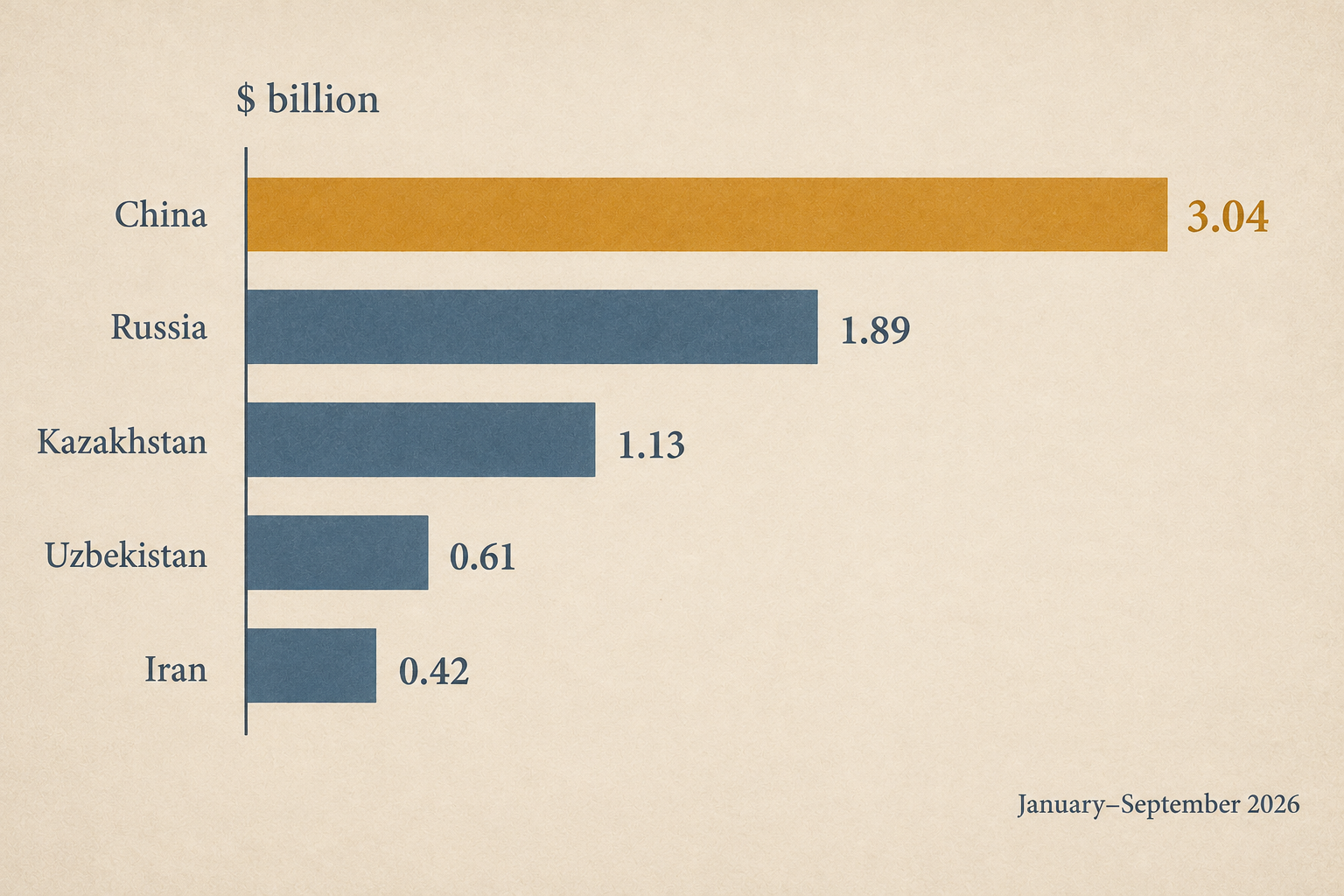
China was the first partner at $3.04 billion, up 53.1%, with exports to it of $662.6 million against imports of $2.38 billion, and Russia second at $1.89 billion, up 12.4%, with $118.1 million going out and $1.77 billion coming in. Kazakhstan followed at $1.13 billion, Uzbekistan at $607.3 million and Iran at $418.1 million.
By buyers, China took 30.5% of exports, Switzerland 23.5%, Uzbekistan 9.2%, Turkey 7%, Russia 5.4%, the Netherlands 5% and Belgium 4.3%. By suppliers, China gave 28%, Russia 20.9%, Kazakhstan 12.5%, Switzerland 6%, the United States 5.1% and Uzbekistan 4.8%, and the surpluses were with the Netherlands at $88 million, Belgium at $85.1 million, Afghanistan at $64.3 million and Turkey at $3.5 million. For every dollar exported, the agency’s figures give about $3.90 imported.