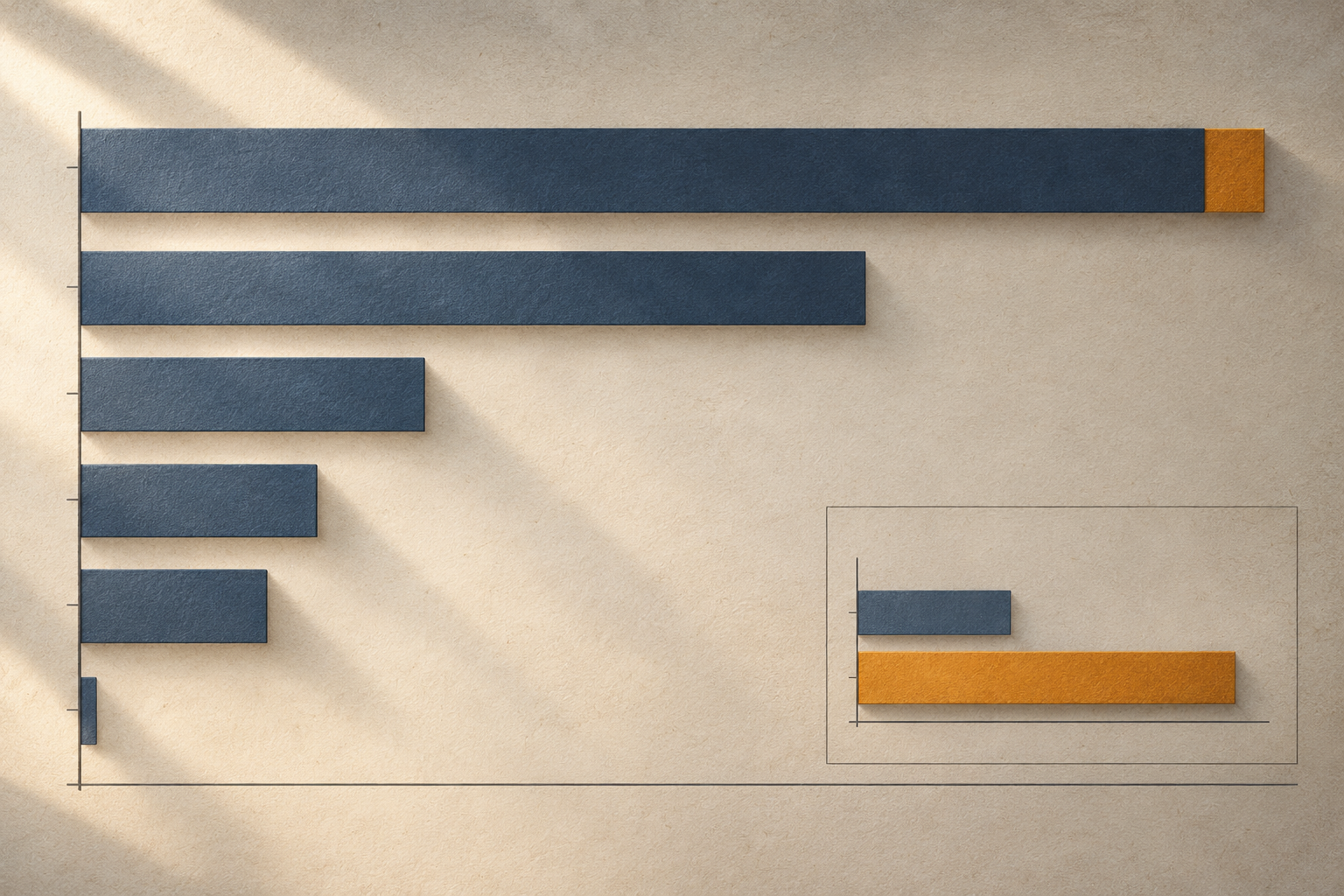
The figures come from Rosstat's monthly report on the socio-economic position of Russia, which Izvestia analysed and Vedomosti and 24.kg relayed. Overdue debt is 4.5% of the total, a little over 43 billion roubles. Ukraine's companies account for 3.5 billion of the total, on old contracts whose enforcement is blocked and which stay on balance sheets for years because a write-off needs documentary grounds, in the account of Alexei Khizhnyak of Mikhailov and Partners. Rosstat counts the mirror line too: Russian organisations owed CIS business about 506 billion roubles, a figure up by about a quarter over the year: half the size, and growing at a quarter against the claims' 40%.
At June's average rate of 73.54 roubles to the dollar, the Central Bank figure Izvestia's experts use, the stock is $13.1 billion: $5.5 billion owed from Kazakhstan, $1.1 billion from Uzbekistan, $880 million from Armenia, $710 million from Kyrgyzstan, and $580 million of the whole overdue. The rouble strengthened about 6.5% over the year, so in dollars the growth is nearer 50%, by Khizhnyak's arithmetic; the currency understates the rise.
The receivable is the boom's financing.
Izvestia's explanation is a payments story. Russian business 'began waiting longer for payment for deliveries because of difficulties with settlements'; after the tightening of US sanctions, banks in CIS countries added checks, transactions take longer, the restrictions on direct transfers between companies multiplied the payment routes, and goods can stay unpaid for months, in the account of Alexei Begaev of the Insek group. The second factor is competition. Chinese and Turkish suppliers offer cheaper goods on more flexible terms, Turkish producers use the routes across the Caspian and the Caucasus, and Russian sellers hold their positions by granting longer deferrals, Oleg Abelev of Rikom-Trast says. Natalya Milchakova of Freedom Global reads the total as Russia redirecting its exports to the Global South and the near abroad, and gives the first-half turnover: with Belarus up 12.5% to about $28.5 billion, with Uzbekistan up 15.7% to $7 billion, with Kazakhstan up 7% to $13.2 billion.
Set the Kyrgyz line against Kyrgyzstan's own books. Imports in January to July were $8.336 billion, 37.3% of them from the EAEU and 65.1% of that from Russia, by the National Statistics Committee's figures: about $2 billion of Russian goods in 7 months, or $290 million a month. The 52.3 billion roubles Russian suppliers are waiting for is about two and a half months of that flow. The same morning 24.kg carried The New York Times's account of the boom on the other side of the ledger: growth of 11% in 2025, re-exports worth 30 to 40% of growth over four years, EU exports to Kyrgyzstan near $2.5 billion last year, eight times the 2021 level and below the 2023 peak of $3.1 billion.
Armenia's 65 billion sits beside a different Russian ledger. The produce restrictions that the Central Bank of Armenia named on Tuesday as a risk of oversupply at home cut what Armenian firms can sell north; the receivable counts what they have bought from Russia and not yet paid for.
The receivable is the boom's financing. A Russian seller who ships to Bishkek or Almaty and waits months for the money is the trade's lender, for a flow that CIS banks now slow with compliance checks, and the two Rosstat lines together make Russia the net creditor of its own near-abroad trade by some 460 billion roubles, a gap that widened over the year as the claims grew 40% and the counter-claims a quarter. Claims up more than 40% in a year, against 11% growth in Kyrgyzstan's economy last year and 4.1% in Kazakhstan's in the first 8 months of this one, say the credit is growing faster than the trade. The margin sits with the intermediaries and the risk sits on Russian balance sheets, which carry it at a 14% policy rate and with fixed investment down 9.9% in the first half; 4.5% overdue says the buyers pay, late, and Artur Leer of the Association of Exporters and Importers sees no critical risk yet while the partners' economies grow. What changes next is the sanctions calendar at both ends: every new check in a CIS bank lengthens the queue of unpaid goods, and every Chinese or Turkish offer with softer terms lengthens the deferral a Russian seller has to match. The line to watch is Rosstat's next print of the same table, and whether the overdue share moves with the total.